By Marc C. Jeter
Analyzing war and its outcomes remains an important exercise—for tactical, political, humanitarian and a whole host of other reasons—though not all critics or analysts will agree on the ideas that emerge from such scholarship. For example, the question of whether or not the establishment of the Southwest Pacific Area (SWPA) command during WWII was necessary or unnecessary militarily remains, some eight decades on, a contentious argument among historians of the Second World War.
At the heart of much of this criticism lies General Douglas MacArthur himself, as he remains one of the most polarizing figures in American military history—a five-star paradox who was simultaneously a “Chief of Chiefs” and, to his detractors, a master of self-aggrandizement. While his resume boasts a first-in-class West Point graduation and a record-breaking rise to Chief of Staff, modern critics often view his leadership in the Southwest Pacific Area (SWPA) not as a strategic masterclass, but as an unnecessary drain on American lives and resources fueled by personal ego.
MacArthur’s career remains a study in contradictions. While his early defense of the Philippines was marked by significant errors in judgement, he later became one of the most successful theater commanders of the war. Ultimately, his ability to execute complex operations, such as the 1944 New Guinea leapfrogging, is often weighed against his need for personal glory, making him a figure who, according to historian D. Clayton James, was often inseparable from his own vanity.
Prevalent conclusions question the SWPA theater’s necessity and MacArthur’s corresponding role, the associated return to the Philippines beginning in the fall of 1944, the loss of American lives directly attributable to the SWPA’s establishment (and MacArthur’s idiosyncrasies), and the role and contributions of the Americans’ strategic bomber in the war with Japan. Furthermore, some commentators of the war present an apparent rhetorical question as to why the Japanese by the spring or early summer of 1945 did not surrender when they could not win the war outright or achieve an acceptable, negotiated peace.
Many historians assert that the SWPA added no strategic value towards the Japanese defeat and existed only to placate General Douglas MacArthur’s ego. Authors of this ilk compound this claim with the notion that Allied leadership at the Tehran (SEXTANT) Conferences (November 1943) established the SWPA operational theater and the strategic priority of German defeat over that of Japan at this time. In truth, the Americans and British identified Germany as the more prominent existential threat well before the fall of 1943. This strategic view among the Anglo-Americans first emanated during the ABC-1 meetings in January 1941. The correlating claim of MacArthur’s overt pursuit of SWPA command is also questionable in the timing of the announcement and the general’s active solicitation.
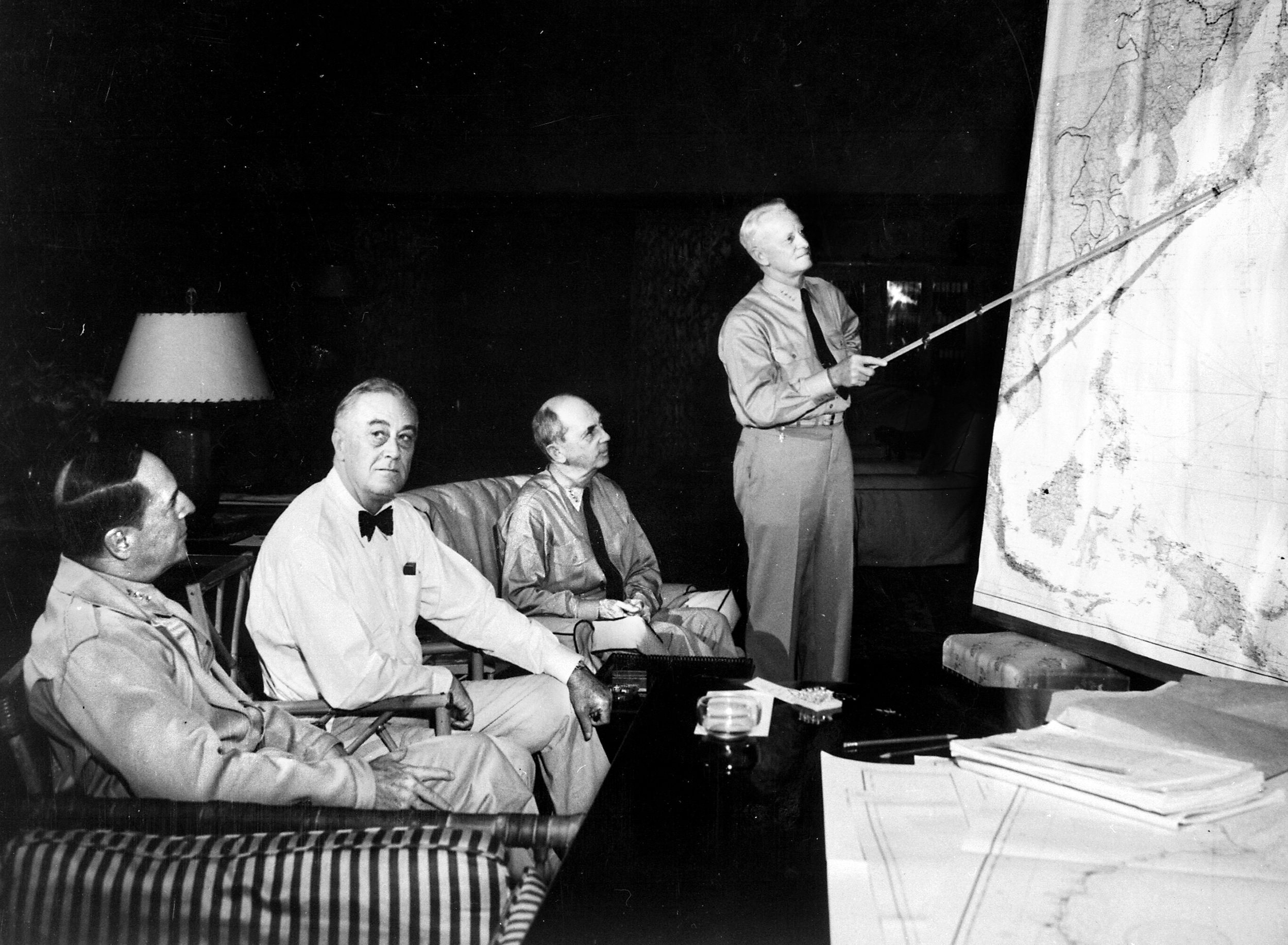
MacArthur believed it should be an Army officer and that he was the best flag officer for the supreme SWPA command billet position. The topographical realities of the SWPA made it obvious that it would be a theater decided by land campaigns with the Navy and Army Air Forces in complementary, if not support roles. MacArthur in 1941-42 was one of, if not the, most senior flag officer within the service of the U.S. armed forces. He also had considerable experience within the region in question and his performance within the opening hours, days, and weeks of the war notwithstanding, one of its ablest strategic leaders. There exists no context making objective sense for President Roosevelt not to have named MacArthur to this position.
No empirical evidence suggests that Roosevelt or Army Chief of Staff, George Marshall contemplated (on record), identifying another senior-level flag officer for the SWPA command billet. Historians’ apparent common distaste for political influence, at least in the case of MacArthur, is odd given that political concerns are an inherent factor in all military and naval decisions, especially at the national, strategic level. One must also acknowledge that MacArthur’s appointment in deference to specific American political and military goals, also represented the administration’s desire to nurture Allied relationships. Australian Prime Minister John Curtin was a vociferous supporter of the general and conveyed such to American leadership. MacArthur’s eventual position as SWPA Commander and the widespread rub with the mere existence of the SWPA in the first place, both during the war and in the subsequent years remains prevalent.
Disagreement with establishing and subsequent operations within the SWPA is attributable to three elements. First, full-scale operations within that region were unforeseen and therefore unplanned by pre-war American military planners. Second, critics conclude the SWPA’s existence diluted the nation’s overall war effort, especially Adm. Chester Nimitz’s Central Pacific theater. Thirdly, many authors see MacArthur’s personal behavior as never-endingly boorish. Much of the persistent postwar disagreement with the organization of the SWPA is attributable to the pre-war strategic theorems against war-time realities. The U.S. pre-war strategic plan for Japan was known officially as “War Plan Orange.” A product of joint Army-Navy planners, the continued reference to this plan, especially concerning theater-level command, is by those sympathetic to the Navy’s pre-conflict view of a hypothetical Pacific war. However, this plan did not account for Japanese offensives beyond the Philippine archipelago and the existential threat to New Zealand and Australia. Therefore, Japan’s strategic prioritization of operations within the South Pacific and Southeast Asia rendered Orange useless, in a comprehensive fashion.
The American joint chiefs required of the Army the planning, preparation, and execution of enduring land operations. A role not inherent to the U.S. Marines Corps organizational tables and tactical doctrine. The strategic realities of 1942-45 presented American leadership with the challenge of waging war across an immense theater that in a polite sense, challenged the unity of command principle. Critics continuously imply debatable reasons behind the hyphenation of the war with Japan and MacArthur’s appointment. Certain observers view these contentious points as inextricably linked.
While such doubts existed during the war, Marshall, and Admiral Ernest J. King explicitly and for the record, repeatedly recommended the eventual command structure without Roosevelt’s imposition. Tactical bifurcation itself represents a doctrinal principle often missed in post-war analysis. Maintaining tactical pressure across the breadth of Japan’s line of expansion allowed the U.S. to retain the strategic initiative and eventually determine a primary effort as circumstances warranted and opportunities presented themselves.
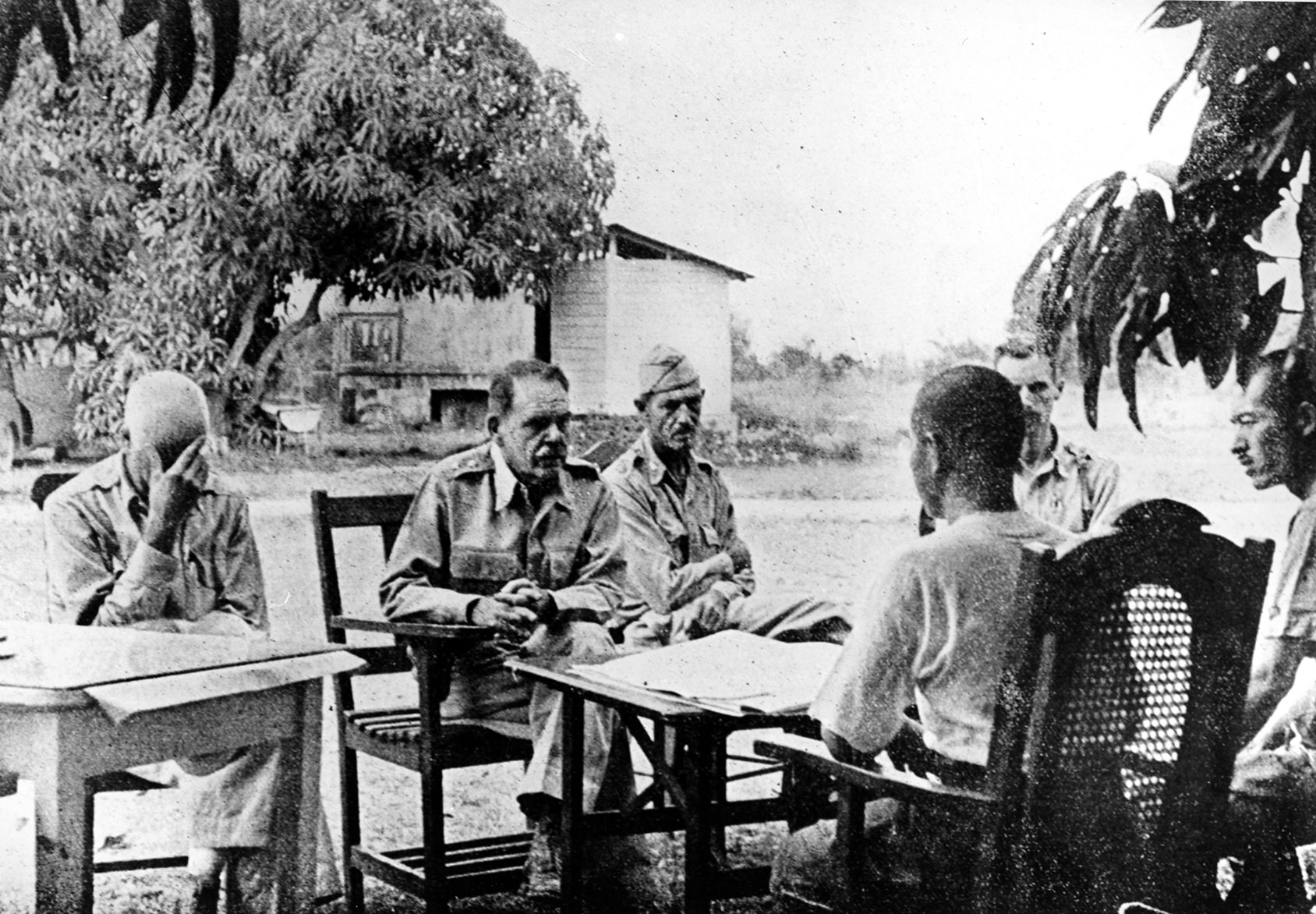
American national and senior-level military and naval leadership encountered such a situation in the summer of 1944. A common and implied pejorative is that the Hawaiian meeting between Roosevelt, Nimitz, and MacArthur had political undertones. It was a political, publicity junket supporting Roosevelt’s campaign for a fourth term. That in and of itself means little in the historiographical question of the Philippines versus Formosa from a strategic standpoint.
As noted in a contemporary article, MacArthur, and Nimitz each had the opportunity to present their respective recommended courses of action for defeating Japan. The president chose MacArthur and the axis of advance through the Philippines.
Historians and contemporaries sympathetic to Nimitz, the Navy’s overall opinion of the proper manner of conducting the war, or simply out of personal dislike for MacArthur continue advancing the notion of a main advance across the central Pacific being unquestionably correct.
D. Clayton James, who wrote the bestselling three-volume The Years of MacArthur, astutely observes two strategic considerations concerning the Pacific War. Those opposing contemplations were not the Southwest versus Central thrusts, but military (including naval) and national or political strategic considerations driving American war planning. Readers and researchers will do well to understand the persistent and tangible political reality resulting from the Pearl Harbor raid and the Philippines invasion.
How Japan brought war to America made the resulting war not only one of geo-political strategic concerns but a deep-rooted emotional event for the American people. For Roosevelt to have demonstrated a slighting of vigorously answering Japan’s underhanded attacks would have been political abdication and brought into question American citizens’ wholehearted, enduring support for the entirety of the war effort. A concern that, at least for Marshall, remained throughout the war.
Considering the war’s strategic realities, antagonists to the American command structure present two elements supporting their cause. First, again, is the supposition that the SWPA’s existence pilfered valuable and finite resources and equipment better served in support of Nimitz’s Central Pacific thrust. Such a conclusion supposes that the American Joint Chiefs would have directed to Nimitz those resources that found their way to the SWPA. Such conjecture fails to consider the full breadth of the logistical realities and concerns of the war. Identical interests existed in the European theater, and it is possible, if not likely, that had there been no SWPA, much of those formations, munitions, equipment, and supplies the American chiefs would have utilized in North Africa, Italy, and eventually Western Europe.

Second, even if the observer can present a case in which Nimitz received all or a sizable portion of SWPA resources, they must also demonstrate how he (Nimitz) would or could have employed them.
All historians and students acknowledge the Central Pacific theater was operationally and tactically a naval theater based upon physical realities. However, increasing the volume of resources does not directly correlate to a shorter war or the appropriate, widescale application of those resources. MacArthur’s SWPA organizational structure was for warfare on land masses significantly larger than anything Nimitz encountered until Okinawa. How would the latter have employed multiple U.S. Army divisions, including armored forces on the line of minuscule atolls and islands characteristic of the Central Pacific? Constricting this combat power into a narrow thrust would have played into Japan’s strategic defensive design by allowing them to concentrate their available combat power directly opposite such an axis of advance instead of the entirety of their defensive perimeter. Thereby diminishing the depth of their combat power.
Historiography treats the Philippines’ position within the U.S. strategic survey as solely MacArthur’s personal vendetta or redemption project. It is accurate to point out the SWPA commander’s ultimate strategic objective was the archipelago, but the idea that he alone held this view is faulty.
Roosevelt himself never dismissed out of hand the idea of returning to the Philippines and directly liberating the Filipino people through military operations and the defeat of occupying Japanese forces. Throughout the war, the president implied or explicitly conveyed the U.S. intention to break the shackles of Japanese occupation and oppression forcefully and directly. The road traveled to the destination of simultaneous axes of advance consisted of many curves and potholes.
James concludes that while such a command arrangement was not ideal when researchers objectively considered all elements, considering the war’s eventual outcome, these mutually supporting theaters provided a decisive American victory.
Another conclusion against MacArthur and the SWPA’s mere existence concerns the loss of American lives due to theater operations. Authors have concluded without context or argument that the Americans would have avoided the over 47,000 American casualties, including 10,380 deaths had they not established the SWPA. There is no mechanism by which historians may confirm or dispel such a subjective conclusion. Even had there been no SWPA, the formations dedicated to said theater the American Joint Chiefs would have utilized elsewhere. Therefore, the Central Pacific or European theaters’ casualty lists would have correspondingly increased. Meaning that some or many of those killed or wounded in the SWPA would have yet suffered the same fate in the Central Pacific area, France, or Italy. Attempting to quantify the Americans’ unnecessary establishment of the SWPA based on these numbers is entirely self-serving for those presenting such conclusions and dismissive of the real contributions of those lost and all soldiers, airmen, sailors, and marines assigned to the SWPA theater of operations.
The next common historical fallacy is the correlation of the U.S. bombing campaign, its strategic contributions, and how such weapons systems further demonstrated the SWPA’s redundant existence. The geographical realities of the Pacific War did elevate the tactical and strategic roles of airpower. However, post-war conclusions that bombers especially proved to be the decisive factor in attaining victory is hindsight. The operational objective for most of the SWPA and Central Pacific was to control airfields in a mutually supporting fashion. But during the war, this was to provide American (and Allied formations) with tactical air support in the eventual land operations on the Japanese home islands. Neither MacArthur nor Nimitz foresaw the war concluding as it eventually did. The Americans intended their bombing campaign of 1942-45 to support this strategic view by helping establish (shaping) conditions more conducive to potential American and Allied success in follow-on land operations. Therefore, to imply that the mere existence of the strategic bomber voided the need for the SWPA, after the fact, is a fallacy.
The final rebuttal point concerns some historians’ questions regarding Japan’s war continuance despite situational realities by 1945. The simple answer is that the militarists throughout positions of power and influence had everything to lose in Japan’s defeat and unconditional surrender. Japan’s diminishing state, in every sense, and the atomic bombs’ unspeakable destruction mattered little to this clique, and only exacerbated their desire to see Japan fight a protracted battle of Armageddon proportions among the home islands. An objective examination of the war’s terminus through that lens offers a logical answer to a rhetorical question.
A plethora of historical narratives and articles poses a valid broad question concerning the Pacific War at the strategic level. The bifurcation of the American command structure in the war with Japan has valuable lessons and insight for military and civil strategic level leadership today and in the future. It also warrants noting that leaders should not religiously adhere to this principle regardless of each war’s unique physical and therefore operational (and tactical) context. Doctrine is malleable by design and intention. At the strategic level, logistical and communication lines relating to distances and geographical (including weather) considerations in conjunction with political realities influence command and control structure. That is unavoidable. Analysts of the Pacific War continue to fail to incorporate the full array of factors and elements leading to the SWPA’s establishment. Another common theme of Pacific War study is the hyperbolic conclusions of MacArthur due to his performance in the war’s opening weeks and months and his personal foibles.
Though MacArthur did himself no favors with instances of personal and professional missteps, his record was impressive. His ego was large and he could be scathing in interactions with subordinates. But researchers must contemplate the full spectrum of his personality and consider that some of his bombast was not for show, but to elicit a response and action from staff, subordinate commanders, and at times his superiors in support of his troops. The researcher’s positive or critical conclusion would acknowledge that he was human with all the failures common to all human beings but within the context of a world war and the burden of strategic level command.

Join The Conversation
Comments
View All Comments