Latest Posts

Members of the U.S. 1st Infantry Division march ashore at Gela, Sicily, while an LST burns off shore on the first day of Operation Husky in this 1943 painting by Navy war artist Mitchell Jamieson. Soldiers injured during the fighting can be seen being evacuated to hospital ships. Sicily became the stepping stone for the invasion of the Italian mainland.

Latest Posts

Sicilian Slugfest

By Flint Whitlock

The island of Sicily, lying in the Mediterranean Sea between Tunisia and the toe of the Italian peninsula, is no stranger to war and conquest. Read more

The U.S. Air Force B-2 Spirit stealth bomber is the most advanced flying wing ever built. A combination of classified technology that reduces infrared, acoustic, electromagnetic, visual and radar signatures of the aircraft makes it difficult for enemy defense systems to detect, track and engage it.

Latest Posts

The Northrop B-2 Spirit

By Kelly Bell

The old axiom that “forewarned is forearmed” is as true nowadays as it was millenia ago. Since 1989 America’s B-2 Spirit flying wing has been assailing the Free World’s foes, and consistently taking them unawares. Read more

Using black ink and crayon, Eigener drew German tanks advancing across a stark landscape during a Wehrmacht advance. He titled this sketch “Panzer Angriff,” or “Tank Attack.”

Latest Posts

German Soldier’s Sketchbook

By Flint Whitlock

It’s called Mein Skizzenbuch (My Sketchbook)—a 72-page booklet of pencil drawings and watercolors by noted German war artist Ernst Eigener, a soldier with Propaganda Co. Read more

Fokker Dr1 Triplane of the type flown by Baron Manfred von Richthofen, the “Red Baron,” from an Airfix model kit featuring art by Roy Cross.

Latest Posts

The Red Baron

By Kelly Bell

Manfred Albrecht Freiherr von Richthofen was born May 2, 1892, as the second of four children to Baron Albrecht and Kunigunde von Richthofen. Read more

Latest Posts

Forest of Death

By Nathan N. Prefer

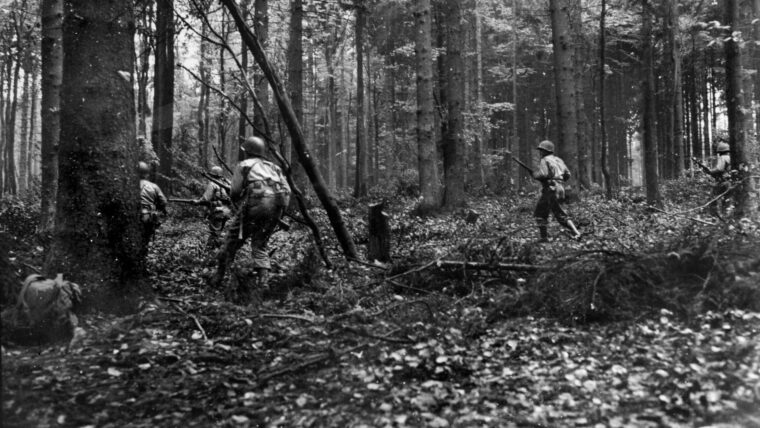
“Passchendaele with tree bursts” was how war correspondent Ernest Hemingway described it. The three-month slugfest that became known as the Battle the Hürtgen Forest was that and much more. Read more

A pair of soldiers from the U.S. 80th Infantry Division make their way through the rubble strewn streets of St. Avold, France, in November 1944. The 317th Regiment, 80th Division occupied St. Avold briefly before encountering stiff German resistance at the town of Farebersviller just down the road.

Latest Posts

Ferocious Fight at Farébersviller

By Leon Reed

The heady days of summer—when Third Army made 600 miles in a week as the German troops fled for their lives—were a distant memory, a sort of story the veterans told the waves of replacements. Read more

A group of American tankers of the 193rd Tank Battalion take a break on and around their M4 Shermans before returning to combat on Okinawa, April 1945. Note that the white stars on the sides of the tanks have been painted out to reduce their visibility to the enemy. Nevertheless, exceptionally strong Japanese resistance took a heavy toll on American tanks and tankers.

Latest Posts

Death Ride of the Shermans

By Nathan N. Prefer

They weren’t originally supposed to be there. In the early planning for the invasion of the island of Okinawa, the 27th Infantry Division was to be held in reserve as the eventual garrison force after the defeat of the Japanese 32nd Army. Read more

Latest Posts

Axis Powers: The Infamous Tripartite Pact

By Blaine Taylor

On the evening of September 26, 1940, American radio announcer and journalist William L. Shirer noted in his later famous Berlin Diary that the next day Italian Foreign Minister Count Galeazzo Ciano would arrive there from Rome, adding that most people thought it was for the announcement that Francisco Franco’s Spain was entering the war on the side of the Axis. Read more

Follow-on troops of the Royal Marine Commandos, lugging their equipment, come ashore at Juno Beach, Normandy.

Latest Posts

A “Light-Hearted War”

By Mark Simmons

Vice Admiral Norman Denning said of Ian Fleming, the “ideas man” who worked at British Naval Intelligence, that a lot of his proposals “were just plain crazy.” Read more