By Kevin Seabrooke
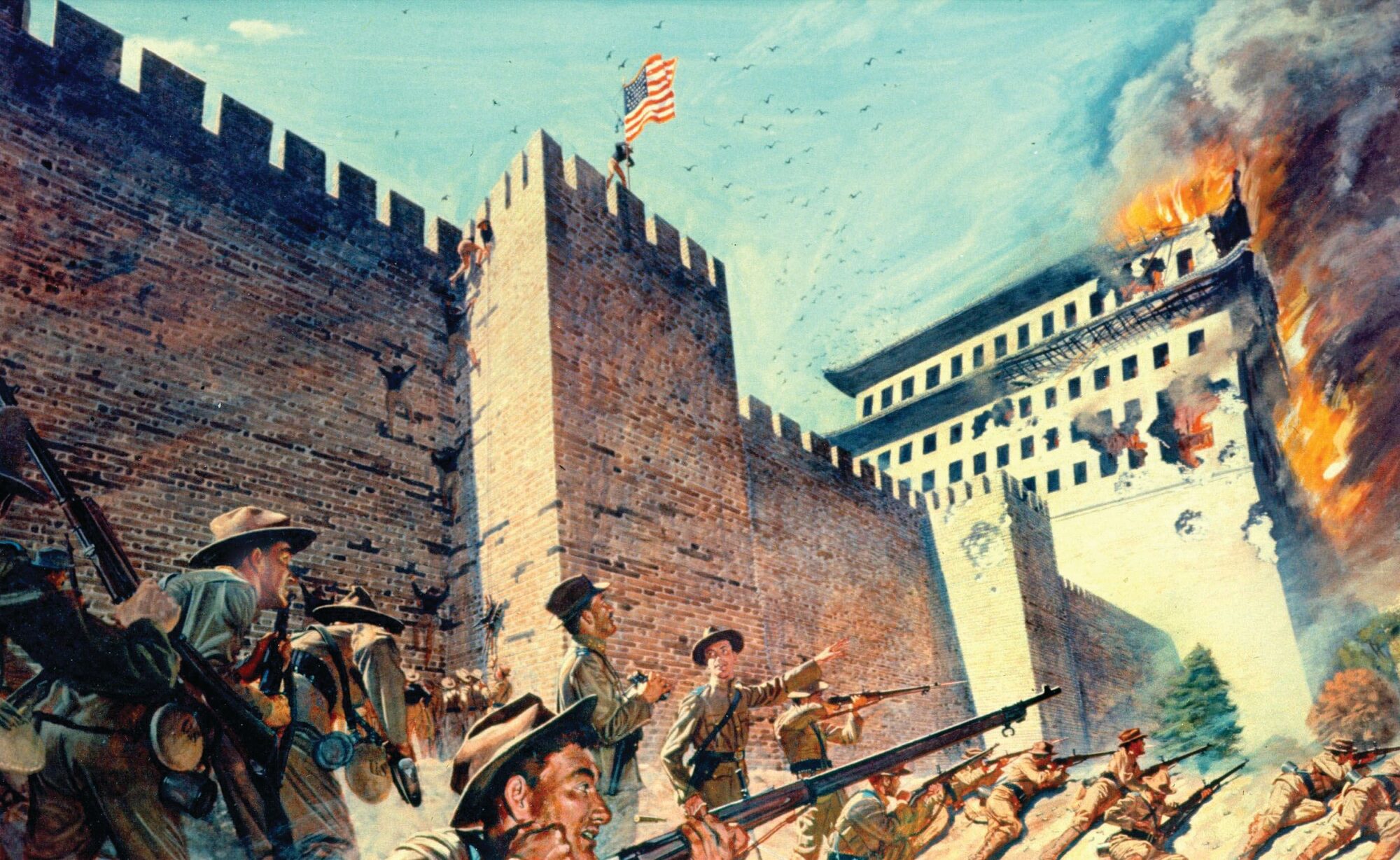
The geopolitical implications of the so-called “Boxer Rebellion” were unlikely to have crossed the mind of U.S. Marine Corps Private Daniel Joseph Daly as he and Capt. Newt H. Hall moved along the top of the ancient Tartar Wall surrounding China’s capital city of Peking (modern Beijing).
Alert for snipers, the two men were scouting a position to build another barricade on a section of the massive wall fronting the American and German sections of the diplomatic quarter of the city—an area of less than a square mile that was squeezed between the Tartar Wall to the south and the wall of the Imperial City to the north.
Incorporating towers and gates, the stone, earth and brick fortification built in the early 1400s was 40 feet tall and 40 feet across. It offered a commanding vantage point and a formidable firing platform that had to be defended from the growing uprising of violent groups closing in on the “Legation Quarter.” A legation is overseen by a minister or envoy, as opposed to a more formal embassy headed by an ambassador. Ministers and their families from the United States and seven other countries—Austria-Hungary, France, Germany, Great Britain, Italy, Japan, and Russia lived in this small city within a city.
Daly and Captain Hall were up on the wall on July 15, 1900, after Hall had taken over for the wounded Capt. John T. Myers. Hall wrote in his report that the first secretary of the U.S. legation had gone up on the wall with him to point out where a new barricade should be built—at the “far end of the bastion about 100 yards from our last barricade and yards from the enemy’s barricade.”
They had set out to “reconnoiter the bastion” at about 9 p.m. It had been arranged that if they weren’t attacked, a work crew would follow 10 minutes later with improvised “sandbags” sewn of any available fabric and filled with rubble.
In the preceding days, Chinese forces had built barricades outside of the Tartar Wall, gradually moving closer and closer until they were able to build a tower overlooking the wall and the diplomatic neighborhood. It was in leading a night attack with American, British, and Russian Marines to capture the tower—catching the Chinese asleep and killing about two dozen—that Myers was injured by an iron-pointed Chinese spear below the right knee.
Hall and Daly waited and watched for some minutes, with no sign of an attack or the work crew. Finally, Hall became impatient and Daly volunteered to stay while the captain went back to see what the holdup was. A reluctant Hall noted in his report that “I did not wish to leave one man in the bastion as there were stray shots flying along the wall from the front and rear.”
A number of complex cultural, economic and environmental factors had come together to place Daly alone on top of that nearly 500-year-old wall for a night that would become part of Marine Corps history.
The trouble in the provinces surrounding the capital had been brewing for decades. By the end of the 19th century Western European nations and Japan had carved up China into “spheres of influence” that led to nationalistic resentment and unrest. China’s defeat in the two Opium Wars (1839–1842, 1856–1860) had been a humiliation. Forced to accept unequal treaties, China was compelled to allow foreign merchants in its ports, foreign envoys in its capital city and Christian missionaries across the countryside.
As anti-foreign and anti-Christian sentiment continued to grow—exacerbated by widespread flooding of the Yellow River in 1898, followed by severe drought—popular resentment led to the formation of secret societies such as I Ho Chuan (“Fists of Righteous Harmony”) often called “Boxers” because their martial arts practices reminded Westerners of pugilism.
The Boxers first turned their rage against the Chinese Christian converts, derisively called “rice Christians,” in the form of brutal ritualistic murders and church burnings. In December 1899, the beating and beheading of British missionary Reverend Sidney Brooks sent shockwaves through the West.
In response to the continuing unrest, the U.S. minister in Peking requested help. From the Cavite Navy Yard in the recently captured Philippines, the gunboat USS Wheeling was sent to patrol China’s northern coast in March of 1900, along with ships from European navies based at Dagu (modern Port of Tianjin). The Navy’s first modern cruiser, USS Newark, took over the patrol at the end of April.
As widespread violence against foreign missionaries and Chinese Christians had begun to spread in the spring of 1900, Peking’s population grew by the hundreds as they fled to the city for protection. Several railroad stations near Peking were burned on May 28 and 29. Fearing they would soon be trapped, the legations telegraphed for help. Sailors and marines from foreign ships off China mobilized immediately.
From the USS Newark at Dagu, about 100 miles southeast of Peking, a force composed of two Marine detachments disembarked on May 29: 25 under Captain Myers and 23 Marines, 5 sailors, and U.S. Navy Assistant Surgeon Thomas M. Lippitt under Captain Hall.
Daly was one of the Marines in Myers’ detachment. For a Brooklyn-born kid who had once hawked newspapers on the streets of Manhattan, he could hardly be further away from home.
Daly had been 25 in 1899, when he was inspired to enlist in the Marines by the exploits of Teddy Roosevelt and the Rough Riders in the Spanish-American War. To his disappointment, the conflict had ended before he finished boot camp and he found himself in the South Pacific assigned to the Asiatic Fleet cruiser USS Newark.
The newly formed Legation Guard under the overall command of Myers, arrived at Peking on May 31 with a Colt machine gun with 8,000 rounds and 20,000 rounds of rifle ammunition. Another train brought 79 British marines, 75 French sailors, 72 Russian sailors, 51 German marines, 39 Italian sailors, 30 Austrian marines, and a 23-man Japanese special navy landing force.
The westerners tried to rescue and shelter as many persecuted Chinese Christians as they could, inflicting what Myers called “heavy punishment on the Boxers and their attendant train of pillagers” who were burning churches and communities.
Protected by walls to the north and south, the refugees in the Legation Quarter barricaded the eastern and western approaches as more and more Boxers closed in. After badly burned refugees showed up at the barricades on the morning of June 14, a rescue party brought back some 150 Chinese Christians. Throughout that night came the constant cries of “Sha! Sha!” (Kill! Kill!).
“It was realized at the time that these rescuing parties served to inflame the Boxer element more deeply against the foreigners,” Myers said, “but it was more than flesh and blood could stand to see the terribly burned and lacerated bodies of those who escaped to our lines, and refuse to send aid to their comrades known to be still within the power of the fiendish Boxer hordes.”
China’s Empress Dowager Cixi sympathized with the anti-foreign feelings, offering tacit support for their actions. But in response to the Allies’ seizure of the Dagu Forts on the coast, the Empress had the foreign ministers informed on June 18 that a state of war existed, giving the Westerners 24 hours to leave Peking with guaranteed protection to the coast.
Skeptical of the offer, the Allies requested a meeting with the Zongli Yamen (Office of General Management) established by the Qing state to deal with the foreign presence in China. On his way to the meeting on the morning of June 20, German minister Baron Clemens August von Ketteler was fatally shot by an Imperial Qing soldier.
In his description of the period between June 20 to July 17, U.S. Minister to China Edwin H. Conger, who would survive the siege of the Legations with his wife, Sarah, wrote that “there was scarcely an hour during which there was not firing upon some part of our lines and into some of the legations, varying from a single shot to a general and continuous attack along the whole line.”
The firing from the surrounding Boxers was so frequent that when the besieged Westerners began to run low, “ five quarts of Chinese bullets were gathered in an hour in one compound and recast.”
Myers noted in his report that Chinese soldiers began firing on the legation along with the Boxers, but the attack was not coordinated.
“Any hope that the Imperial Government would put down the trouble had long been dispelled, as our spies brought us word that the Boxers were entering the city through all the gates, guarded as they were by soldiery, and in all parts of the city mingling freely with the troops, with whom they appeared to be on the best of terms,” Myers wrote.
“The besieged had not been idle during the days of uncertainty,” Myers said, “and all barricades had been more or less re-enforced with brick, beams and stone torn from the demolished Chinese houses within the lines.”
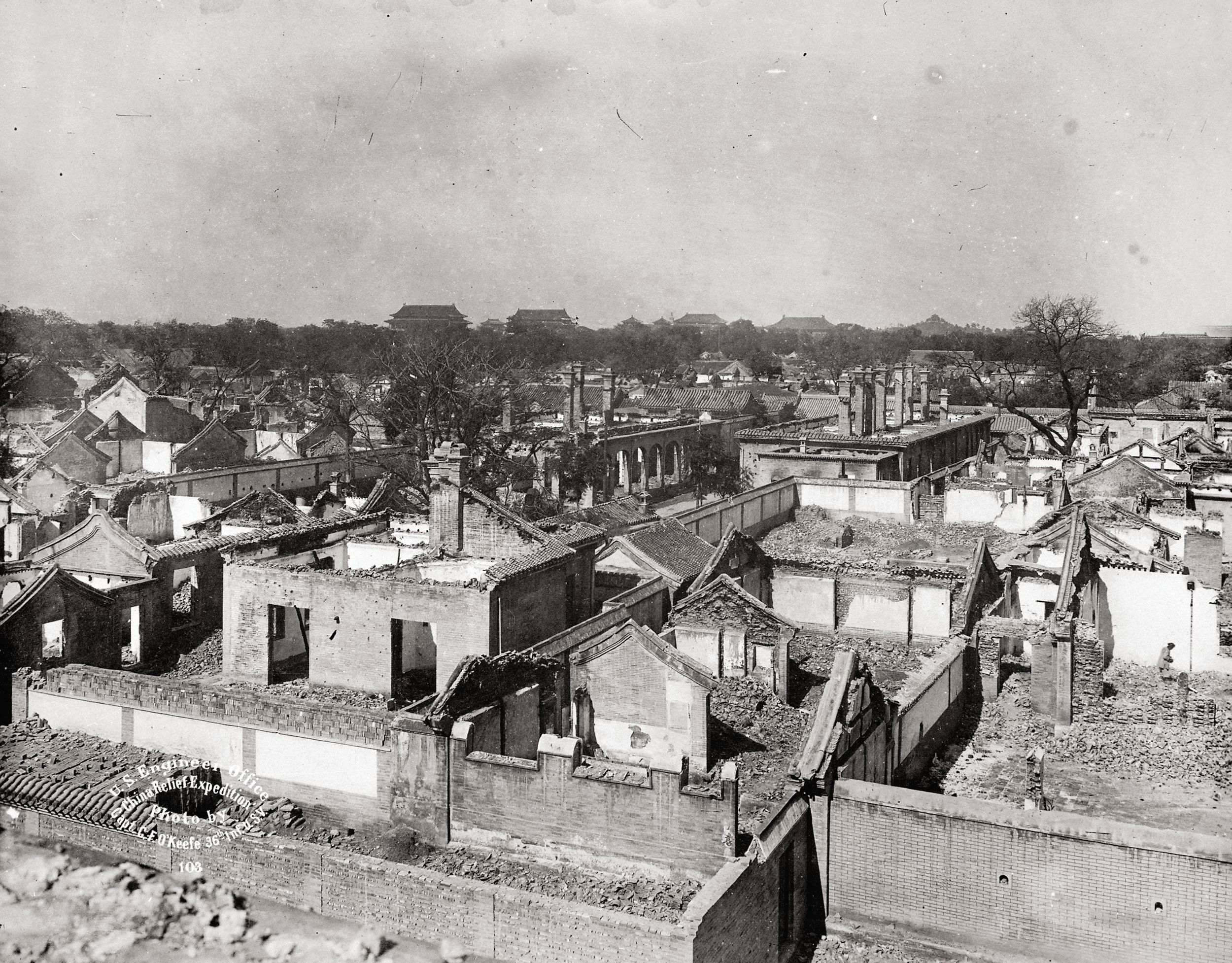
With the backing of Cixi, the Boxers and Imperial Chinese soldiers now began a full-scale siege of the Legation District. Boxers set fire to the Austrian, Belgian, Italian, and Dutch legations as well as the customs house, foreign banks, stores and neighboring houses.
There were nearly 500 diplomatic and missionary civilians in the British compound, which had been strengthened with makeshift fortifications. Some 3,000 Chinese Christians were also sheltered there. Defending them were about 400 soldiers and marines from the eight countries.
Some estimates place the ratio of Boxer and Qing imperial forces to legation defenders as high as 40-1. Snipers were the most immediate danger. The first four Marines killed in the Peking compound, from June 24 to July 1, had all been shot in the head.
It would be 55 days before relief forces could reach the small international legation guard, the besieged diplomats and their families.
Alone on that ancient wall as a stranger in a strange land, Daly found himself caught up in an maelstrom of cultural and political idealogies that had morphed into a very real beast of destruction—burning buildings, torture, shooting and shelling, sounding sirens and lighting fireworks through the night, building towers, tunneling—all to “exterminate the foreigners.”

For Daly, though, the situation probably seemed clear enough—he was on that wall to stop anyone from getting over it. His actions that night exhibited a determination he would display time and again. Straight-backed, disciplined and tough—though only 5’ 6” and 132 lbs., Daly had boxed semi-professionally as a young man.
During his 30 years in the Marine Corps, he was said to have been offered a commission numerous times. Reportedly, he turned them all down remarking, that he would rather be known as an outstanding sergeant than “just another officer.” That statement seemed to fit the character of the future “Devil Dog”—who never married and was taciturn regarding any of his own experiences, disdaining any “fuss” made over him.
Some accounts claim Daly had an M1895 Colt-Browning machine gun up on the wall with him, but there remains no evidence. What he did have was a canteen and a Lee-Winchester Navy Straight-Pull Rifle with an M1895 bayonet and possibly 180 rounds of 6 mm ammunition in 5-round clips—all standard issue at the time.
Subjected to sniper fire and numerous attacks, Daly spent the night on the wall because all other Marines were “bogged down along other sections of the defensive works,” and critically, “no reinforcements were available” to support the advanced position.
There were reports that the bodies of 200 dead or dying attackers were found on the ground below Daly the next morning, but there is no evidence to support that number.
One account reports that Daly heard the Boxers yelling “Quon-fay” during the night and was told that it meant “Very bad Devil.”
For his stand on the Tartar Wall on the night of July 15, 1900, Daly was awarded his first Medal of Honor (though the citation incorrectly lists August 14, the day the siege was broken).
In March 1911, while garrisoned at the San Juan Naval Station in Puerto Rico, Daly saw a fire near the forecastle of the merchant schooner Springfield that was threatening to ignite its powder magazines. Along with nine other Marines and sailors, Daly was able to put out the fire, though he was severely burned and spent a few weeks in the hospital. For his quick action, he received commendations from both the Secretary of the Navy and the Commandant of the Marine Corps.
In April 1914, during the Battle of Vera Cruz, Daly was part of the landing force that captured the Mexican city.
On July 28, 1915, Gunnery Sergeant Daly was among the 330 Marines that landed at Port-au-Prince, Haiti, following the assassination of its president, Vilbrun Guillaume Sam, who was dragged out of the French legation and hacked to death after only some four months in office.
The so-called “Banana Wars” (1898-1934) were a series of U.S. military interventions in Central American and Caribbean countries to protect U.S. business interests, especially the banana trade, and maintain regional political stability. After interventions and police actions in Cuba, Panama, Honduras, Nicaragua, Mexico, Haiti, and the Dominican Republic, the conflicts ended with the withdrawal from Haiti in 1934.
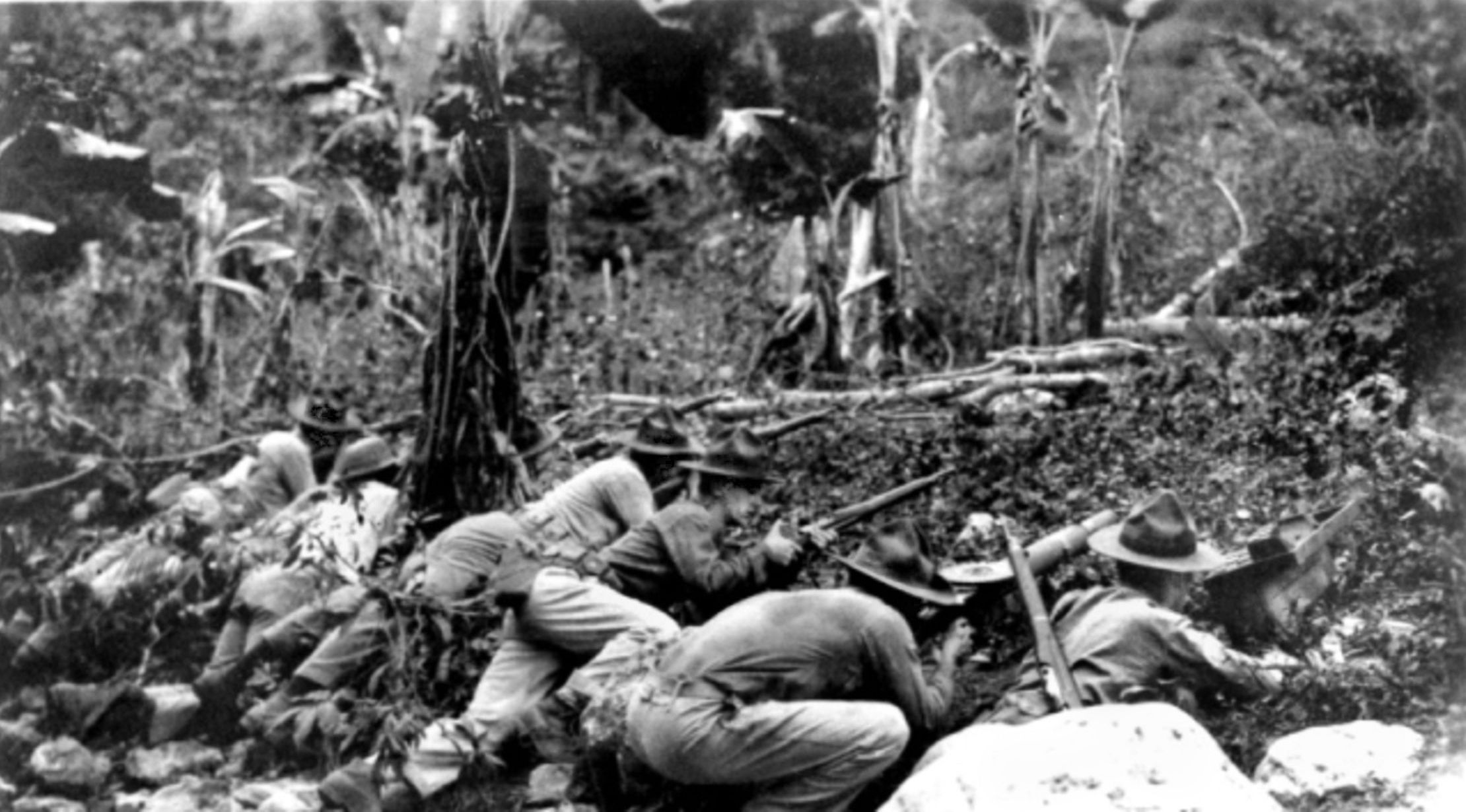
On October 24, 1915, Daly was part of a 35-man mounted reconnaissance patrol from the 15th Company of Marines, operating out of Fort Liberté. While crossing a deep ravine at dusk, the detachment was caught in a crossfire by about 400 Cacos (guerrillas resisting forced labor) hidden in the bushes.
In the chaos of the assault, the patrol lost its machine gun when the mule carrying it was killed crossing the river. Pinned down under continuous fire throughout the night, the small Marine force was in a dire situation without it.
Daly made his way out of the defensive perimeter through enemy lines to find the submerged machine gun, which he strapped to his back, along with the ammunition and crawled back to his unit undetected.
At daybreak, the Marines, now re-armed and with their morale bolstered by Daly’s incredible feat, launched a daring counter-attack. Dividing into three squads, they advanced in different directions, surprising and scattering the Cacos in a decisive engagement. Daly led one of these squads, fighting with exceptional gallantry throughout the action. His retrieval of the machine gun, coupled with his leadership in the subsequent assault, earned him his second Medal of Honor.
Major General Smedley Butler, who served with Daly in Haiti and is the only other Marine to earn two Medals of Honor for separate acts of valor, famously called him “the fightinest Marine I ever knew.” Former Commandant of the Marine Corps, Major General John A. Lejeune, acclaimed him as “the outstanding Marine of all time.”
In November 1917, 44-year-old First Sergeant Daly deployed to France as part of the American Expeditionary Forces. In the brutal crucible of the Western Front, Daly would further cement his legendary status, particularly during the ferocious Battle of Belleau Wood in June 1918.
It was a pivotal engagement that showcased the tenacity and fighting spirit of the Marines, earning them the moniker “Devil Dogs” from their German adversaries. The fighting was savage, characterized by intense artillery bombardments, relentless machine gun fire, and desperate hand-to-hand combat in the dense woods.
It was during this battle that the most famous, and perhaps apocryphal, quote attributed to Daly was uttered. As his company, the 73rd Machine Gun Company, 6th Regiment (Marines), found itself pinned down by devastating German machine gun fire near Lucy-le-Bocage, facing seemingly insurmountable odds, Daly reportedly sprang from cover and yelled, “Come on, you sons-o’-bitches, do you want to live forever?” This despite the fact that there is no evidence or witnesses that he ever uttered the line.
According to Alan Axelrod, author of Miracle at Belleau Wood: The Birth of the Modern U.S. Marine Corps, Daly had told a Marine Corps historian that what he had actually shouted was, “For Christ’s sake, men—come on! Do you want to live forever?”
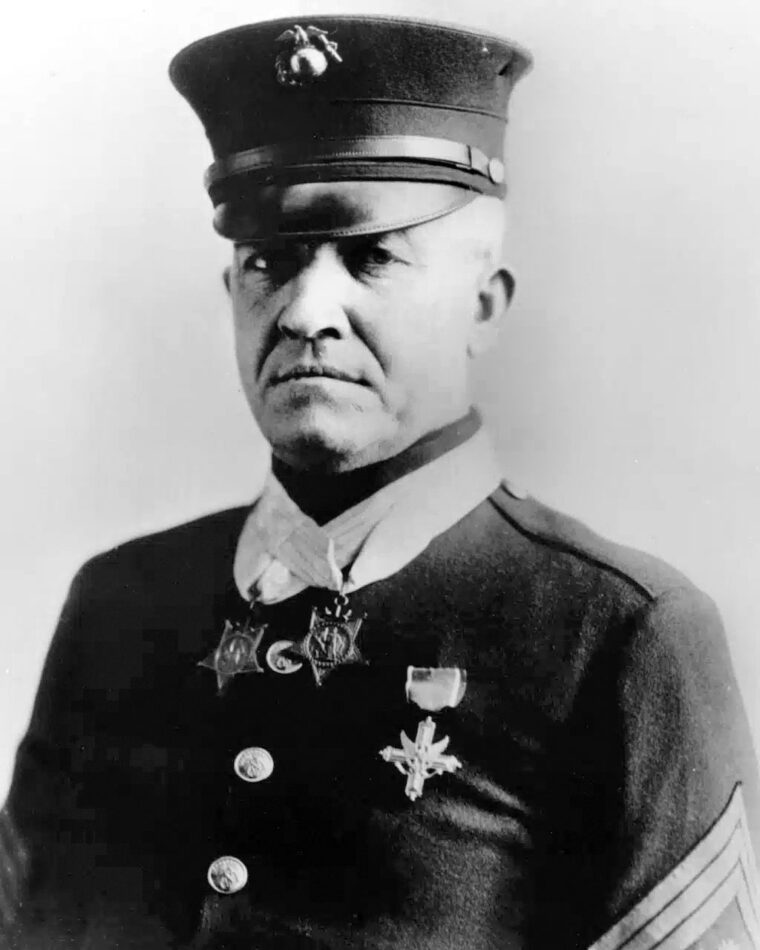
Daly received the following honors from the U.S. government during his three decades in the U.S.M.C: two Medals of Honor; Navy Cross; Distinguished Service Cross; three Letters of Commendation; Good Conduct Medal with two bronze stars; China Relief Expedition Medal; Philippine Campaign Medal; Expeditionary Medal with one bronze star; Mexican Service Medal; Haitian Campaign Medal; World War I Victory Medal with Aisne, St. Mihiel, Meuse-Argonne and Defensive-Sector clasps;
For his service in World War I, Daly received from the French government a Medaille Militaire, Croix de Guerre with Palm, and the Fourragere.


Join The Conversation
Comments
View All Comments