By Kevin Seabrooke
The smoke from the heavy artillery had barely begun to clear over the rocky, shattered landscape of Devil’s Den when the camera shutter snapped. In the resulting photograph, taken by Timothy H. O’Sullivan in the days immediately following the Battle of Gettysburg in July 1863, a lone figure sits perched among the massive granite boulders.
He’s not a soldier, though his rugged, weather-beaten appearance suggests the harsh realities of life in the field. He wears a dark slouch hat, a durable campaign jacket, and high riding boots. A long, unkempt beard frames a face that has witnessed more carnage than almost any general in the Union army. He has a pencil in his hand and a sketch pad on his lap. This solitary, intense figure is Alfred Rudolph Waud, the preeminent “Special Artist” of the American Civil War.
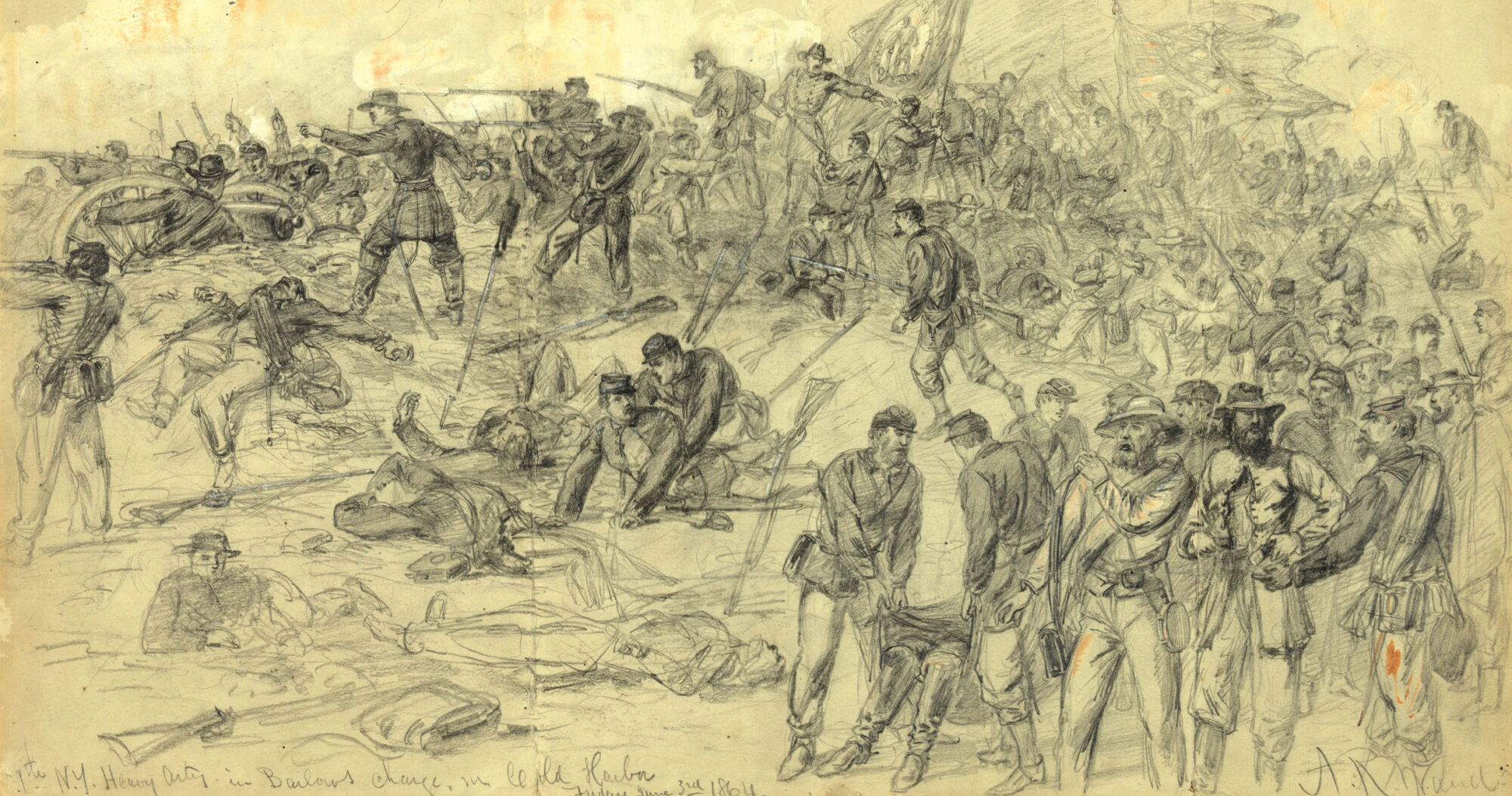
Generals and heroes from the conflict have been carved in marble or cast in bronze, but it was Waud’s eye—and his frantic, brilliant pencil strokes that truly allowed the American public to see the war. In an era before photography had the ability to capture the kinetic violence of combat, Waud stood in the crossfire, translating the terrifying majesty and intimate horrors of battle onto paper.
His journey from a young, aspiring marine painter in England to the visual chronicler of America’s bloodiest conflict is a testament to the power of journalistic art and the enduring need for eyewitness truth.
Born in London on October 2, 1828, Waud grew up during a period of massive industrial and cultural transformation in Great Britain. He was the eldest son of Alfred Waud Sr. and Mary Fitz-John, and from an early age, he exhibited a profound natural talent for draughtsmanship. Seeking to channel this ability into a respectable profession, he enrolled at the Government School of Design at Somerset House in London. His initial ambition was to become a marine painter, capturing the elegance of the British fleet and the wild, unpredictable nature of the sea. But the harsh economic realities of the mid-nineteenth-century art world forced him to seek more practical employment.
As a student, Waud found work painting scenery and backdrops for the bustling London stage. This experience was crucial to his development, teaching him to work quickly under pressure, how to compose a scene for maximum dramatic effect, and how to utilize light and shadow to guide the viewer’s eye. These skills would later prove essential on the battlefields of Virginia.
By 1850, the promise of opportunity in the United States proved too alluring to resist. Armed with his artistic training and a formidable work ethic, the 21-year-old Waud sailed to New York City on the Hendrik Hudson. He hoped to continue his work in the theater, seeking employment with the prominent actor and playwright John Brougham. But he found more money and stability in publishing, as the 1850s marked the dawn of the illustrated newspaper in America, a medium that sought to combine the timeliness of the daily broadsheet with the visual appeal of fine art. Waud initially settled in Boston, where he worked as an illustrator for various periodicals, including the Carpet-Bag, and provided engravings for books such as the 1857 publication of Hunter’s Panoramic Guide from Niagara to Quebec. During this decade, he also married Mary Gertrude Jewell, a New Yorker, and settled in Orange, New Jersey, to raise their growing family. His younger brother, William Waud, also emigrated from England in 1855, bringing his own artistic talents to America and setting the stage for both brothers to leave an indelible mark on the nation’s visual history.
To fully understand Waud’s later impact, one must understand the technological limitations of the era. The mid-nineteenth century is often celebrated as the dawn of photojournalism, spearheaded by pioneers like Mathew Brady, Alexander Gardner, and Timothy O’Sullivan. However, the wet-plate collodion photographic process used during the Civil War was incredibly cumbersome. It required heavy wooden cameras, delicate glass plates, and mobile darkrooms—often referred to as “What-is-it?” wagons by bewildered troops—to immediately develop the images before the chemicals dried.
More importantly, the required exposure times were agonizingly slow, ranging from several seconds to nearly a minute. If anything moved during the exposure, the resulting image would be an unreadable blur. Consequently, photography was largely confined to the aftermath of battle—shattered landscapes, ruined fortifications, stiffly posed officers, and corpse-littered fields. The wet‑plate process could convey the war’s grim toll, but it could not reliably capture the chaos of live action: the frantic infantry charge, the desperate hand‑to‑hand fighting, or the terrifying burst of an artillery shell.
Even so, the thousands of images created by Brady and his corps of photographers brought a new, photographic realism to the public understanding of the war. Brady’s 1862 exhibition of photos by Alexander Gardner and James F. Gibson at his studio in New York, “The Dead of Antietam,” shocked the nation. It was the first public display of images of a battlefield before the dead had been removed. In October, the New York Times wrote that, “Mr. Brady has done something to bring home to us the terrible reality and earnestness of war. If he has not brought bodies and laid them in our door-yards and along the streets, he has done something very like it…”

But until the development of halftone printing in the 1880s, newspapers could not reproduce photographs directly; illustrators like Waud were essential to translate scenes into printable blocks for mass circulation.
This technological gap was filled by the “Special Artists” or “Specials”—brave, highly skilled illustrators employed by illustrated weeklies to accompany the armies and sketch the action as it unfolded. In 1860, as the nation seemed destined for disunion, Waud was hired by the New York Illustrated News. When the Confederate bombardment of Fort Sumter ignited the Civil War in April 1861, the demand for visual news skyrocketed. Families across the North, desperate to understand what their sons, brothers, and husbands were enduring, clamored for images.
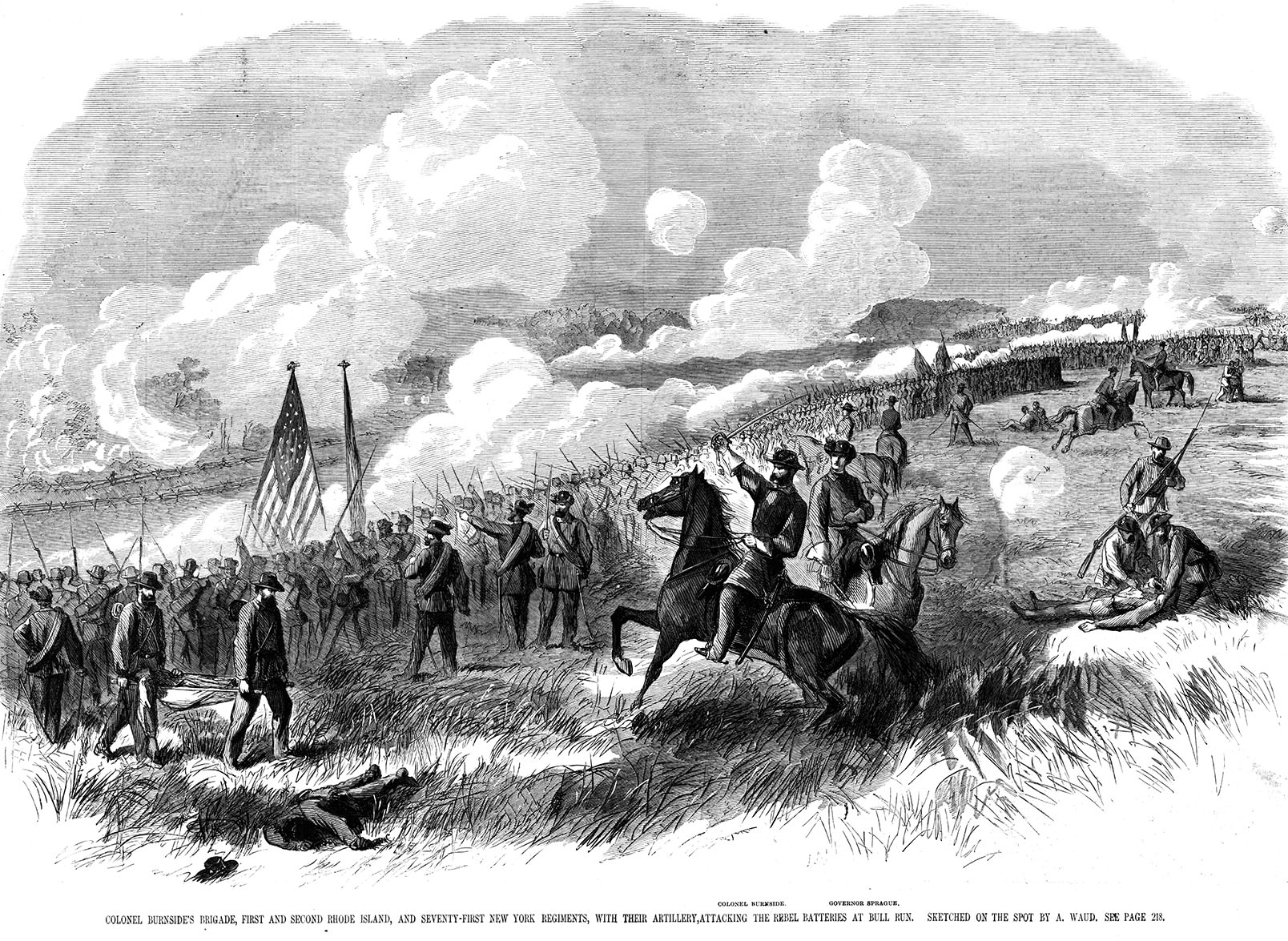
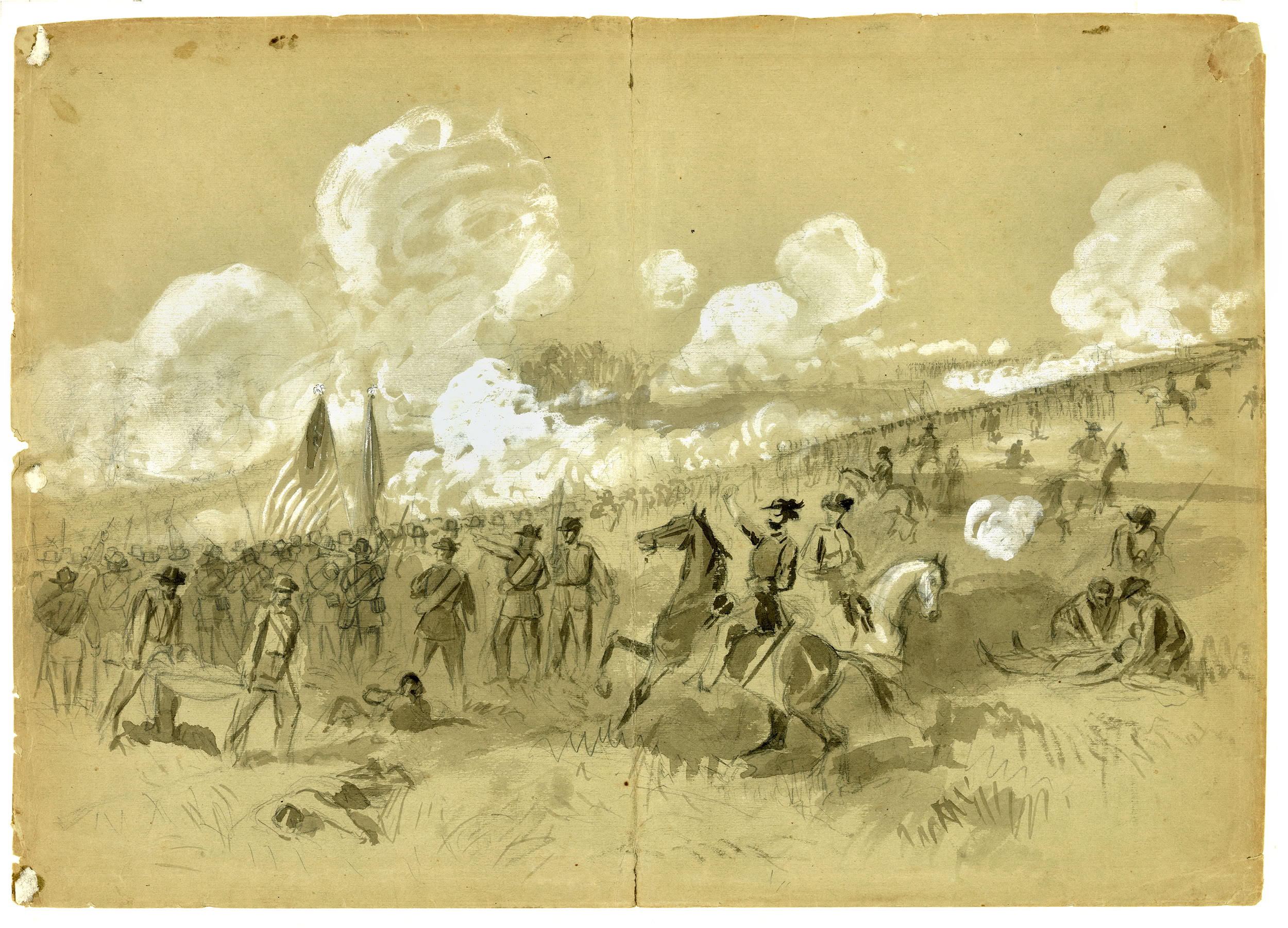
The paper assigned Waud to cover the newly formed Army of the Potomac, the principal Union force in the Eastern Theater. His baptism by fire occurred in July 1861 at the First Battle of Bull Run near Manassas, Virginia. Before this battle, the Northern public, and even many of the artists, had romantic illusions about the war—widely expected to be a brief, glorious crusade culminating in a swift Union victory. Waud traveled to the battlefield in the company of reporters and his friend Brady, fully expecting to witness a triumphant march toward Richmond.
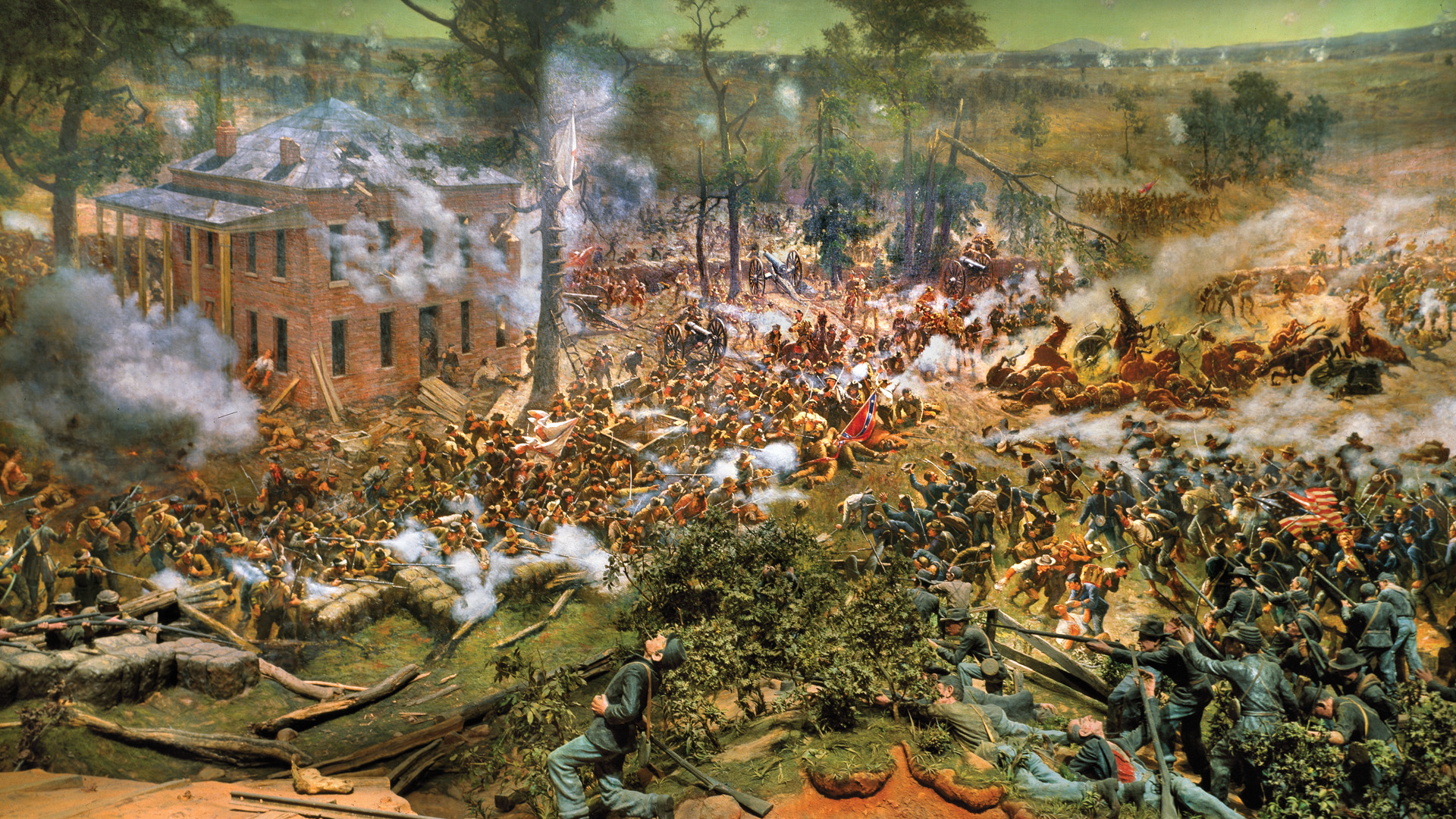
Instead, First Bull Run devolved into a chaotic, bloody nightmare. Waud’s pencil flew across the page as he worked in the blistering summer sun, capturing the shattering Union lines and the panicked, headlong retreat back toward Washington. The terror and confusion of the rout were profound. At one point during the chaotic withdrawal, Waud was forced to draw his personal revolver to prevent a panicked Union soldier from commandeering his horse. Returning to the capital exhausted and covered in dust, Waud dispatched his sketches to New York. The resulting engravings published in the Illustrated News were a shock to the Northern public. The traditional, heroic imagery of warfare—characterized by immaculate uniforms, orderly lines, and painless, noble sacrifice—was immediately challenged by Waud’s raw depictions of the disorganized, brutal reality of combat. Bull Run fundamentally changed Waud’s approach to his art. He realized that this war would not be a romantic adventure; it would be a grim, grueling slog, and he committed himself to capturing the experience of the common soldier with unflinching honesty.
By the end of 1861, Waud’s talent caught the attention of Harper’s Weekly: A Journal of Civilization. Harper’s was the premier illustrated newspaper of the era, boasting a massive circulation and a roster of legendary artists, including Winslow Homer and Thomas Nast. Waud left the Illustrated News to join Harper’s as a Special Artist, cementing a relationship that would define his career.
Unlike many other correspondents who rotated in and out of the field, Waud remained permanently attached to the Army of the Potomac. He was the only Special Artist to accompany the army continuously from Bull Run in 1861 to the final surrender at Appomattox Court House in 1865. This gave him an extraordinary perspective on the evolution of the army, the changing tactics of the war, and the shifting psychological state of the men he lived alongside.
Life as a Special Artist was physically punishing and relentlessly dangerous. Waud shared every hardship endured by the infantry. He marched through knee-deep mud, slept on the frozen ground, suffered through torrential downpours, and subsisted on the same meager rations of hardtack and salt pork. Contemporary accounts describe him as an unmistakable figure on the battlefield—tall, striking, and rugged. He was an incredibly brave man who exhibited a total disregard for his own personal safety. Driven by a reporter’s instinct and an artist’s demand for visual accuracy, he pushed himself toward the front lines and was known to ride his horse into active skirmishes, seeking the optimal vantage point. He developed a keen understanding of military tactics, allowing him to anticipate where the decisive moments of a battle would occur.
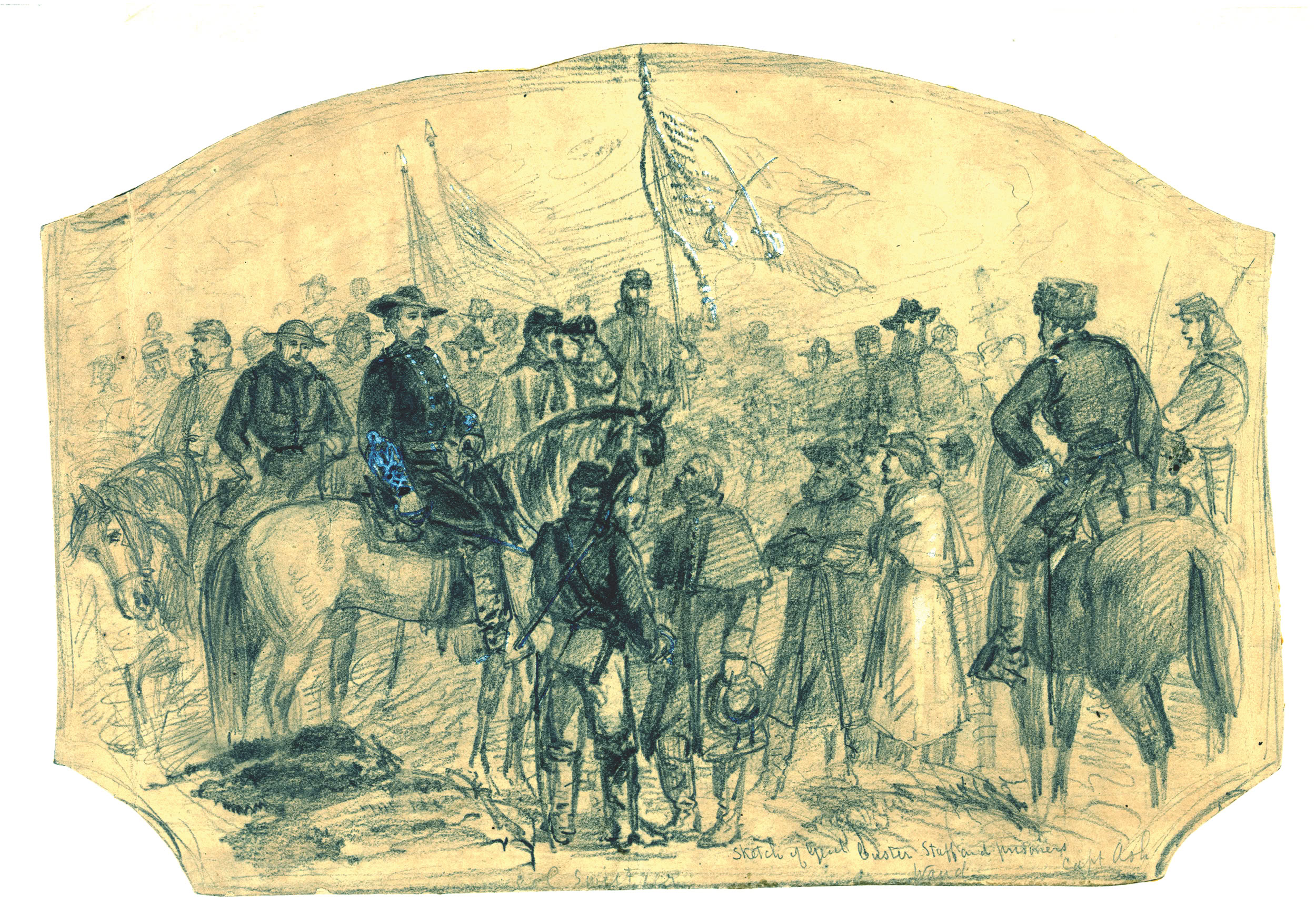
General George Meade, commander of the Army of the Potomac, recognized Waud’s tactical eye and often granted him special access to the front, occasionally even using the artist’s highly accurate panoramic sketches of enemy fortifications to help plan his own infantry assaults. Yet, despite his proximity to the high command, Waud’s true affinity lay with the enlisted men. He spent countless hours sketching them in their winter encampments, cooking over small fires, writing letters home, and enduring the agonizing boredom punctuated by moments of sheer terror.
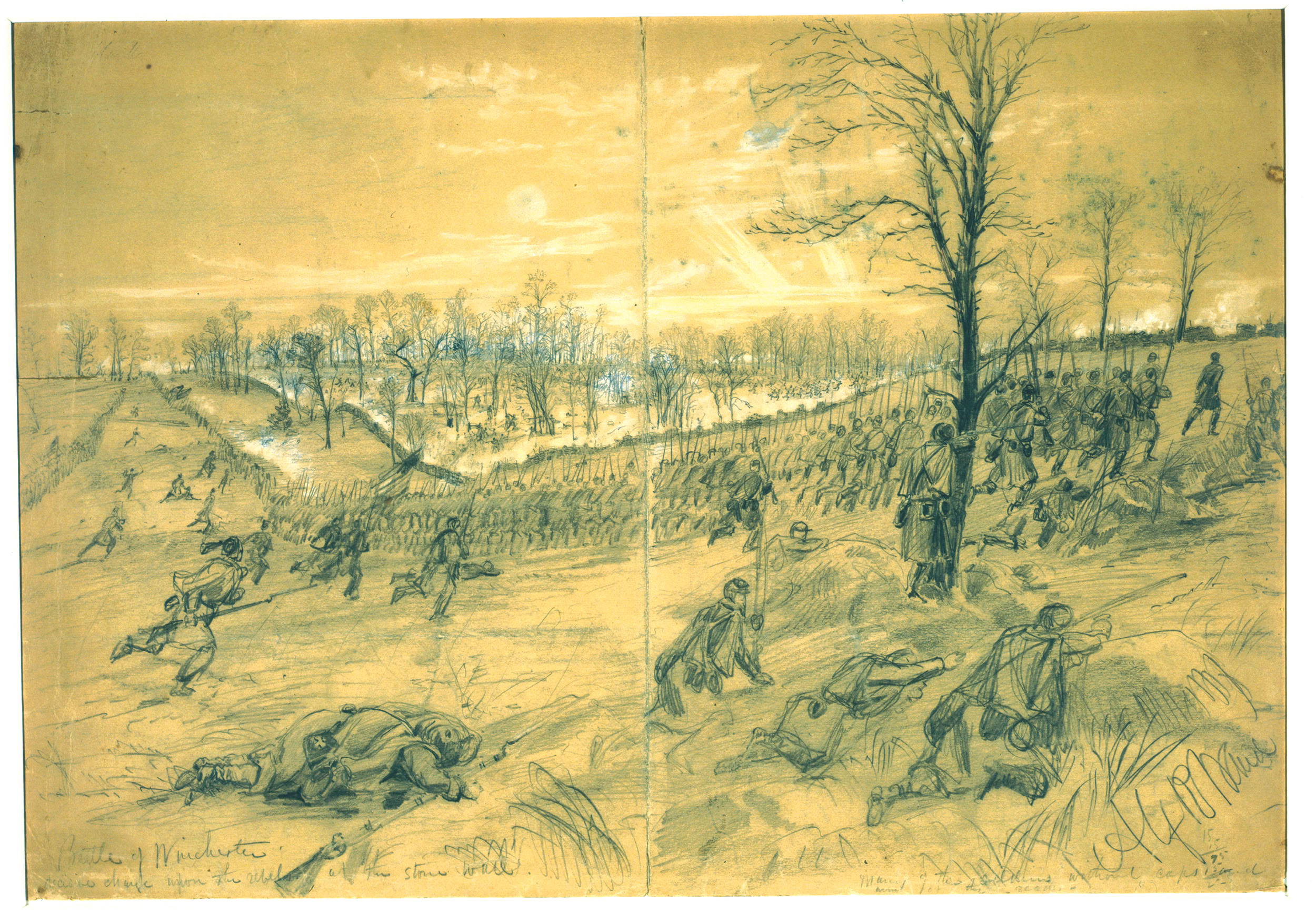
The process of translating Waud’s battlefield sketches into mass-produced magazine illustrations was a complex, industrial feat. When an engagement began, Waud would seek out a vantage point—sometimes a prominent hill, the roof of a farmhouse, or even the high branches of a tree. Ignoring the hiss of Minié balls and the roar of cannon fire, he would sketch furiously on rough-textured paper. He rarely had time to complete a highly polished drawing; instead, he worked in a kind of visual shorthand. He outlined the topography, placed the masses of troops, and captured the direction of the action. He would then hastily scribble descriptive notes—”heavy smoke here,” “rebels charging from these woods,” or “men look very exhausted”—in the margins of the paper for the engravers in New York.
Once it was as complete as the combat conditions would allow, the sketch was handed over to a fast horse courier, rushed to the nearest railhead or steamboat, and sped to Harper’s Weekly in Manhattan. There, a team of highly skilled wood engravers took over. A master draughtsman would redraw Waud’s sketch in reverse onto a block of end-grain boxwood. Because a single block of boxwood was relatively small, a large, double-page illustration required several blocks to be bolted together. The drawing was split across the seams, and the blocks were unbolted and distributed to a dozen different engravers. Working by gaslight with sharp burins, the engravers carved away the negative space, leaving the black lines of the drawing raised in relief. Once the individual blocks were carved, they were bolted back together, and a master engraver smoothed over the seams to ensure a continuous image. This block was then used to create an electrotype metal printing plate. The entire process, from Waud’s pencil stroke on a Virginia battlefield to the printed magazine landing on a doorstep in Massachusetts, could take as little as two weeks—an astonishing speed at the time.
This collaborative process introduced a layer of editorial control—the artists at Harper’s sometimes altered Waud’s original sketches to suit the patriotic sensibilities of their Northern readership. If Waud drew an exhausted team of horses dragging an artillery piece through deep mud, the engravers might raise the horses’ heads and add a flourish to their tails to make them look more spirited. If Waud depicted a gruesome field hospital amputation, the editors might soften the gory details to spare the delicate sensibilities of the Victorian public. Despite these occasional alterations, the core truth of Waud’s observations survived the engraving process. His compositions were so dynamic, his understanding of anatomy and movement so precise, that the visceral impact of the war could not be entirely sanitized.
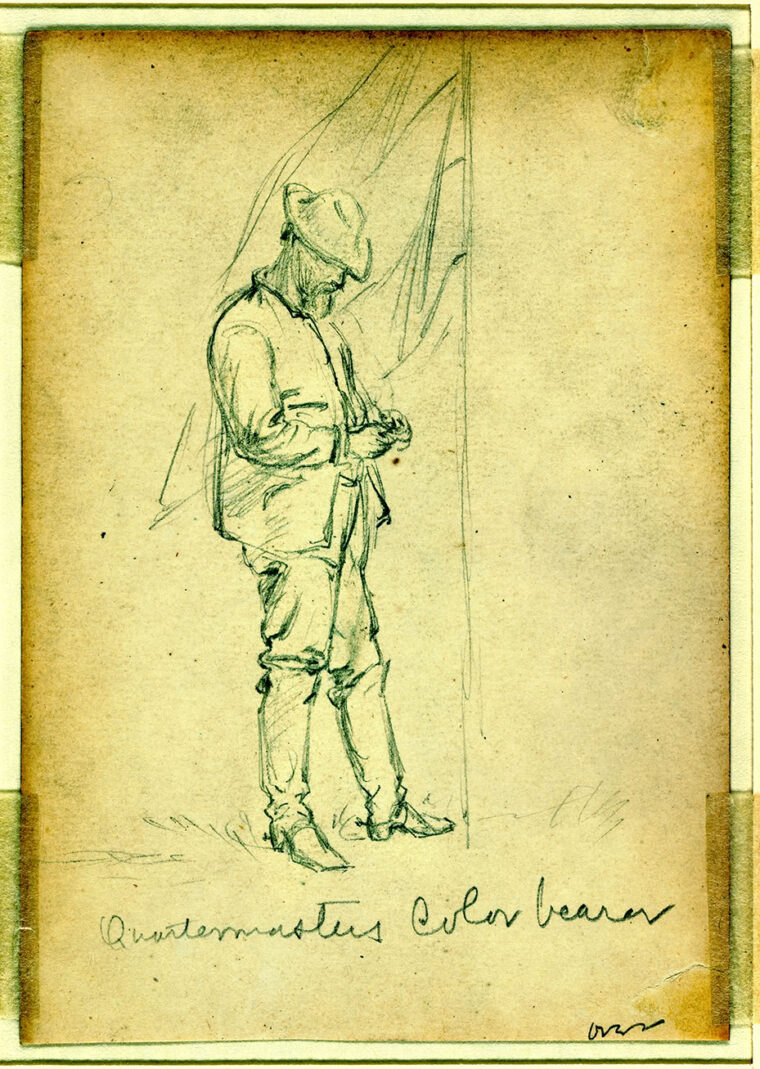
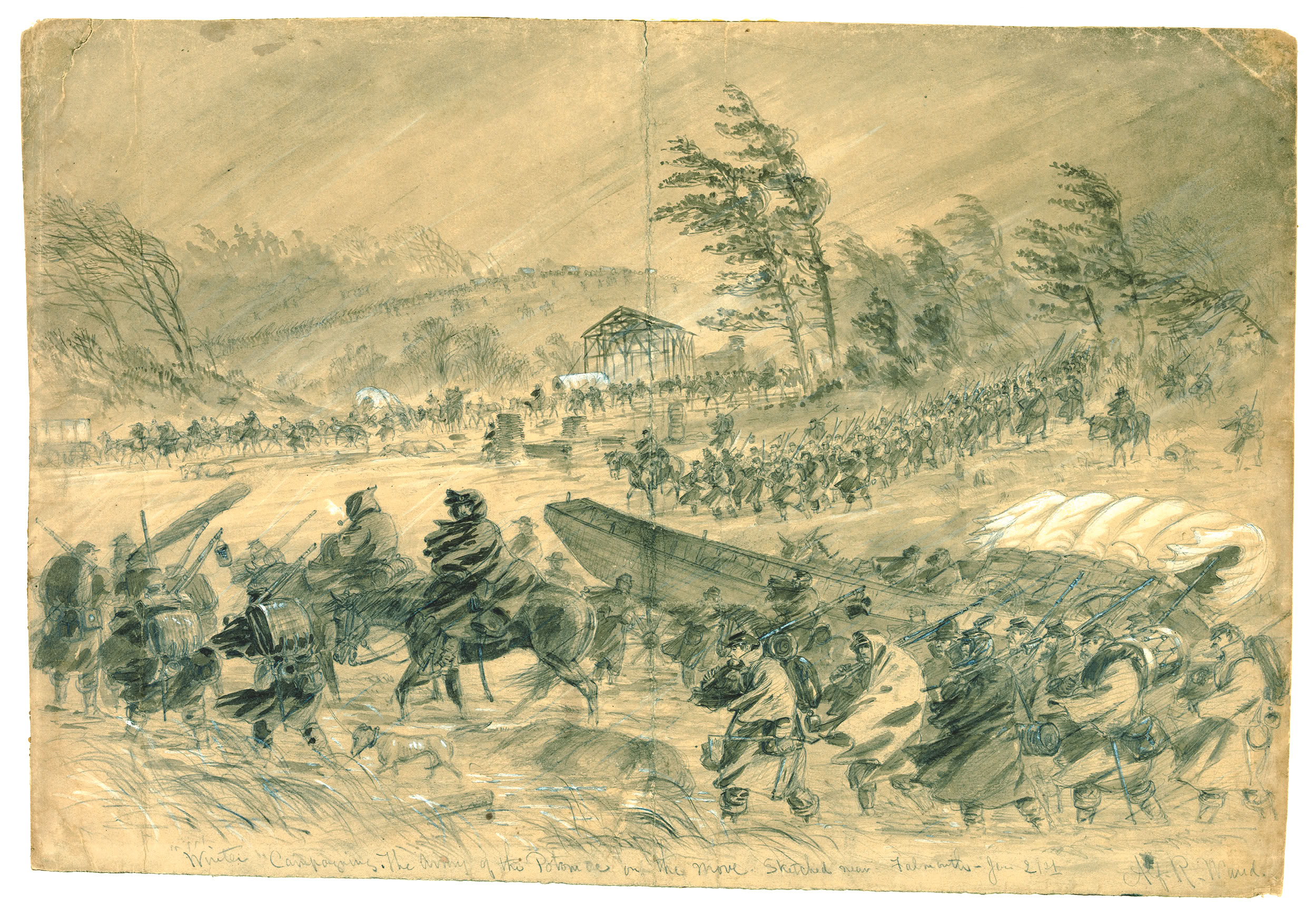
The year 1862 saw Waud chronicle the Army of the Potomac through the grueling Peninsula Campaign and the horrors of the Maryland Campaign. In September, he was present at the Battle of Antietam, the single bloodiest day in American military history. Working amidst a landscape choked with the dead and dying, Waud produced some of the most enduring images of the conflict. He sketched the desperate struggle for Burnside’s Bridge, the aftermath of the fighting in the Miller Cornfield, and the grim reality of the field hospitals where surgeons worked frantically with bone saws. Later that year, in December, he witnessed the disastrous Union assaults at the Battle of Fredericksburg. The “Mud March” of early 1863 provided Waud with the material for one of his most famous genre sketches—the absolute misery of the Union army bogged down in freezing, knee-deep mud, physically illustrating the crushing despair that had gripped the northern war effort.
In July 1863, Waud traveled north into Pennsylvania to cover the Battle of Gettysburg. He was one of only two Special Artists to witness the engagement firsthand, and he was the only artist present to sketch the climactic Confederate assault known as Pickett’s Charge on the third day of the battle. Positioned near the Union center on Cemetery Ridge, Waud watched as thousands of Confederate infantrymen emerged from the distant tree line and marched across the open fields. He sketched the horrific artillery bombardment that preceded the charge, the closing of the ranks as the men fell, and the desperate, violent melee at the stone wall. His frantic sketch of Confederate General Lewis Armistead, hat raised on the tip of his sword as he breached the Union defenses just moments before being mortally wounded, remains one of the few first‑hand visual records of the high-water mark of the Confederacy.
Following the battle, Waud spent days roaming the corpse-strewn fields, capturing the devastating aftermath of the three-day slaughter, an effort that brought him to the rocks of Devil’s Den where Timothy O’Sullivan forever captured his likeness.
As the war ground on into 1864, Waud accompanied the army through Ulysses S. Grant’s relentless Overland Campaign. The war had changed, shifting from grand, open-field maneuvers to brutal, continuous trench warfare. In the dense, burning thickets of the Wilderness and the muddy, blood-soaked trenches of Spotsylvania Court House, where he produced a famous sketch titled “The toughest fight yet,” depicting the savage, hand-to-hand combat at the Mule Shoe Salient.
During this campaign, Waud’s bravery verged on the reckless. Perched in a tall tree to get a better view of the Confederate lines, he drew the attention of enemy sharpshooters and calmly finished his sketch as bullets clipped the branches around him, showering him with bark and leaves. His dedication often put his life in jeopardy, but his images provided the Northern public with an unflinching look at the war of attrition that Grant was waging against Robert E. Lee’s Army of Northern Virginia.
The final year of the conflict saw Waud sketching the grueling siege of Petersburg. His drawings from this period are incredibly detailed, showing the complex network of bombproofs, zigzagging trenches, and heavy mortar batteries that scarred the Virginia landscape. He documented the disastrous Battle of the Crater in July 1864, where Union forces detonated a massive mine beneath the Confederate lines, only to suffer a horrific defeat in the resulting crater. Waud’s eye for the granular details of soldier life never wavered; he sketched the men attempting to stay cool in the sweltering heat, the endless digging, and the ever-present danger of sniper fire.
When the Confederate lines finally broke in April 1865, Waud was there to ride with the victorious Union army into the burning capital of Richmond. Days later, he was present at Appomattox Court House to sketch the emotional scenes surrounding the surrender of Lee, bringing his four-year odyssey with the Army of the Potomac to a triumphant, exhausted close.
Harper’s Weekly rightly acclaimed Waud as the most important artist-correspondent of the Civil War. He had submitted hundreds of sketches, far more than any other artist in the field. But the cessation of hostilities did not end Waud’s career as a visual journalist. In the years following the war, he utilized his reputation to explore the rapidly changing landscape of the reunited nation. Harper’s sent him on extensive tours throughout the South and the American West. His postwar assignments were in many ways an attempt to visually knit the fractured country back together. He documented the devastating impact of the war on southern cities, the slow process of Reconstruction, and the struggles of newly freed slaves. His illustrations of the Freedmen’s Bureau and African Americans exercising their newly won right to vote are vital historical records of the era’s complex social dynamics.
Waud’s travels took him down the Mississippi River, where he captured the steamboat culture, the bustling levees of New Orleans, and the sprawling Acadian homesteads of Louisiana. His eye for dramatic scenes remained as sharp as ever; in 1871, he traveled to Illinois to document the catastrophic aftermath of the Great Chicago Fire, rendering the smoldering ruins of the city with the same meticulous detail he had applied to the shattered landscapes of Virginia. As the nation moved toward the Gilded Age, Waud’s work continued to appear in prominent publications, including The Century Magazine, and his wartime sketches were extensively utilized in the massive, multi-volume historical compilation Battles and Leaders of the Civil War. In 1870, the British-born artist who had done so much to document the American experience officially became a naturalized U.S. citizen.
Despite his advancing age, Waud remained an active, working artist into his early sixties. In 1891, he embarked on a tour of the South to sketch the old, overgrown battlefields for a new series of war narratives designed to promote travel by aging veterans. The landscapes that had once been stripped bare by artillery fire and choked with the dead were now quiet and returning to nature. It was while touring these hallowed grounds that Waud’s heart finally gave out. On April 6, 1891, at the age of 62, Waud suffered a fatal heart attack in Marietta, Georgia, his sketchbook in hand. He was buried at the Saint James Episcopal Cemetery in Marietta, a fittingly quiet resting place for a man who had spent his life amidst the deafening roar of history.
Preserved in the archives of the Library of Congress, which houses more than a thousand of his original, raw battlefield sketches that reveal the frantic, terrifying energy of the Civil War. The smudged pencil lines, the hastily scribbled notes, and the occasional stain of mud or weather provide a visceral connection to the past that no photograph of a static, post-battle landscape can ever achieve. Waud did not merely record the events of the American Civil War; he captured its soul, its misery, and its terrible grandeur. Through his unwavering courage and his extraordinary artistic vision, he saw that the sacrifices of the men who fought from Bull Run to Appomattox would never be relegated to the realm of abstract statistics. Through his sketches, Waud put a human face on the Civil War.
Join The Conversation
Comments
View All Comments