By David H. Lippman
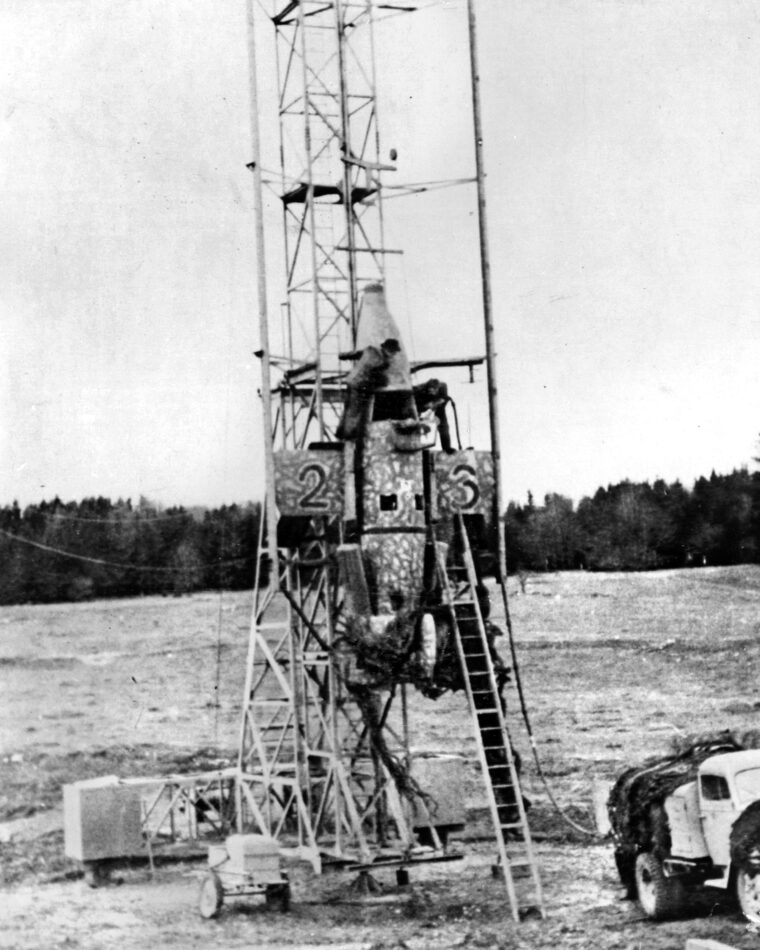
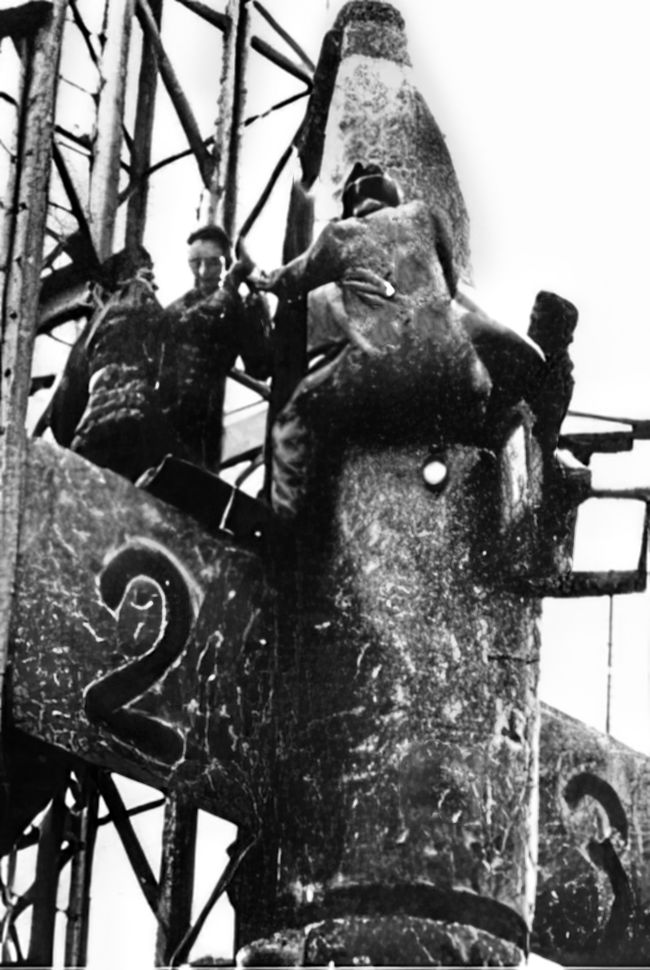
Wearing his flight suit, Luftwaffe Aviator and Bachem test pilot Lothar Sieber approached Natter (“Viper”) M23, standing on its launcher at the Heuberg Training Area in southwest Germany on March 1, 1945. Fueled with the same dangerous mix of C-Stoff and T-Stoff used to power the Reich’s Me 163B rocket fighter, the 5,000-lb rocket stood erect, painted in camouflage, on a cross-shaped wooden frame. Wearing a dark suit, Natter’s designer Erich Bachem stood among the crew near the launcher.
Bachem and Sieber discussed the imminent launch and shook hands before the pilot was helped into the cockpit by the Schwarze Männer (“black men”)—the Luftwaffe nickname for its ground crew who wore black or dark gray denim work coveralls.
If all went well, Sieber would become the first man to fly a rocket into the atmosphere.
The road to this day was not very long. By 1944, daylight American air raids and nightly Royal Air Force bombing were putting an immense strain on German cities and the Luftwaffe’s defenses. With the Americans deploying long-range P-51 fighters as far as Berlin, German Bf 109s and Fw 190s were overmatched. So were German radar and antiaircraft guns. In 1942, Luftwaffe Flak Commander Walther von Axthelm had asked the Ministry of Armament to develop antiaircraft missiles to add to the defense.
Germany’s top scientists and engineers hatched three: the Rheintochter (“Rhine Daughter”), Enzian (“Flower”), and Wasserfall (“Waterfall”) missiles. None worked—no Enzians saw service and only 12 of the 45 firings of the Wasserfall were successful.
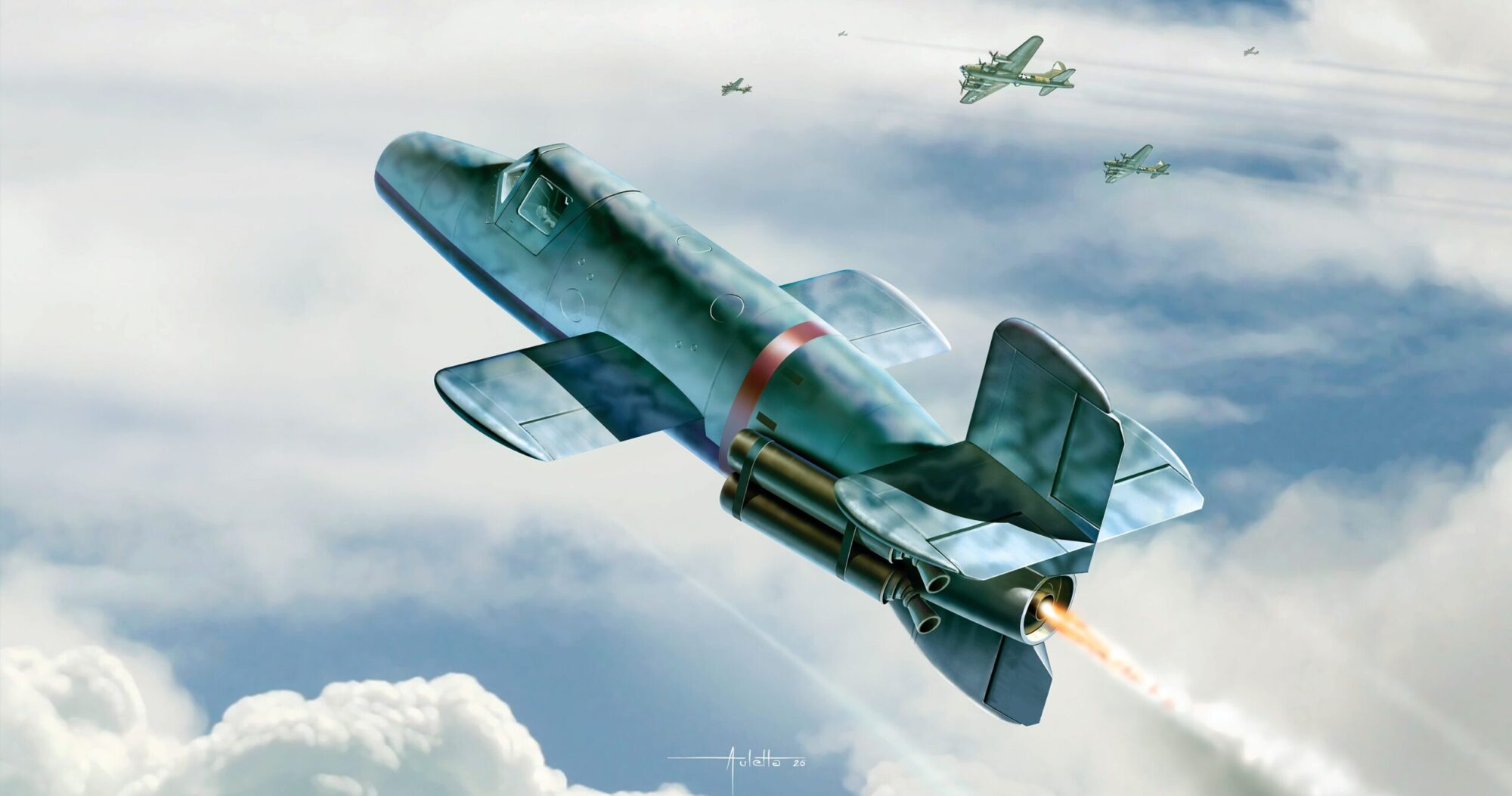
A controlled fighter would do better. In 1944, the German Air Ministry (RLM) sought designs from the usual suspects: Messerschmitt, Junkers, Heinkel, and Fieseler, all aircraft companies with proven track records of success, for something new in war: a real manned rocket fighter that would launch off a stand like the new V-2—the world’s first operational long-range guided ballistic missile—leap into the air at high speed and climb into an approaching American bomber formation. The rocket’s pilot would fire a fusillade of smaller nose-mounted rockets at point-blank range into an American B-17. At that point, the pilot would turn away from the “Amis,” as the Germans called the Americans, fly some distance, where the pilot would hit two parachute buttons. One would eject him from his now “half-plane,” so he could land safely, while the other would slow down the plane’s descent, so that it would neatly land somewhere in the Reich, its rocket engines and wings intact, be recovered, and both pilot and rocket re-used.
The request for a proposal landed on the desk of Doctor of Engineering Erich Bachem, who had been a one-time director of Fieseler, now a consultant to the aircraft industry. An experienced glider pilot with contacts at Fieseler, Bachem was familiar with that company’s work to develop the V-1.
Bachem went straight to work. He said the proposed rocket would have to be flown by autopilot for its first few seconds, until reaching an operational height of 30,000 feet. At that point, the rocket would have burned out its fuel, the pilot would have regained his senses, and he could turn off the autopilot and operate the machine as a glider, swooping down at high speed and altitude into the incoming formation of B-17s. Then he would fire off his array of mini–rockets, glide away from the Amis, and parachute both himself and the remains of the plane over his home airfield. Total time of flight: three minutes.
Bachem brought his brainchild to the attention of the RLM in August 1944 through Luftwaffe general and legendary fighter ace Adolf Galland. Both were impressed. So was the SS—they knew about everything going on in the Reich after the July 20 “Bomb Plot” by Army officers that nearly killed Adolf Hitler—and gave it full support as well.
In September 1944, the SS designated the design the Ba 349 “Natter” and gave it the highest priority, classifying it under the top level of secrecy—Geheime Reichssache (“Secret Reich Matter”). Only the designers and construction staff were allowed to know about the project, and even that knowledge was compartmentalized.
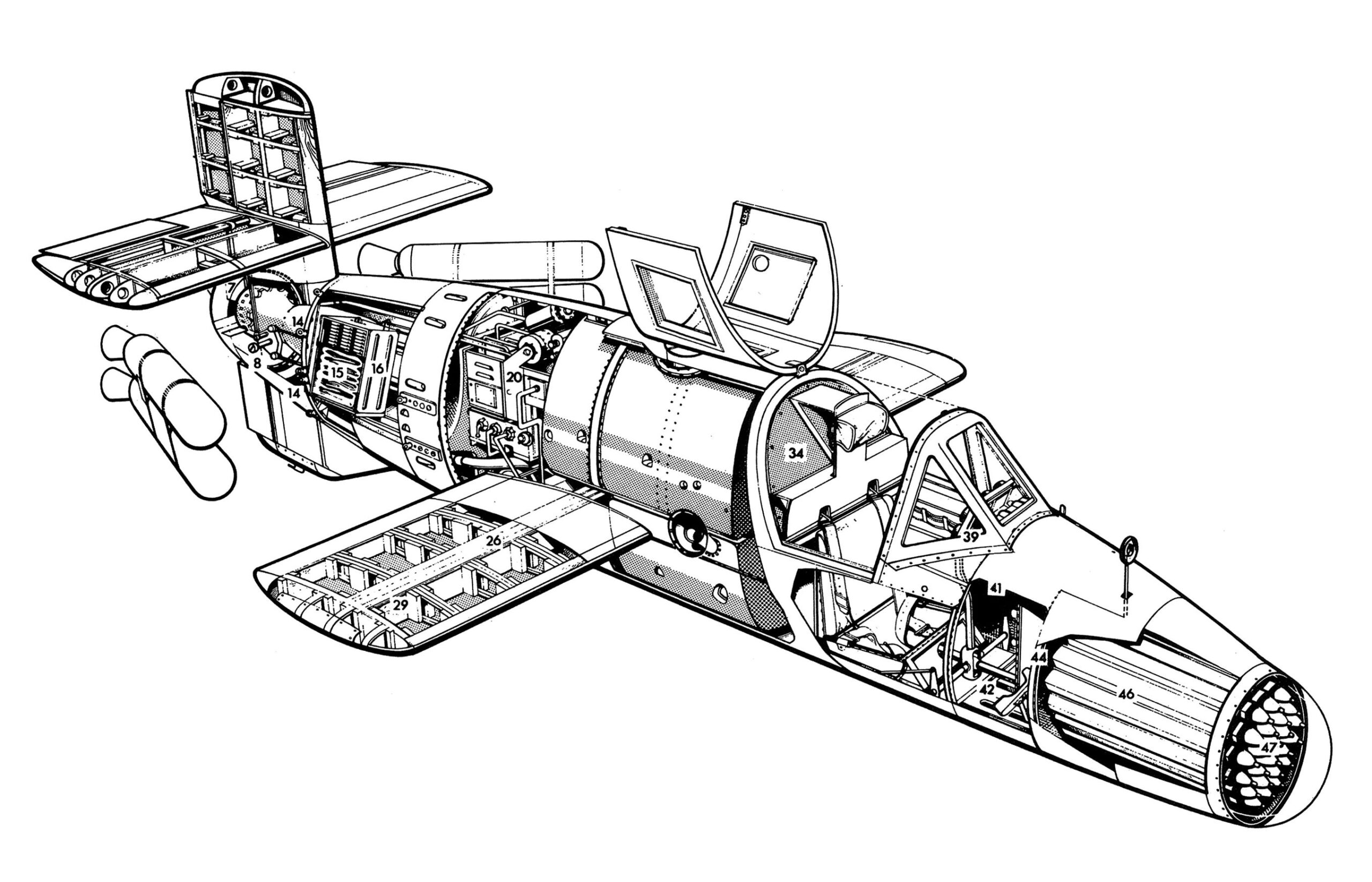
In October 1944, the first Natter was rolled out, a mid-wing monoplane standing 3.7 meters long, with a 3.2-meter wingspan, made entirely of wood, which saved the Reich increasingly rare metals. It had two-stage propulsion. The primary motor was a Walter 109-509A-2 bi-fuel rocket that used T-Stoff (hydrogen peroxide) and C-Stoff (a solution of hydrazine hydrate, methanol, and water). The two fuel components could never be allowed to mix—whether servicing the Natter or the Me 163—lest they react violently on contact. T-Stoff was an aggressive oxidizer that caused violent hypergolic combustion upon coming into contact with organic materials; even a spray hitting a passing insect could set off a blaze. The first stage carried 1,320 pounds of fuel, which gave the rocket motor a full thrust of 3,700 pounds for about 80 seconds.
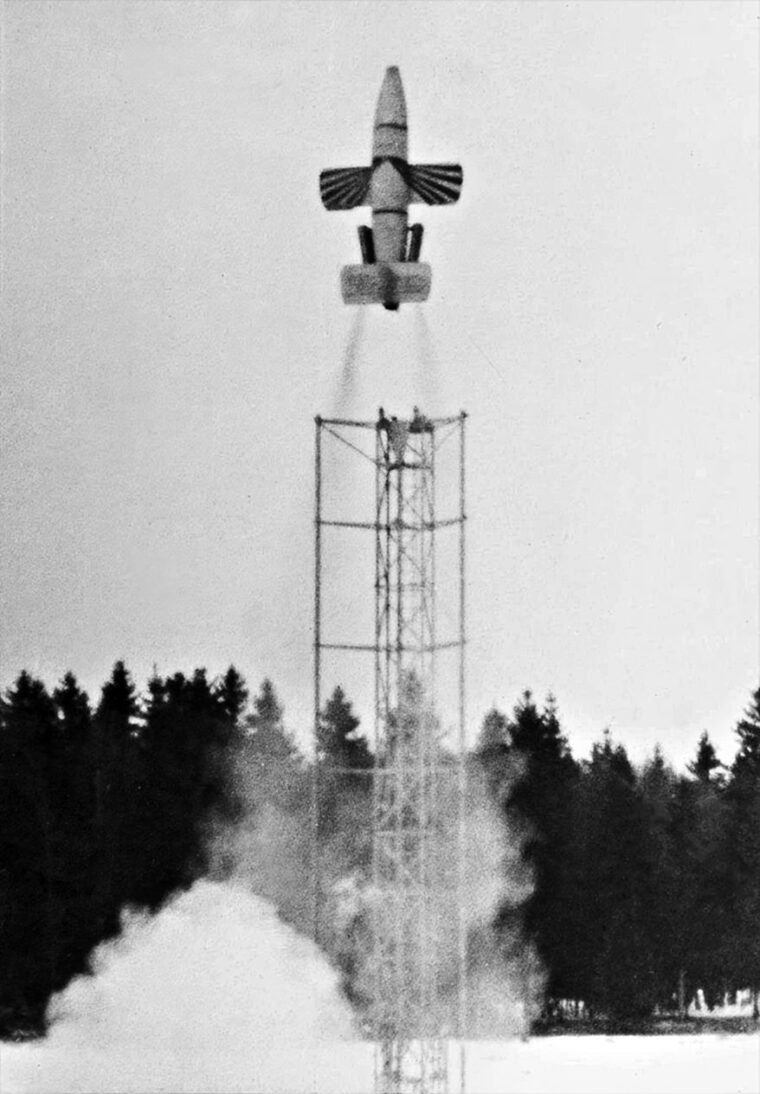
The liftoff impulse was borne by two of perhaps four SR34 solid-fuel rockets, each firing 2,200 pounds for 12 seconds, while the main engine built up its power.
The Natter would be launched almost vertically from a lattice framework. A winch and hoist placed the aircraft on the launcher.
Bachem’s rocket would leave the pad accelerating at 2.2 g, and hit 3,500 feet before its liftoff rockets burned out and the main engine reached full power. The Natter would then accelerate at full power at about 0.7 g, reaching a speed of 435 mph. Then the pilot would take over, continuing to 39,400 feet. At that point, he would throttle back to 406 mph, until the fuel had been consumed.
Next, the pilot would glide down into the American formation, and aim 33 R4M rockets in a cluster of barrels in the nose at a B-24, or 24 73-mm Föhn rockets, or a bank of 30-mm cannon at the target. However, the final choice was never made.
Once the ordnance was fired, the pilot would go into an evasive glide, heading for his home base, until he reached an altitude of 10,000 feet. At that point, he would jettison the nose of the fuselage, release his safety harness, and fold the control column forward. That automatically released the braking parachute packed in the Natter’s tail, followed by the ejection of the pilot.

Bachem and the Luftwaffe believed that the braking parachute would enable the empty tail to be landed on its nose at a low speed, and the “black men” could salvage the rocket motor, wings, and cockpit, and the Natter could be used again. However, trials showed the damage to the rocket motor was too great for it to be easily or economically repaired.
Even so, given that it took less than 1,000 man-hours to build and was made of cheaply available wood, the Natter seemed to be the answer to Germany’s air defense crisis. It was cheap, fast, maneuverable, and packed a punch. All that was needed was some testing—and courageous men to fly it.
Testing was done by Bachem at Waldsee and models in wind-tunnels at Berlin and Brunswick. Flight tests began in November 1944, with unmanned takeoffs and gliding trials with model Natters towed behind an He 111 bomber at Heuberg, near Sigmaringen.
Wind-tunnel tests completed, it was time to construct the full-size rocket, and tests were soon being made on them. Bachem planned for production to start in November 1944 and hit 200 a month by February 1945.
However, time was against the Natter project. Hitler’s massive counterstroke in the Ardennes, the Battle of the Bulge, turned into a catastrophic failure. Soviet troops stormed into Poland and to the Oder-Neisse River. American and British bombers continued to pulverize the Reich’s cities. Heinrich Himmler, head of the SS, ordered an output of 3,000 to 5,000 Natters per month.
They also ordered, inevitably, manned testing, of a Natter with a rocket motor and take-off rockets, even though the bird was not ready. No matter—it was a Heinrich Himmler order, and he was head of the SS.
Time for the manned test. All that was needed was the right man. The Luftwaffe found him in Pvt. Lothar Sieber, a Luftwaffe veteran with a checkered career.
Born on April 7, 1922, in Dresden, he volunteered for the Luftwaffe at age 18 in January 1940. After Instrument School, he was commissioned in 1941 and assigned to flight jobs in the Reich. He found them dull and asked to go to the front.
The Luftwaffe obliged, sending him to Kampfgeschwader 51 (KG 51) “Edelweiss” on the Eastern Front in April 1942, where for 10 months he flew many highly successful combat missions in a Junkers Ju 88 bomber.
The turning point in his career, and ultimately, his life came in Minsk in February 1943. Stories have persisted that the 20-year-old Leutnant (Second Lieutenant) got drunk at a farewell party for a friend and showed up late for guard duty.
What is on the record is that on February 11, 1943, Sieber was court-martialed at Luftflotte 2 for drinking while on guard duty and going AWOL. He was demoted to Gefreiter (Lance Corporal) and sentenced to four months in military prison. Citing his son’s previous commendations, his father wrote to Hermann Göring requesting leniency. Göring reduced the sentence to six weeks of close arrest, but the demotion remained.
After release, a humiliated Sieber was determined to win back his rank and his self-respect by volunteering for high-risk missions such as flying undercover German agents to be inserted into the Soviet Union behind enemy lines in best cloak-and-dagger fashion. On another mission deep behind enemy lines to evacuate a group of German officers who had been encircled by Soviet troops, Sieber earned an Iron Cross but no promotion.
In 1944, Sieber was posted to Greece to fly missions into Libya before returning to Russia. His logbook had mysterious mission codenames like “Heidelberg,” “Melone,” “Reiher,” and “Feldspar.” He made a flight in an Arado 232 to rescue 23 German soldiers under enemy fire. Maybe he had a discipline problem, but he was clearly a fine pilot.
He also had future plans: on November 29, 1944, he became engaged to Gertrud Nauditt, a Luftwaffe employee, with the wedding set for July 5, 1945. On December 22, Sieber joined the Bachem-Werk as a test pilot.
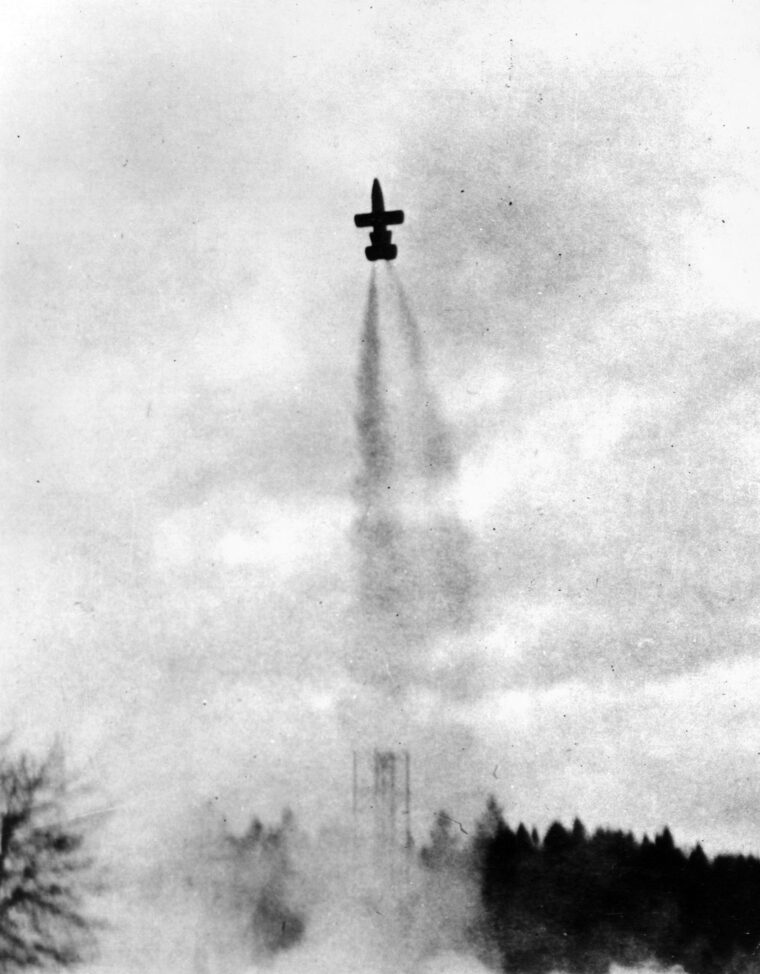
The Natter was ready, fully fueled, weighing a whopping 2,540 kilograms, the heaviest such Viper yet launched. At 11 a.m. precisely, the signal was given, the engine was fired, and the Natter soared 100 meters, Sieber becoming the first man to take flight from rocket launch (as opposed to the Me 163 rocket fighters, which took off like airplanes, from the ground). Luftwaffe “black man” Karl Mielenhausen, on the scene, wrote, “Towards 1100 M23 is ready for take-off. Low stratus clouds lie over the Ochsenkopf. The last mechanics leave the take-off area. The take-off signal is given with signal rockets.”
It rolled into the inverted position and continued to climb at 60 degrees from horizontal.
Fifteen seconds after launch, the cockpit hood flew off and the engine cut out. Incredibly, the Natter continued to climb, reaching 1,500 meters before it was lost in clouds.
A battery of binoculars was trained towards the clouds, and everyone hoped to see Sieber on his parachute, descending to the ground. Instead, they heard an explosion. For an hour they waited to hear Sieber on his radio saying he had landed safely, and then a search was begun. An hour after that, the crash site was found at Nusplingen, about seven kilometers away.
A convoy of staff cars and Kübelwagens drove to the scene to find a small crater five meters deep marking the spot. No sign of the Natter. As for Sieber, only three pieces of his body were found. The remains were buried on March 3 with full military honors in the cemetery at Stetten am kalten Markt. His rank of lieutenant was posthumously restored.
Now for the investigation of the disastrous 55-second flight. The experts determined that Sieber may have approached the speed of sound or even cracked it. However, his failure to land safely would keep him out of the record books.
But what caused the horrifying fiasco? With no wreckage to study, all the investigators could do was hypothesize. Perhaps under the 3g acceleration, Sieber involuntarily pulled back on the control column, which caused the Natter to tilt on its back. Upside down, Sieber’s weight might have pushed on the cockpit and pushed it out. Or the canopy was not properly latched. The blow of it flying off might have broken Sieber’s neck. Or the Walter motor may have shut down prematurely. Or Sieber, dazed but conscious, might have lost orientation in the cloud, tried to level out, and gone into a vertical dive. In 1998, an excavation of the site found that one of the Schmidding boosters had failed to release.
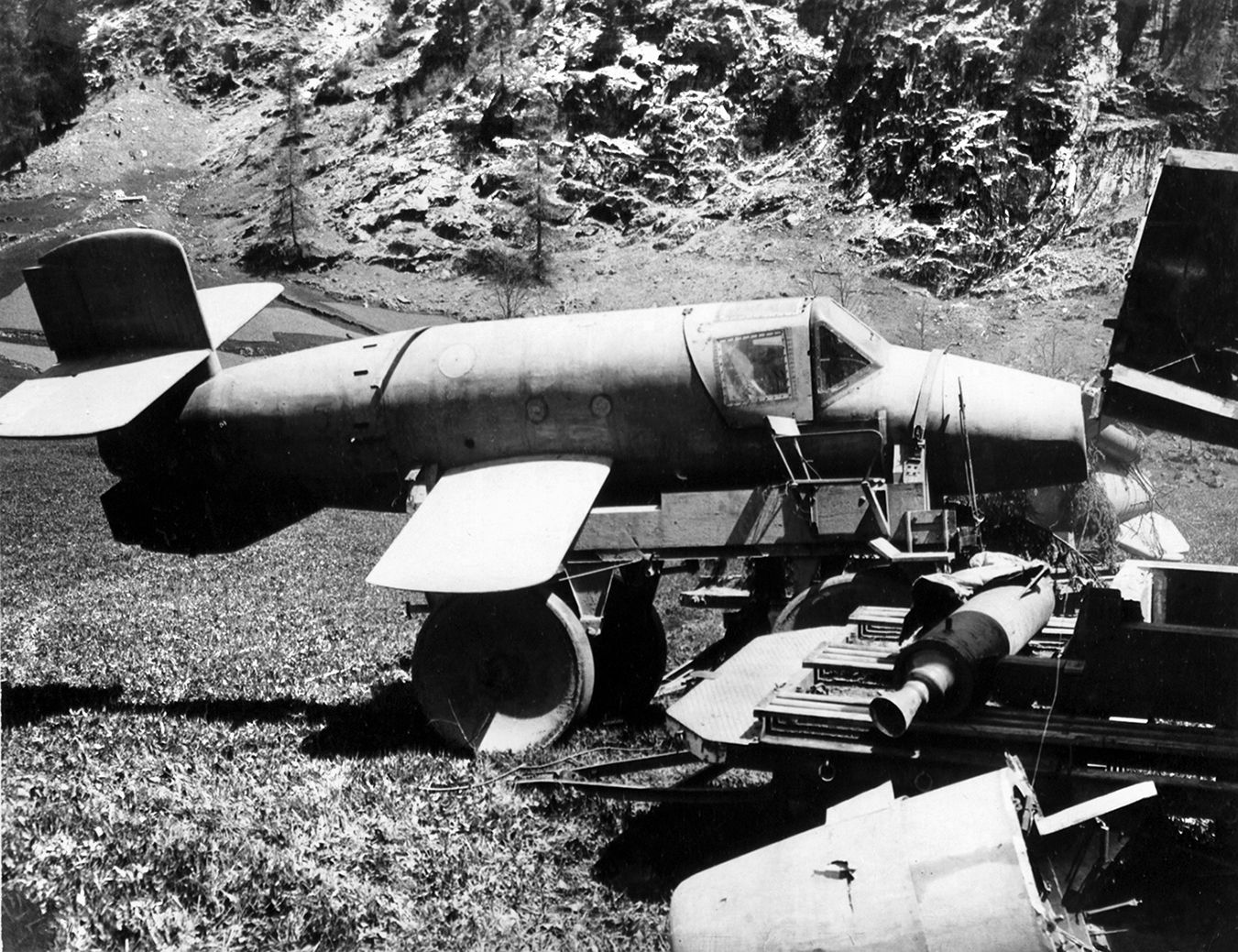
That was the first (and only) manned test of the Natter, but the project was continued. Germany was desperate. March saw more unmanned launchings, to get rid of Natter’s bugs. On March 15, Natter Prototype M24 raced off its lattice framework and its two sections parachuted safely to the ground. The next day, Natter M14, fitted with automatic guidance, did the same, but the machine was completely destroyed when it hit the ground.
The next launch was on March 21, with Natter M34 also crashing. The problem seemed to be the autopilot not being programmed to fit the specific aerodynamics of the interceptor.
M13 went up on March 30 and despite one booster cutting out, flew well. The last Heuberg launch was on April 10, with M25 leaping up on its Walter motor. The four boosters failed just as M25 cleared the tower. The Walter engine did not have enough power, and it crashed 200 meters from the launch pad.
The Luftwaffe kept trying—they rebuilt the lattice launcher, set it up in Heuberg, and rolled out the A1 Natters, the operational types. For both the Natter and the Reich, time was running out.
M32 flew off the new pole launcher in early April with a faultless flight and dummy pilot, both floating to earth in their parachutes.
The Luftwaffe pressed on with Operation Crocus, an operational base for the Natter near Stuttgart, with eight pilots chosen to fly the rockets. The base was established, three launchers constructed, but that was it. Decades later, an author researching a book on the Natter and his team found the launch site in deep forest near the village of Jesingen.
Back at the Bachem plant, the factory was still turning out the prototype wooden rockets, along with the Foehn rockets, trying to keep ahead of the advancing Sherman tanks of the French 1st Army’s 5th Armored Division. The Bachem team couldn’t. They loaded up completed Natters on Opel trucks and headed for Austria, where Allied intelligence believed rumors that the Germans were establishing a “National Redoubt” of fanatical SS troops, Nazi bigshots, and secret weapons for a last stand against the invaders of the Reich.
The convoys scattered across Bavaria and Austria. One group with two Natters on the trucks fled Bad Wörishofen on April 27 just ahead of the advancing U.S. 10th Armored Division. They slipped through the Fern Pass into Austria, and the defending German troops held off the Americans for two days.
The first group of fleeing Natters arrived at Sankt Leonhard, 60 kilometers west of Innsbruck and could go no further. There was no gasoline and the Allied forces were all around them. On May 4, shortly before V-E Day, Company L of the U.S. 44th Infantry Division’s 324th Regiment entered the Pitz Valley and took Bachem and the other Natter design team members prisoner.
Though many German scientists and engineers were scooped up by the U.S. in 1945, Bachem managed to leave Germany through Denmark and Sweden in 1947 or 1948 to move to Argentina—possibly to avoid recruitment by U.S. agents for Wernher von Braun’s rocket group under Operation Overcast. He returned to Germany in 1952 and would later design a streamlined mine locomotive, other mining machinery, long-distance diesel locomotives, and camping trailers.
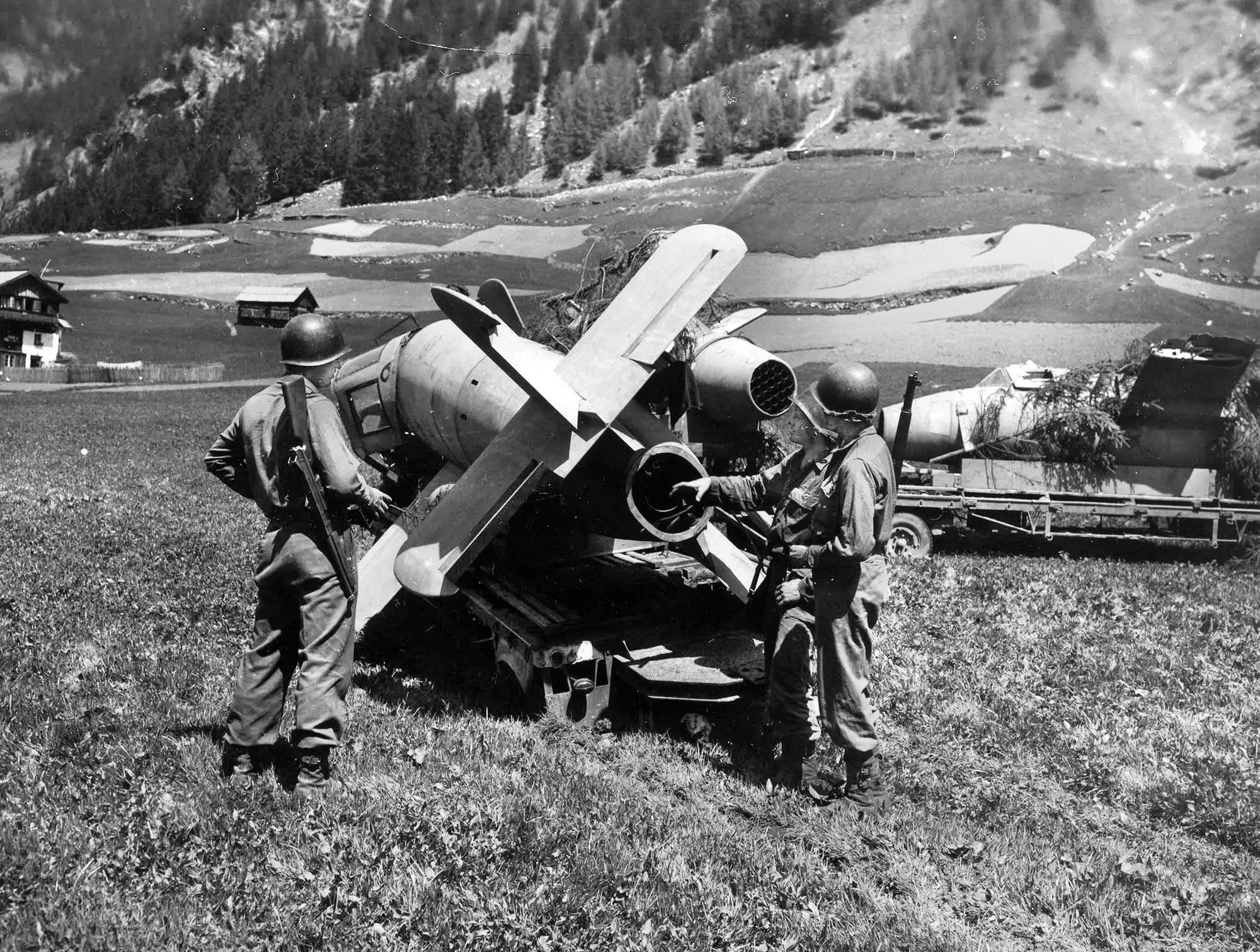
The seven surviving battered Natters did not fare as well. Puzzled GIs slung their rifles and inspected the ungainly-looking rockets on their trailers. Soon enough the intelligence experts showed up to haul off the wreckage for closer inspection.
The Allied intelligence officers who followed the GIs were puzzled, too, but they soon saw why Natter had failed. Its range was limited to within visible distance of the launch site. Its high speed limited maneuverability, a severe handicap in combat against enemy fighters. After firing its single burst of rockets once, it was defenseless. It was a wasteful weapon.
It also wasted lives—its lone test pilot killed, no safe conditions to train pilots, who would need a course in rocket flight, and the physical strain from the rapid changes and pressure was probably too immense for Natter to ever be deployed in battle.
An unconfirmed rumor has the Soviets getting a Natter. One did go to Indiana for “Freedom Day” in 1946, complete with painted-on Swastikas. Ironically, while in tests, the Natter never sported the Nazi Hakenkreuz. Only one original Natter is known to survive. It went to the Smithsonian Institution for restoration in 1949, but it is not on display. Replicas are displayed at German museums and two American aviation museums.


Join The Conversation
Comments
View All Comments