By Kevin M. Hymel
Averell Harriman, the ambassador to the Soviet Union, visited the American battlefront lines near the German border in the fall of 1944. Harriman was on his way back to Moscow when he met with Gen. Dwight D. Eisenhower, the supreme commander of all forces in Western Europe, at his headquarters in Reims, France, to learn about the conditions under which the American soldier fought.
After successfully assaulting on the beaches of Normandy on June 6, fighting in hedgerows, and racing across France, Eisenhower’s forces had bogged down along the German border. His armies had been stalled by supply problems, revitalized German resistance, incessant rains, and swollen rivers. Eisenhower wanted Harriman to report what he witnessed to Soviet Premier Joseph Stalin. And Eisenhower knew just where to send him.

Eisenhower called Lieutenant General George S. Patton, his Third Army commander, and told him to expect an important guest. Patton’s Third Army had just liberated the French city of Metz, and now, on November 27, 1944, had captured parts of the Saar River, despite heavy rains and mud. Eisenhower wanted Harriman to see the worst of the flooding.
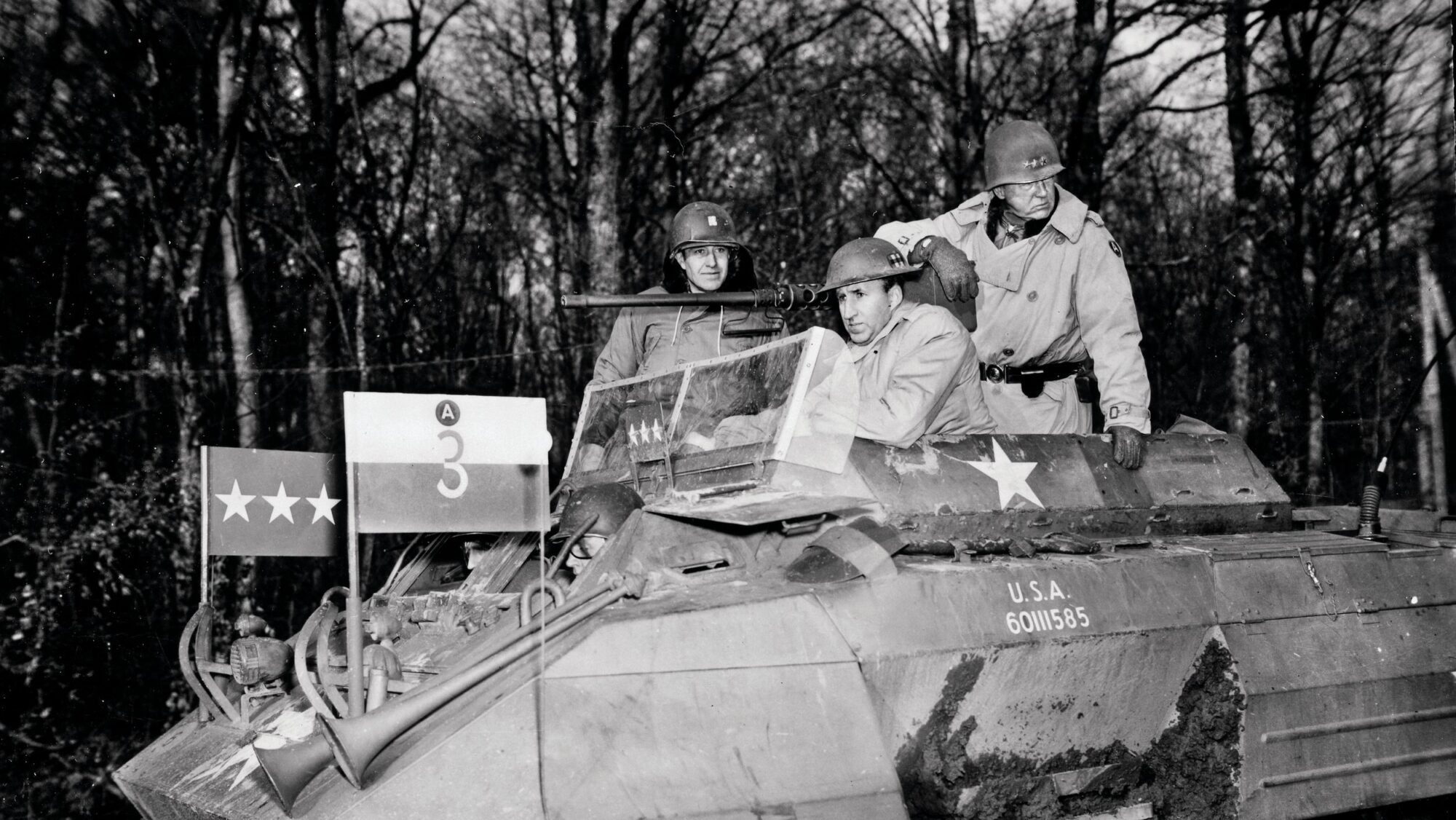
Harriman arrived at Patton’s Nancy headquarters around 10 a.m., accompanied by British Lieutenant Colonel James Gault, Eisenhower’s British aide-de-camp. The three men climbed into a specially modified M20 armored scout car, complete with a windshield, a metal flag adorned with Patton’s three-star rank, and air horns—Patton’s favorite tool for announcing his presence—and headed to the front, passing through empty German defenses.

They visited Major General Jack “P” Wood, the commander of the 4th Armored Division, at Mittersheim, 36 miles south of Sarreguemines, where Patton asked one of Wood’s officers, “how many tanks are you short?” When the officer said 13 medium tanks, Patton snapped back, “we’re not short thirteen medium tanks in the whole United States Army.”
Patton’s chief of staff General Hugh Gaffey quickly explained that the number was including tanks undergoing major overhauls. Wood, who was suffering from a cold, arrived and gave Patton a tour of the facilities as clouds rolled in and the rain poured. Patton also chatted with the troops. When he came across men in a chow line, he asked them about the quality of their food. The men, standing in the open with rain splashing into their mess kits, responded, “fine, sir, fine.”

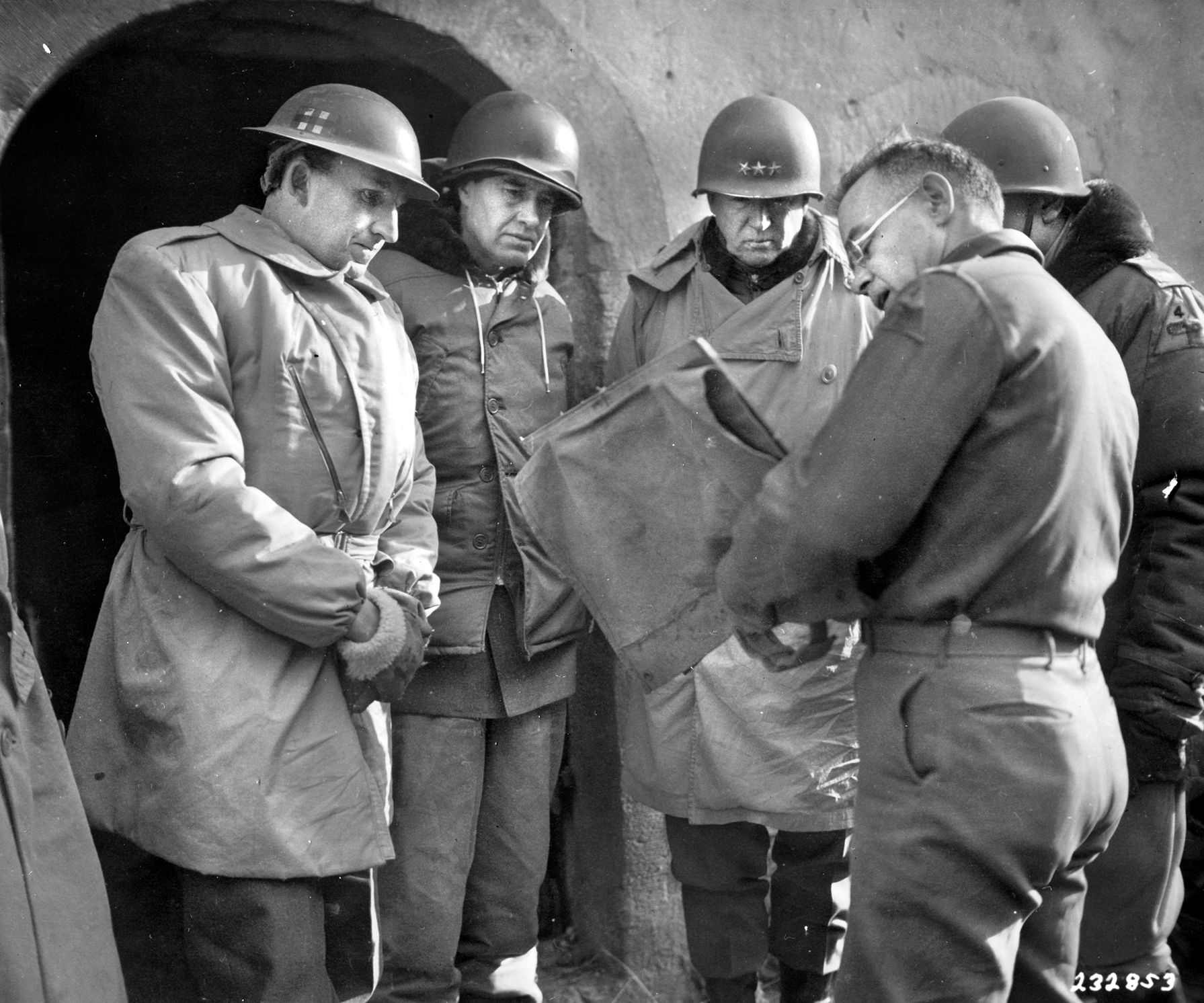
Escorted by Wood, they then took the M20 armored scout car over the Saar River, while Patton pointed out that every field seemed to be a lake. They passed by an enemy tank ditch so poorly prepared that Patton told Harriman it was not worth a damn and, instead, stopped by some artillery firing on the enemy. Then it was off to Maj. Gen. Willard Paul’s 26th Infantry Division, where Harriman witnessed Patton give Paul and his staff “unshirted hell for not driving ahead faster.” Closer to the front, Harriman watched as Patton addressed a group of exhausted soldiers who were waiting to be relieved. “If you can make it to the top of that hill,” Patton told the men as he pointed to a nearby rise, “it will make a hell of a difference to the unit that takes over from you.” He acknowledged the tough fighting they had already done, and admitted it was a lot to ask, but encouraged them to attack nonetheless. The men rose and charged the hill. The scene amazed Harriman, who saw Patton put the fighting spirit back into these men, “knowing exactly when to give them hell and when to encourage them.”
They drove on to a village where Patton presented the Distinguished Service Cross to a lieutenant who had forced a crossing of the Saar. After presenting the medal, Patton turned to the gathered men and told them, “You have all done a great job. A lot of you sons of bitches may have deserved this medal,” but, he assured them, “don’t grouse about the fact that he got it and you didn’t, do the same job again and another one of you will get it.” Then he revealed why the medal was important to him. “It is the greatest honor anybody can get. I’d rather have it than eternal life.”

Patton then turned to Harriman and told him he wanted to get his feet wet. With that he walked down to the Saar and waded into the freezing water. Throughout the day, Patton impressed Harriman by telling almost every soldier they came across that they were doing a great job or telling engineers the importance of their bridge-building operations. He also asked soldiers if they had gotten the blankets he had sent to the front, and if they were getting enough sleep.
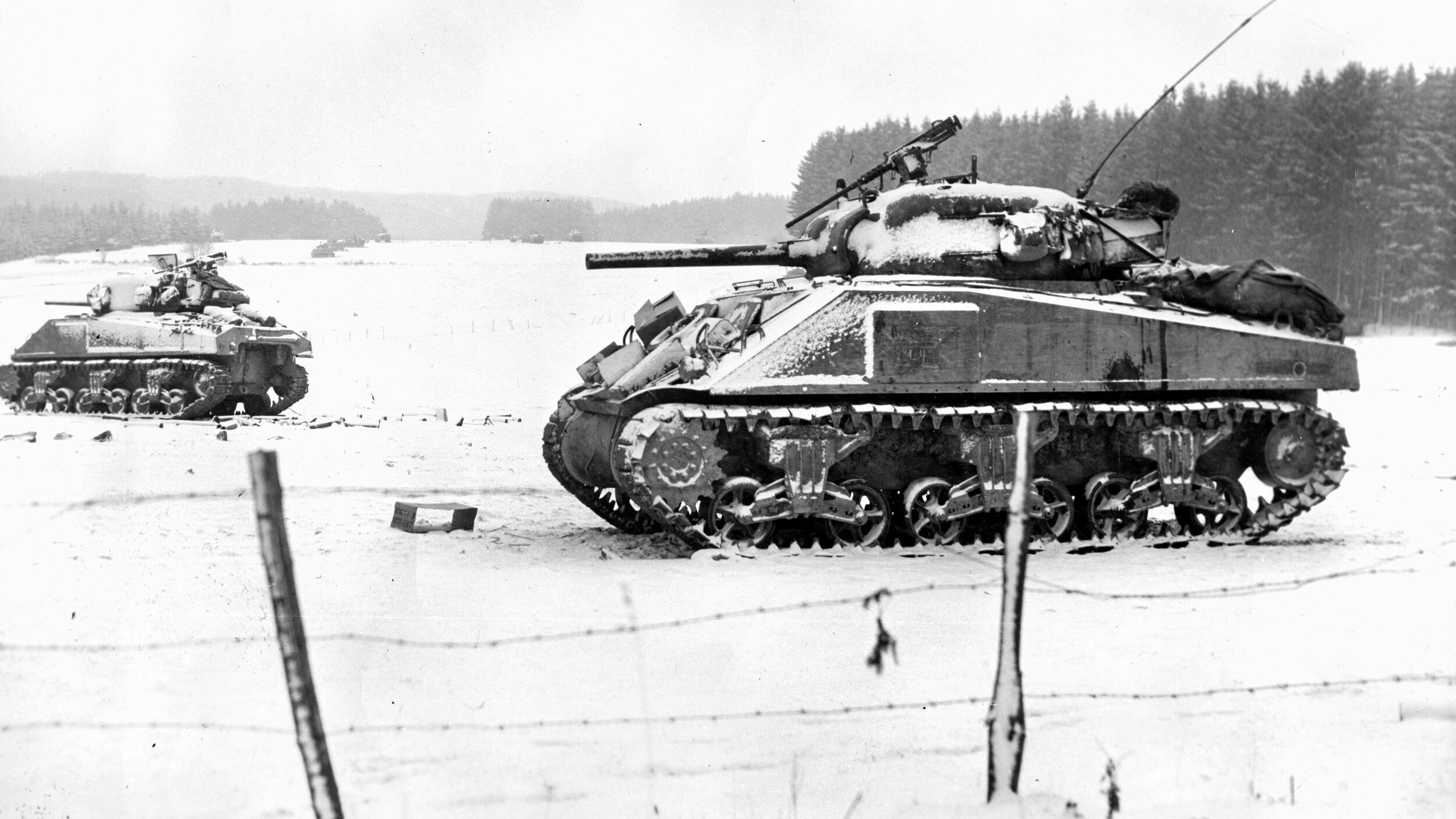
After visiting Paul’s 26th Infantry, they headed back to Patton’s headquarters through Wood’s 4th Armored, coming across a Sherman tank that had knocked out five German Mark IV medium tanks. Fascinated, Patton got out of his vehicle and took several pictures of the tank and the disabled German tanks. Wood was there and asked him to award a Distinguished Service Cross to the tank’s commander, a lieutenant, who was also the tank’s only survivor. Patton was happy to oblige. He then listened as the lieutenant told him how he knocked out two tanks at a range of more than 100 yards, then charged into the middle of three enemy tanks, destroying them at ranges less than 50 yards. “It was a very great piece of fighting,” Patton later wrote. Thanks to Patton, Harriman got an important appreciation of what American soldiers were doing to win the war, something he could later speak of with authority to his Russian counterparts.
Back at his headquarters, Harriman told Patton about his dealings with Stalin, whom he described as a strong and ruthless revolutionary who could threaten the postwar peace. On the positive side, Stalin had praised Patton’s race across France, declaring the Red Army could not have conceived or executed such a maneuver. The comment stayed with Patton the rest of the day and he penned it in his diary that night. “I may get a Red Star yet,” he wrote Beatrice.
The tour was also important to Harriman. Thanks to Patton, he got an important appreciation of what American soldiers were doing to win the war, something he could later speak of with authority to his Russian counterpart.
Frequent contributor Kevin M. Hymel is a contract historian for the U.S. Army. This article is an adaptation from Hymel’s latest book, Patton’s War: An American General’s Combat Leadership, Volume 1: November 1942—July 1944, published by University of Missouri Press. He also leads tours of Patton’s European battlefields for Stephen Ambrose Historical Tours and is the co-host, with John C. McManus, of the podcast “World War II Live.”
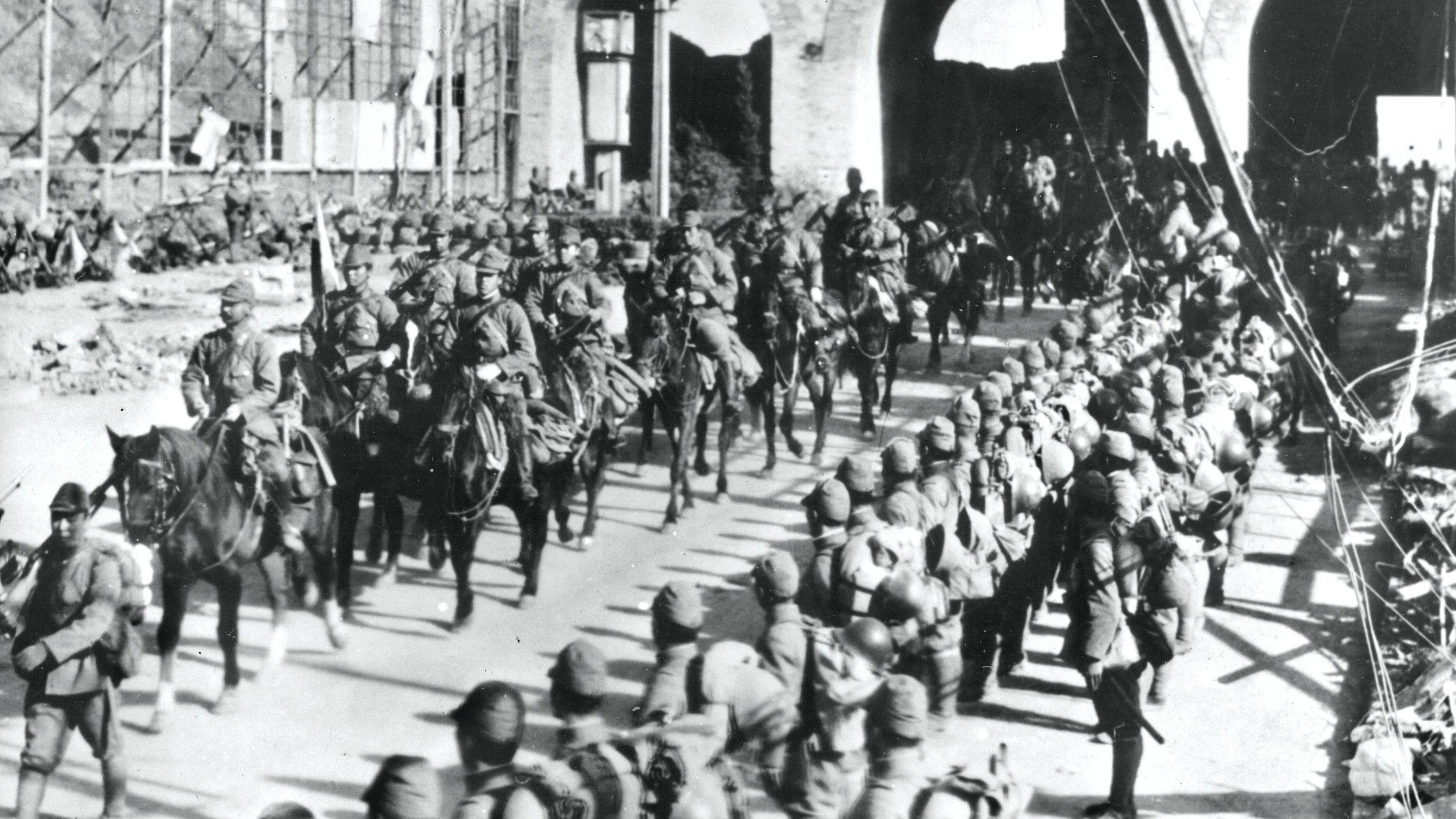
…and at the same time, the US military was in bitter fighting with the Japanese.
Interesting to see Ambassador Harriman wearing a tin hat. Wonder why.