By Johnny Shumate
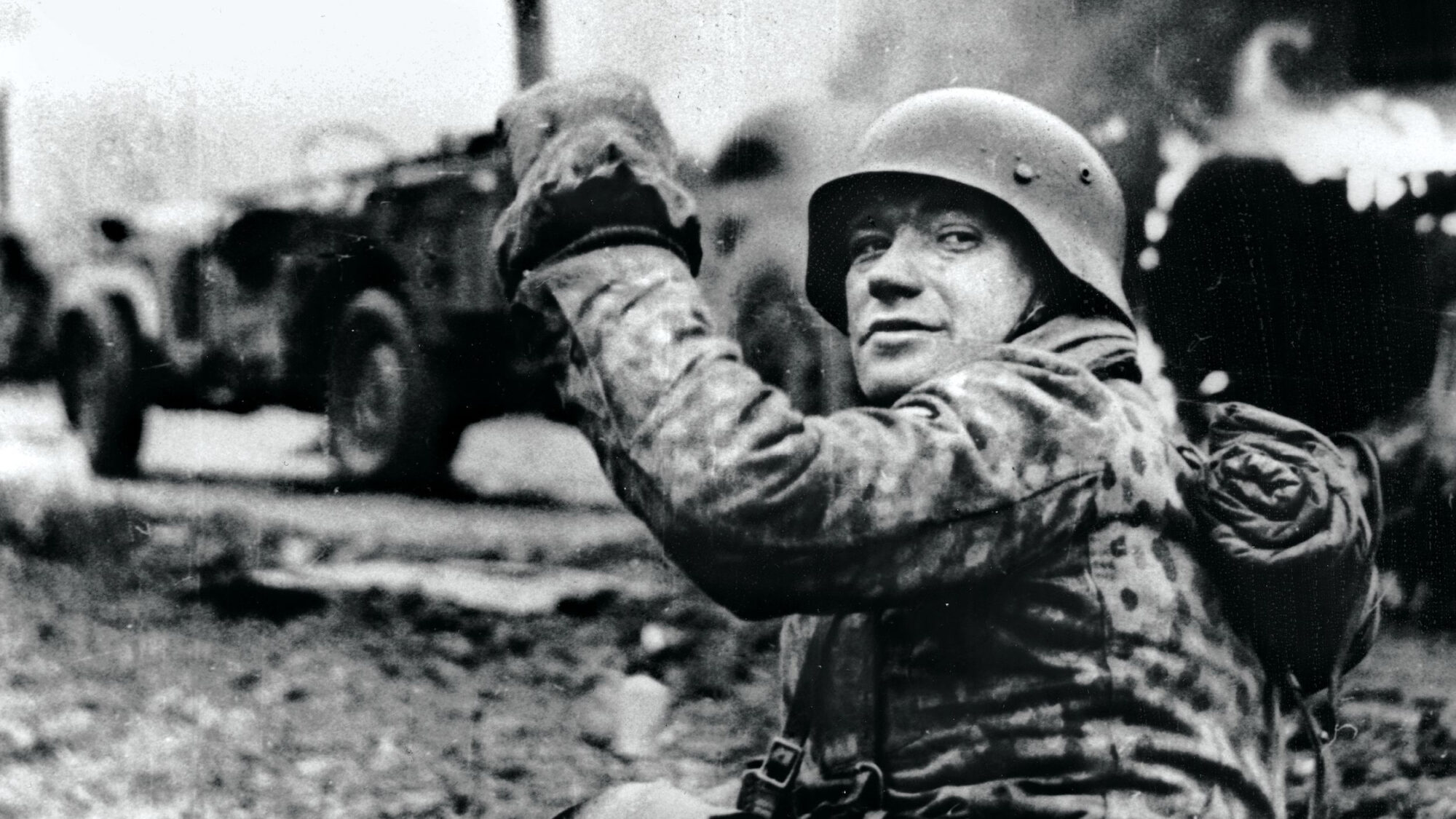
The German unified armed forces were renamed Wehrmacht “defense force” from 1935 to 1945, comprising the Heer (army), Kriegsmarine (navy) and Luftwaffe (air force)—all distinctly separate from the paramilitary Waffen Schutzstaffel “armed-protection squad” of the Nazi Party.
Following World War I, the German army was limited to 100,000 men and officers. However, Germany’s military leadership secretly began taking steps to rebuild its armed forces and by 1939, the Wehrmacht had reached nearly 1.5 million well-trained soldiers, organized into 98 divisions for the invasion of Poland.
The Wehrmacht General staff focused on offensive operations, developing the Blitzkrieg doctrine that initially proved successful. However, by 1943, with much of the Wehrmacht bogged down in Russia, the Blitzkrieg gave way to delaying actions and defense. The Wehrmacht became skilled at creating ad hoc battle groups to respond to emergencies, and to infiltrate enemy lines.
By December 1944, the Wehrmacht in France had retreated to the German border, and the Allies believed they were incapable of offensive operations. Despite even the doubts of the German high command, the initial Blitzkrieg assault through the Ardennes was successful. But with a stiffening Allied defense, the Wehrmacht soldiers of the Volksgrenadier Divisions were soon pushed back into Germany, with inevitable defeat only months away.
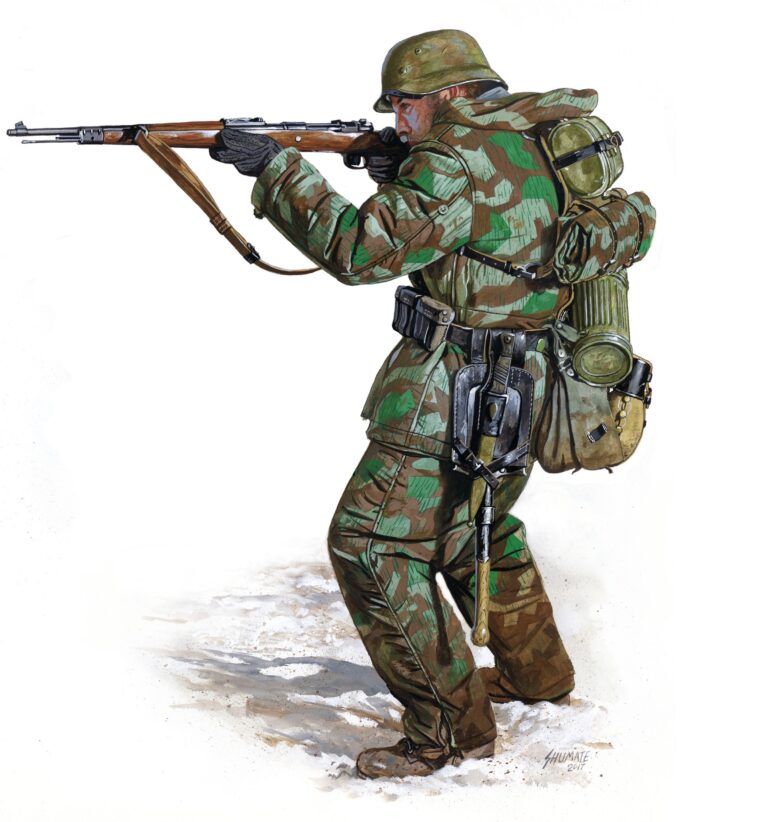 Helmet: Standard Stahlhelm “steel helmet,”simplified in 1942 to expedite production.
Rifle: Karabiner 98k, bolt-action, using the 7.92 x 57mm Mauser cartridge. The K98k was furnished with a cleaning rod, tools and oil.
Uniform: Padded jacket, with hood, and trousers, in Heeres-Splittermuster 31 camouflage pattern. Black mittens.
Gurtbandtragegerüst: A-frame combat assault pack with M31 mess tin, Zeltbahn 31 shelter half/poncho. Below: Gas Mask Canister, M31 haversack (brotbeutel-“breadbag”), Feldflasche 1931 canteen.
Bayonet: S84/98 III bayonet, with a blade length of just under 10 inches. Carried with Kleines Schanzzeug-“small entrenching tool.”
Patronentaschen: Ammunition pouches attached to waistbelt.
Boots: Schnürschuhe ankle boots.

Join The Conversation
Comments
View All Comments