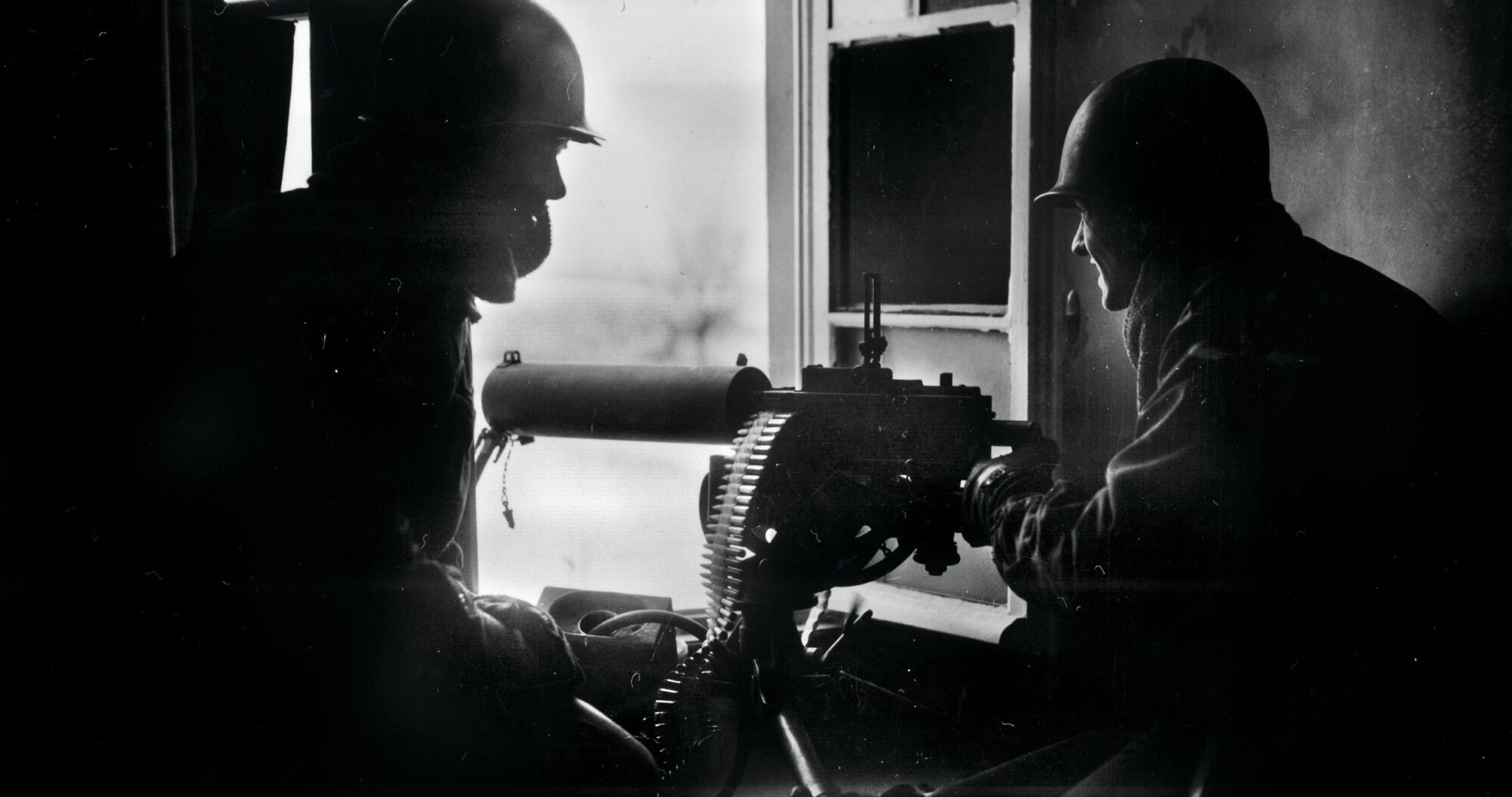
By Leo Barron
A voice crackled over the radio. “Hosingen is falling slowly. They are out of ammo and the tanks cannot hold them. They are hand-grenade fighting from building to building. Hand grenades are all they have.”
The signalman operator scribbled the message in the radio log. It was from Major Harold F. Milton, the battalion commander of 3rd Battalion, 110th Infantry Regiment. The operator looked at his watch and shook his head. It was 6:50 p.m. on December 17, 1944. The last 36 hours had changed everything.
It was the beginning of Hitler’s winter offensive Unternehmen Wacht am Rhein (Operation Watch on the Rhine), now popularly known as the Battle of the Bulge. Facing the two German panzer corps, which numbered more than five divisions, the 28th Infantry Division had only three understrength infantry regiments—the 112th, 109th and 110th. It was a disaster. Within a matter of hours, outposts disappeared as the tidal wave of German armor, artillery, and infantry swept over them. By the morning of December 17, entire companies and battalions started to vanish as the German tsunami roared westward toward the Meuse River. The Germans seemed unstoppable everywhere—except in Hosingen.
At Hosingen, two companies from the 110th Infantry Regiment blunted and delayed an entire German Volksgrenadier regiment for more than 48 hours.
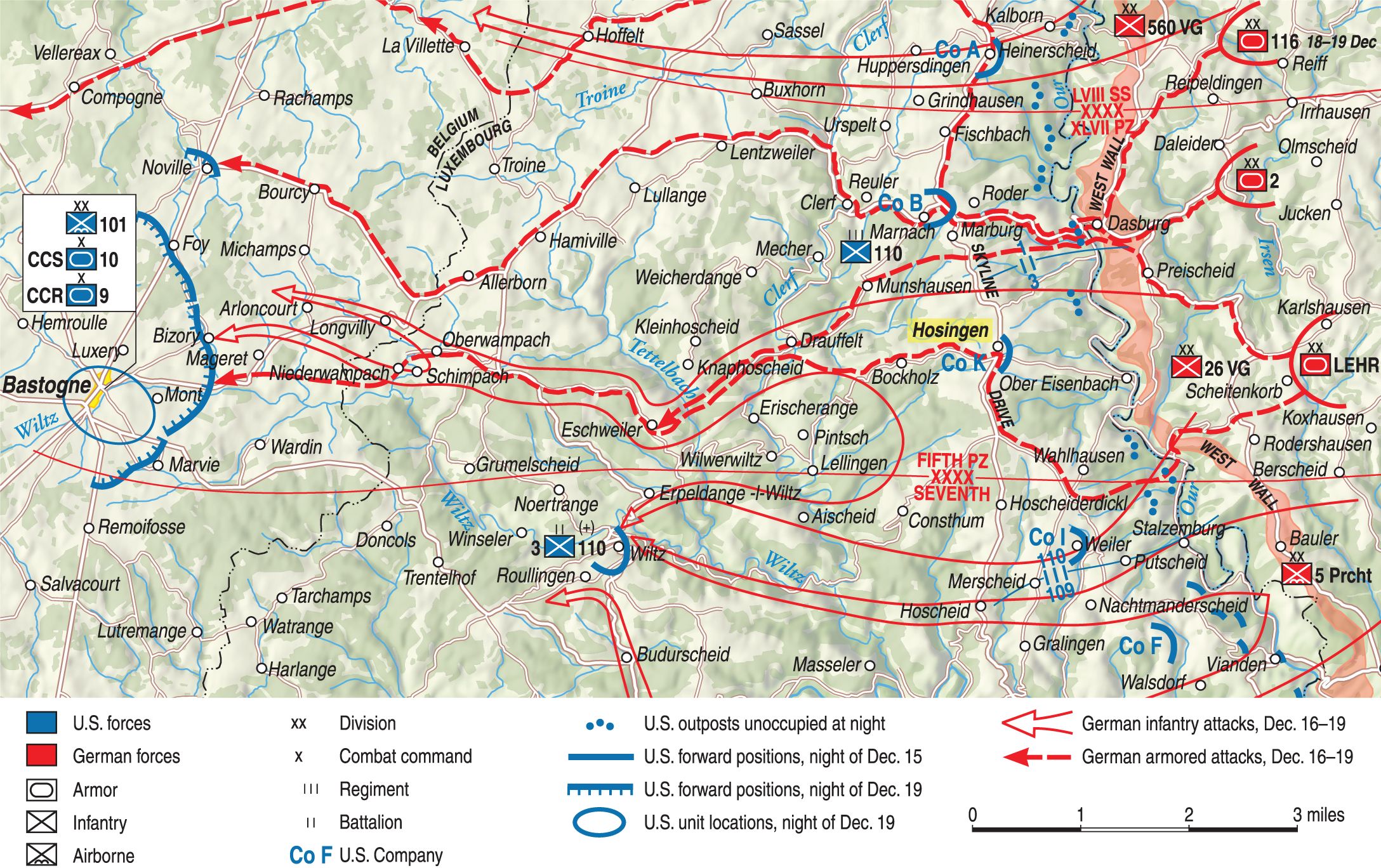
Hosingen was a small, picturesque town that sat astride a north-south artery along the heights of the Our River, which marked the border between Germany and Luxembourg.
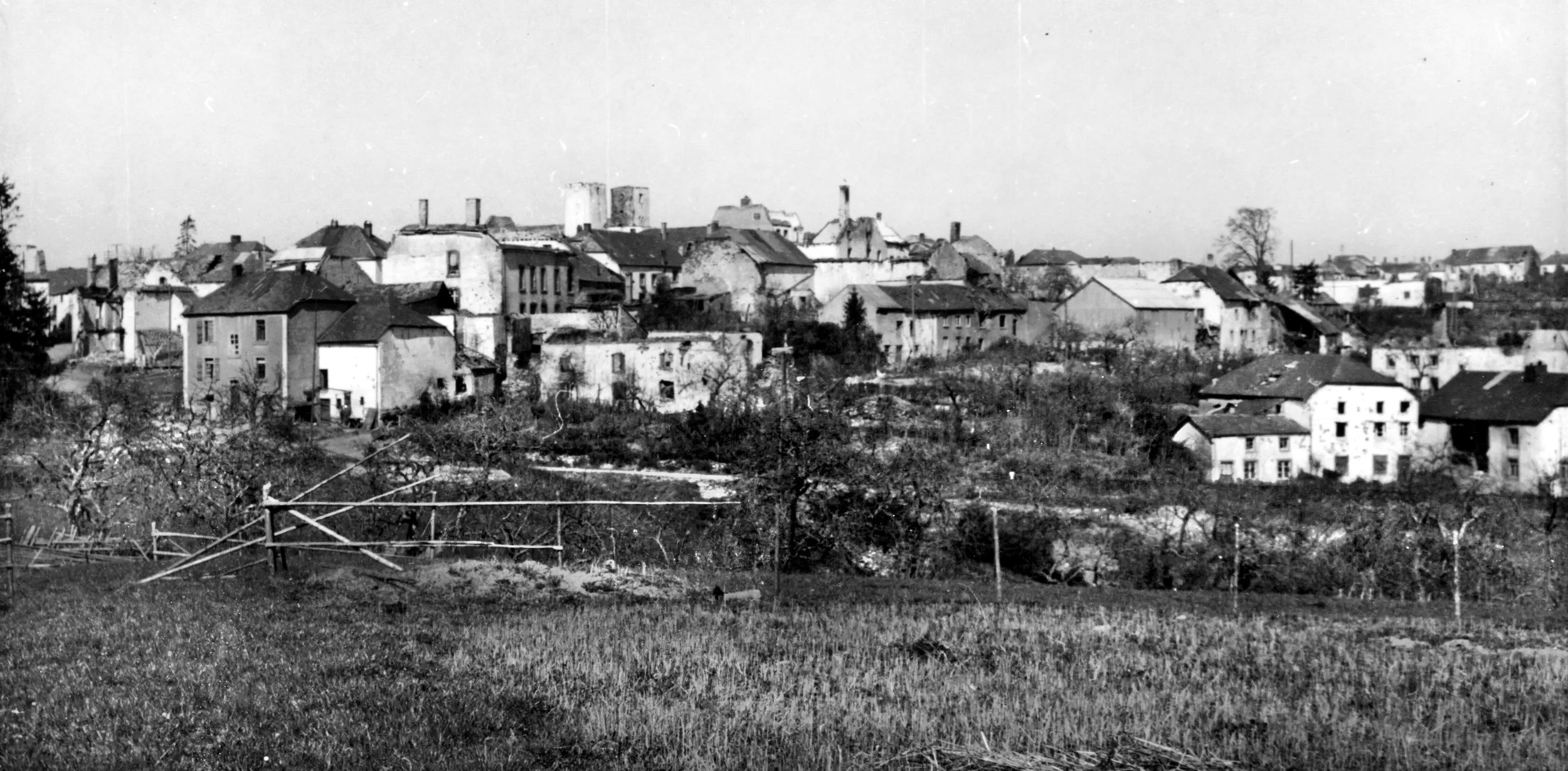
For many of the soldiers, the area reminded them of the Shenandoah Mountains so they called the road Skyline Drive. The most distinguishing feature of Hosingen was its water tower that dominated the skyline. The builders had erected it on the northeast side of town, and from there, an observer could see across the Our River and deep into Germany. Because of this, it provided the 28th Infantry Division a perfect observation post to monitor German activities.
In addition to the tower, on the southern outskirts of Hosingen was an east-west road that started at the Our River and meandered westward to the Clerf River several kilometers away. This east-west road was crucial for any attacker or defender who wanted to control this part of the Ardennes. To control both of these roads then, the attacker needed to control the town.
General Heinrich von Lüttwitz, the commander of the XXXXVII Panzer Corps, had foreseen that Hosingen was key terrain, and in his operation order he placed it along his panzer corps’ main axis of advance. Luttwitz then tasked the 26th Volksgrenadier Division, under the command of Gen. Heinz Kokott, to neutralize the town. He wanted Kokott to push four battalions across the Our River at 5 a.m. on December 16, and then push westward to Drauffelt on the banks of the Clerf River. From there, the Panzer Lehr Division would assume the vanguard and conduct a forward passage of lines so that it could push its panzers to the Meuse River. Meanwhile, if the Panzer Lehr could not capture Bastogne through a coup-demain, then the task would fall to the 26th Volksgrenadier Division. Kokott, though, understood that Bastogne was out of the question if he could not neutralize Hosingen first.
To ensure its neutralization, Kokott developed a plan to isolate the town and then bypass it. This task fell to the 77th Volksgrenadier Regiment under the command of Col. Martin Schriefer. Because of the new task organization, the 77th Regiment now had only two battalions instead of three. A Captain Weber was the commander of 1st Battalion, while Capt. Josef Raab commanded 2nd Battalion. All the senior officers were seasoned veterans who had spent months fighting on the Eastern Front.
Furthermore, right behind the 77th was Reconnaissance Battalion 26 and the Panzer Lehr Reconnaissance Battalion, whose mission was the capture of Bastogne and to assist the 77th if the need arose.
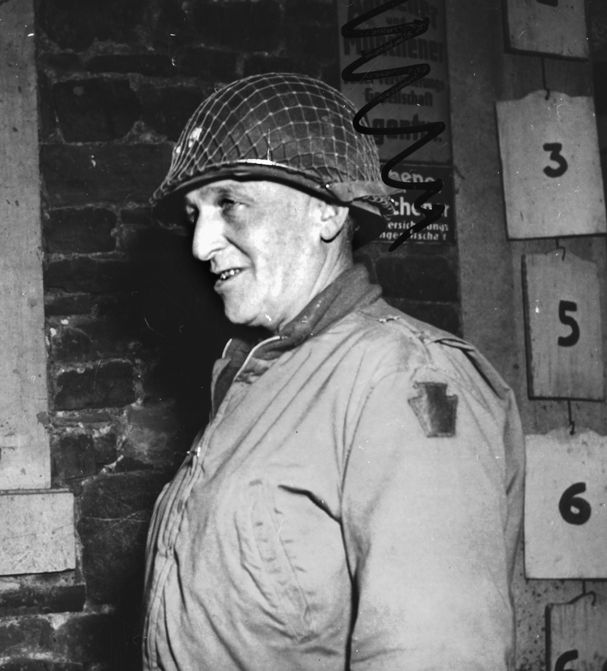
Waiting for the 77th Volksgrenadier Regiment on the west bank of the Our River was the 110th Infantry Regiment. Because of the huge area it had to defend, Col. Hurley E. Fuller, the regimental commander, decided to strongpoint several villages instead of trying to cover down on a front of 10 miles. To add to his woes, his division commander, Gen. Norman Cota, needed a reserve and so he detached Fuller’s 2nd Battalion to act as one, leaving Fuller with only two infantry battalions. This forced him to determine which strongpoint was the most important. Hosingen seemed the likely choice, and so he directed his 3rd Battalion to defend it with several companies: K Company, a section from M Company, one platoon from the Anti-Tank Company, and Capt. William Jarrett’s B Company of the 103rd Division Engineers.
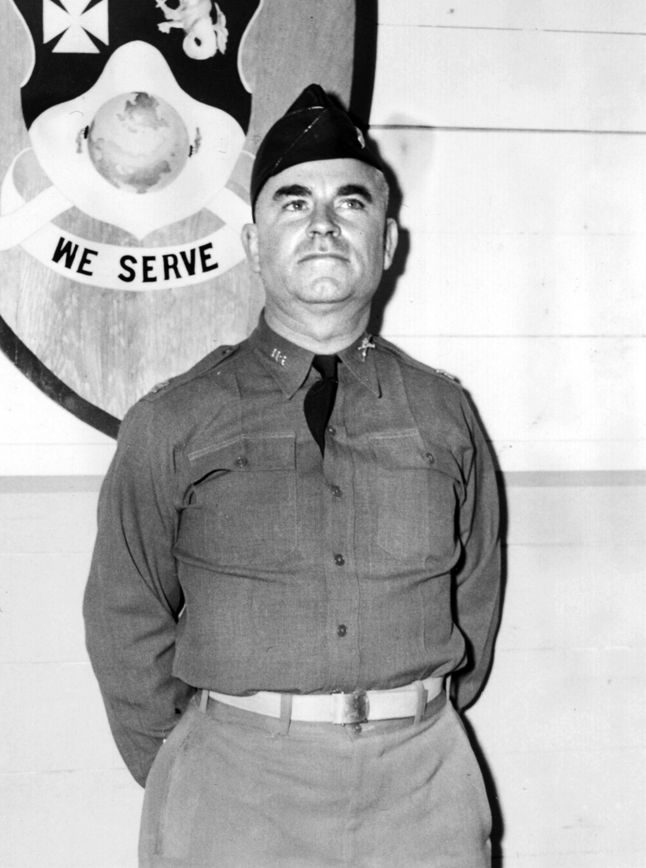
Company K was under the command of Captain Frederick Feiker, and his executive officer was Lt. Thomas J. Flynn. Like the rest of the regiment, K Company’s new sector was far too large for a rifle company to defend. Therefore, Feiker and Flynn decided to concentrate their defenses within the town.
First, Feiker covered the southern approaches with antitank guns since that was the likely avenue of approach for enemy armor. Then, he positioned two of his platoons to cover the northern and eastern sides of the town. In addition to his 1st and 2nd Platoons, he placed his 3rd Platoon to watch south of town. For artillery, Feiker had both his 60mm mortars and an 81mm mortar section from the battalion. Finally, he sited his observation posts on high ground just southeast of the town, one in front of 3rd Platoon, and another one in the water tower. That was all Feiker had to fight an entire German regiment. Company B, 103rd Engineers was also in the town, but not under Feiker’s command—their mission was to maintain the roads, not fight Germans.
During the afternoon of the December 15, the soldiers of K Company began to see abnormal things. Their previous patrols had reported that the German unit opposite them was only capable of patrolling, and though the officers considered an attack possible, no one at battalion cared to discuss it and so the subject remained moot. The patrols, though, claimed a different story. Their observation posts (OPs) reported hearing an increase in vehicle traffic and heavy equipment, but the thick forests hid the suspicious vehicles from view.
At 6 p.m. on the evening of the 15th, the OPs reported hearing more noises. Flynn decided to hear for himself, so he trudged down to the southern observation post. He listened for a bit, but he could not figure out where the sounds were emanating from or what they were. They sounded like motorcycles, but he was not totally convinced. He shrugged his shoulders and marched back to the command post. It was getting dark, and he was cold. Anyway, he figured tomorrow’s morning patrol might find out more information about the odd sounds coming from across the river. Unfortunately, he would not get the chance to send out that patrol.
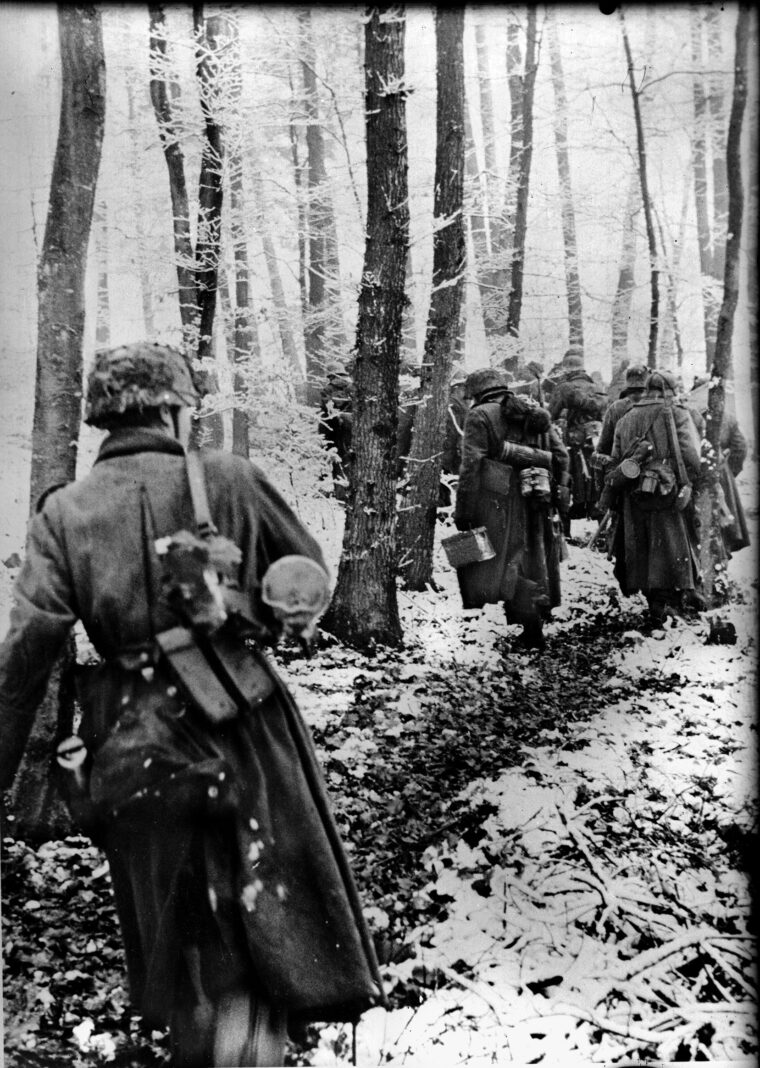
As acting company commander of 6th Company, 2nd Battalion, 77th Volksgrenadier Regiment, Sgt. Ludwig Lindemann adjusted his gear as he prepared to march into battle again, this time against the Americans. Several years of war against the Russians had inured him to combat, but the Americans were a different enemy, and he was fighting on different ground, too. This new terrain was a tangled mess of deep gullies, countless streams, precipitous cliffs, and neverending evergreen trees.

This would be a knife fight.
His company stepped off around midnight on the 15th and started its descent to the Our River. When they reached the river, Lindemann and his Volksgrenadiers crossed a temporary bridge which the pioneers had built out of rafts and planks. When they all had reached the western bank, Lindemann then led the men up the steep hill toward Hosingen. After several hours, the Volksgrenadiers reached a road just east of town. There, the company halted and laid down in the wet and chilly brush. In front of them was a treeless valley and Hosingen itself. He looked down at his watch. It was 3 a.m. They had two more hours before the reckoning.
It was almost 5:30 a.m. on December 16 and nothing had happened for several hours around Hosingen. As the K Company observer atop the water tower rubbed his hands together and cupped them over his mouth to try to warm them, he caught a glint out of the corner of his eye. Turning, he noticed more and more lights flickering along the ridgeline that marked the border of Germany. They looked like hundreds of camera flashes going off during a boxing match. He quickly picked up his field telephone and started his report.
“This is the OP in the water tower and I can see a hundred pinpoints of light coming from Germany—.”
He was cut off by the roar of a hundred steam locomotives, and then the entire world exploded as hundreds of shells rained down on the town, severing all wire communication. The dark, early morning sky became day several hours early as 300 pieces of artillery and mortars blanketed the Allied lines with a deadly rain of steel.
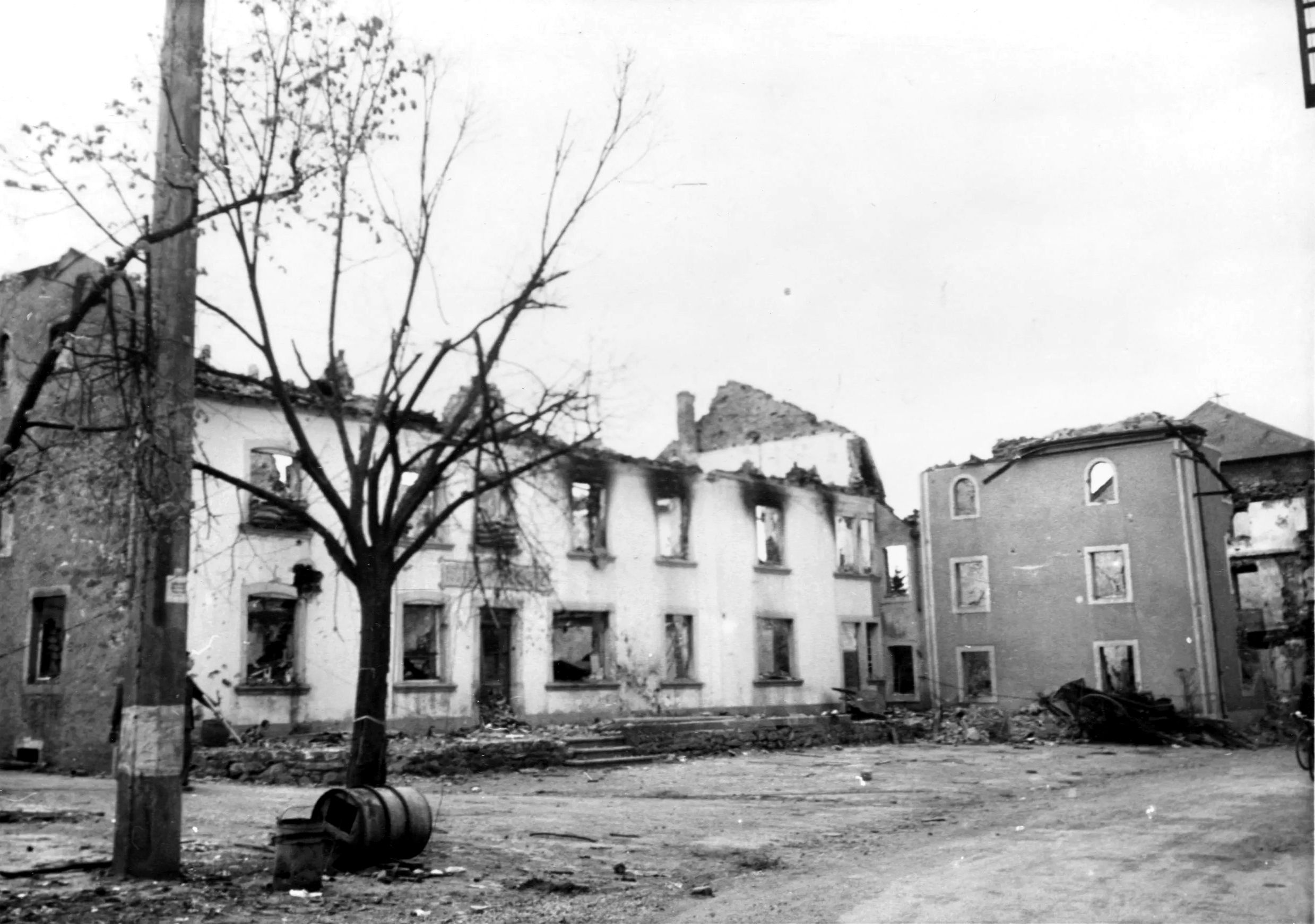
Inside Hosingen, it felt like God had unleashed death and destruction on Sodom and Gomorrah. Fire shot down from the heavens, and within seconds several buildings went up in flames. In response, Captain Feiker tried to raise his battalion on the phone, but the shelling had already cut the line. Luckily, the SCR 300 radios still worked, and he alerted Milton, his battalion commander, that all hell had broken loose in Hosingen.
Meanwhile, Flynn decided his best place to assist in the control of the company was in a foxhole on the north end of town. He dodged through the explosions toward a position that was behind the light machine gun section that watched Skyline Drive from the north. From there, he reasoned he could place suppressive fire on a likely avenue approach for the enemy.
A kilometer south of Hosingen, a rifle squad from 3rd Platoon, K Company, was trying to stay warm while on OP duty. Their observation post was a rustic farmhouse, which was practically a concrete bunker with 18-inch thick concrete walls. That morning, all the men were lounging around upstairs in one of the three small rooms. The squad’s medic, Pvt. James F. Sansom, recalled after the war that Sgt. John Reardon, the squad leader, was giving his morning report over the field telephone when the barrage came crashing down around them. All of them instinctively ducked. Several blasts rocked the farmhouse and the line went dead. Mortar rounds were detonating around them like giant kernels of popcorn.
One soldier peered through a window and could see what looked like muzzle flashes from the wood line 1,000 yards away. Before he could get a second look, a German machine gun opened up, peppering the walls like hailstones.
The soldier dove behind the wall as the windows exploded, showering him with glass shards. No one in that room thought that the attack on this lone farmhouse was part of a much larger offensive.
For Lindemann, the artillery bombardment also was terrifying. Most of the Volksgrenadiers were lying prone when the howitzers and mortars roared. He listened as the rounds whistled over his head, and then he watched the hillside in front of him erupt. Geysers of dirt and branches shot up into the air as each shell exploded. Meanwhile, the ground shuddered and shook. Suddenly, one shell burst near them, instantly killing one man and wounding several others. It was war, and the barrage needed to be that close to be effective. It was unfortunate, but the hellish barrage continued. Between the blasts, Lindemann kept looking at his watch.
Finally, after 30 minutes the hurricane ceased swirling—at that exact moment, the Luftwaffe antiaircraft gun crews switched on their searchlights, and the heavens came alive as beams bounced off the clouds and bathed the area in light. That was the signal, Lindemann recalled. He stood up and then waved his hand forward. The forest floor sprung to life as the rest of the company emerged from the ground. Their task was securing the avenue of approach to Bockholz while bypassing Hosingen to the north. Even though it was still dark, Lindemann could make out the first houses of Hosingen to his right, and he continued to push his men forward through a meadow.
After 45 minutes, the barrage finally petered out. Captain Jarrett instinctively took stock of his losses while he tried to reestablish security around his perimeter. The initial news was mixed. Seven of his trucks were out of commission as result of the shrapnel puncturing all of the tires. Conversely, his company had not suffered any casualties. Thinking this was a prelude to an attack, he quickly reestablished communications via an SCR 300 radio and runners with K Company. Next, he ordered his engineers to mine the north-south approaches into town. After his men finished their tasks, they all settled into the foxholes and waited.
It was now 7:05 a.m. Sensing a lull, Jarrett decided to get a better look at his lines from his company OP, which he had set up in Hosingen’s church tower. He clambered up the stairs and looked toward the wood line. As he peered to the south, he saw shapes inching towards the southern edge of the town and Skyline Drive.
They were German grenadiers.
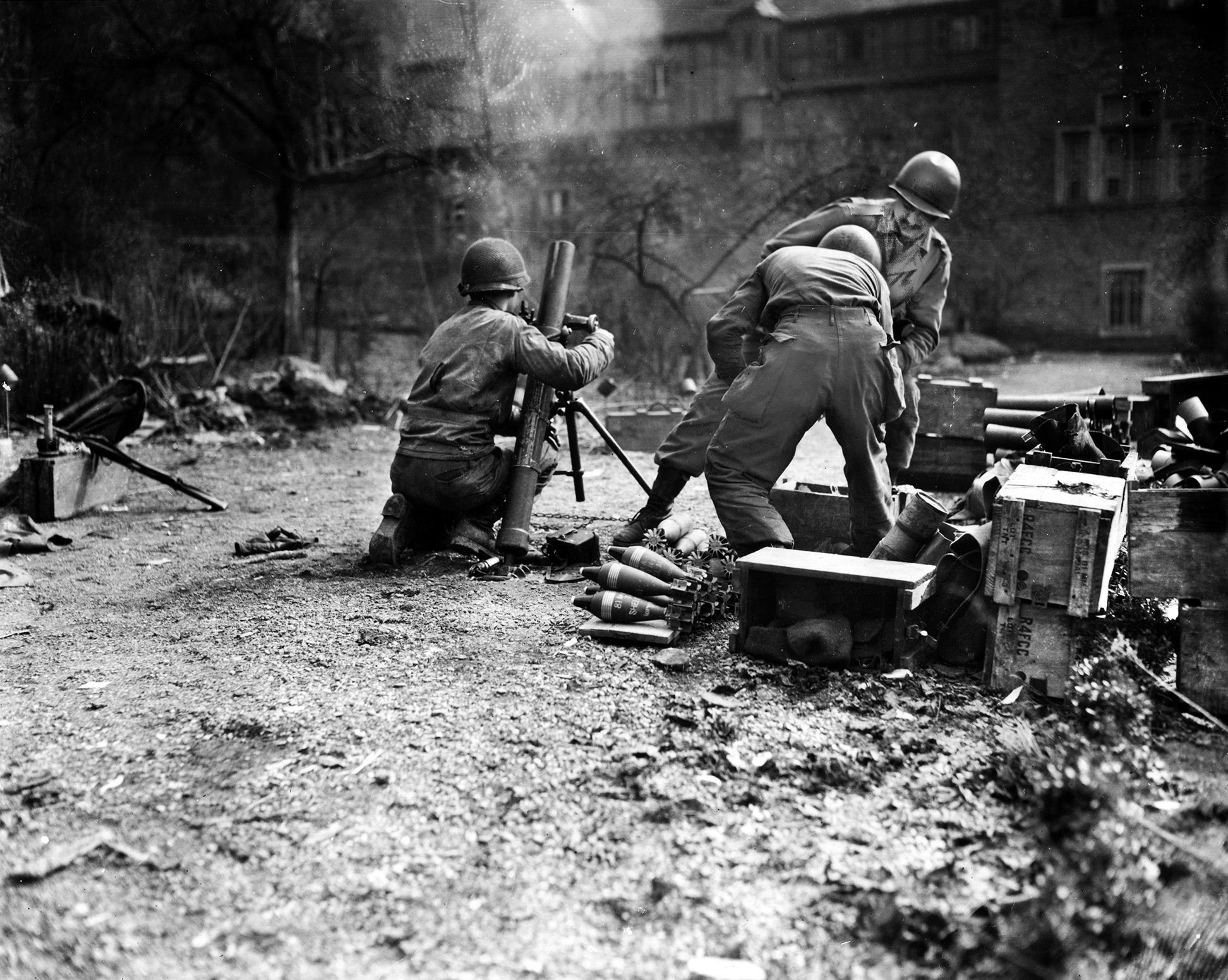
He immediately called over to Lieutenant Morse, the platoon leader for the 81mm mortars, and requested a fire mission to target the columns. Soon, Jarrett could hear the thumping sound of mortar rounds swishing out of their tubes. The rounds wreaked havoc on the column.
Like a leaderless mob, the grenadiers scattered in every direction. Then, another K Company squad position that was in a farmhouse southeast of the town center joined in the melee. It was a slaughter, and it initially stunned the German advance in this sector.
Jarrett was not the only one who had a placed a bull’s eye on a German column.
Between 6:15 and 7:15, K Company OPs reported hearing infantry coming up from the draw to the east. Around 7:30, the north side of town exploded as Company K’s light machine guns opened up on another force that had emerged from the draw. Flynn then directed one of his 60mm mortars to drop more rounds on the unsuspecting column.
For the Volksgrenadiers, it was a rude awakening that the Americans were still there.
Without warning, .30-caliber machine gun rounds ripped into the lines of troops. Like their comrades to the south, this group scrambled in a desperate search for cover while machine gun tracers lanced through their column. The ditches provided little safety from the mortar storm that burst around them.
Farther south, the Germans had better luck.
After the bombardment ended, Lindemann pushed forward through the fields south of Hosingen. Unlike his brethren just outside of town, Lindemann faced little resistance. He could hear the machine-gun fire off to his right, but to his front it was silent. When they reached a group of buildings, a few American soldiers appeared, wearing only their undergarments.
Instead of fighting, they retreated through a garden and then faded into the darkness. Lindemann smiled. They had secured their first objective with few casualties. Holding his hand up, he halted his company and then directed them to form a perimeter for security. After a few hours of waiting, Lindemann received some welcome news from his headquarters.
The 2nd Battalion had succeeded in its mission of isolating Hosingen from the south, and unbeknownst to Lindemann his company had severed the lines between K Company and its 3rd platoon. Now, Lindemann’s orders required him to push his company onto the next objective—the forest between Hosingen and the town of Bockholz, further west.
Battalion wanted his 6th company to clear the forest of American forces. Reading the order, Lindemann nodded his head and shot a glance at the woods to the west. With a wave of his hand, he ordered his company to move out. As they were marching away from the road, Lindemann glanced back at Hosingen. For his company, the battle for Hosingen was over, but for his division the battle had only begun.
Meanwhile, at the 26th Volksgrenadier Division headquarters in Herbstmühle, General Kokott flipped through the latest reports. The news so far was good. The assault detachments of the 77th had advanced west of Hosingen, and his artillery had pinned the defenders of Hosingen inside the town, allowing his units to bypass it to the south. The reports of the desultory flanking fire coming from Hosingen did not trouble him, though it should have.
For Feiker back in Hosingen, the situation was beginning to calm down, but it was far from ideal. After the initial attack, Feiker and Flynn realized they had lost all contact with their 3rd platoon, the OP on Steinmauer Hill, and the company’s attached anti-tank sections.
In short, a third of their infantry and nearly all their anti-tank capability were gone. Luckily, thanks to his battalion commander, Feiker still had Captain Jarrett’s entire engineer company.
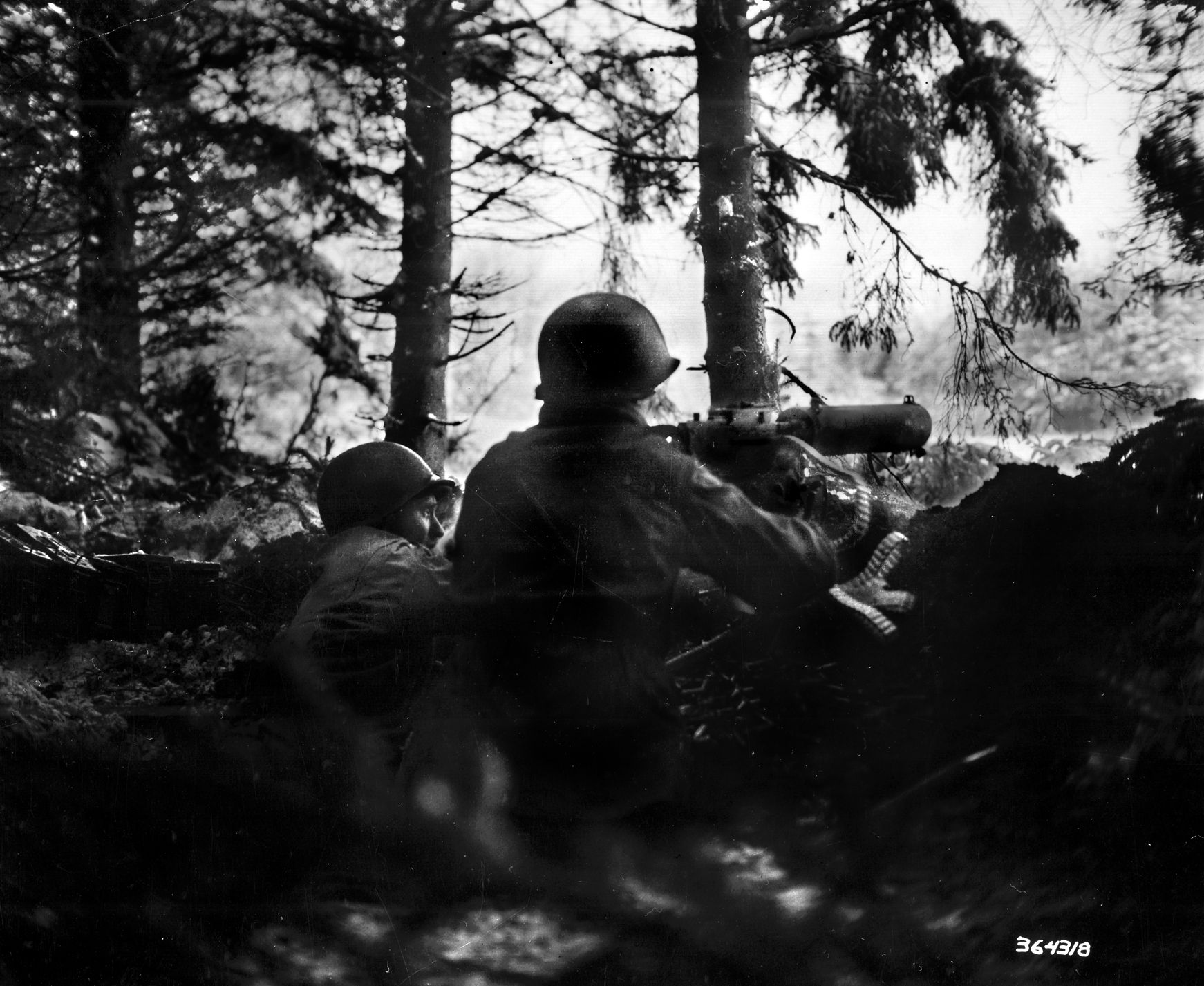
Jarrett and Feiker next decided the best place for B/103rd Engineers was on the west side of town and in direct support of other K Company positions to the south and north. Feiker watched with a smile as the engineers dismounted their lethal Browning M2 .50-caliber machine guns. Each of Jarrett’s platoons had one of them. The M2 was a belt-fed killing machine that could outshoot most direct fire weapons and could punch through light armor. With them, Jarrett and Feiker had turned Hosingen into a fortress.
Unfortunately, the Germans initially chose to bypass it from the south. Feiker watched as the German columns continued to plod their way westward from the Our River to Bockholz. To disrupt this, Feiker decided that a fire mission of 105mm howitzer rounds might upset the German timetable. He then placed a call on the radio to Milton, and he requested a fire mission. Milton, though, had only bad news for Feiker. Lindemann and his company had pushed ahead into Bockholz where C Battery of the 109th Field Artillery had set up its howitzers.
Thus, instead of providing on-call indirect fire missions, the artillerymen of C Battery were desperately trying to defend their own positions. By 8:40 a.m. they reported that they were: “being overrun and need help immediately.” Therefore, Milton told Feiker that he could not provide any howitzer support. Meanwhile, German troops continued to march westward past Hosingen unmolested.
As the morning dragged on, the soldiers of K Company and the engineers of B Company waited. Their order from Milton was to hold the town of Hosingen and expect reinforcements.
At 10:30, Feiker, sensing that the battle could be a long one, requested more ammunition. Milton told him he would receive an ammunition push the following morning. It would never reach Feiker.
Private Sansom and the others south of Hosingen did not know how bad their situation was. With the Germans in Bockholz, 3rd platoon was now several kilometers behind enemy lines, and with each passing hour those lines were moving farther away. Around 1 p.m., the Germans drew first blood. Shots rang out, and then Sansom heard the awful cry for a medic.
Sansom ran into the barn and bounded up the stairs to the loft. Joe Glick, the BAR gunner, was lying on the floor. Sansom quickly knelt down next to Joe. Searching with his fingers, he could feel the exit wound above Glick’s right ear, and he could see that Glick had lost consciousness. Immediately, he injected a shot of morphine to numb the pain, and next he bandaged the wound to staunch the bleeding. He then checked Glick’s pulse, and it was weak. In response, he started CPR. After nearly 30 minutes, he surrendered. Glick was dead.
Another soldier then picked up the BAR and took up his position on the perimeter since the Germans outside would not allow them to mourn the loss of their friend.
By now, Kokott’s morning enthusiasm was beginning to fade as the day dragged on into afternoon. Around noon he received reports that the 77th Volksgrenadier Regiment’s forward momentum was sputtering to a halt just east of Bockholz. Meanwhile, enemy resistance in Hosingen was increasing, and as a result the pesky Americans had blocked his main supply route from Hosingen to Bockholz with mortar and anti-tank fire.
Kokott knew he did not have the forces on hand to take Hosingen. Therefore, he would have to call on soldiers from a replacement training battalion to attack the town. Then, he got another piece of discouraging news—they would not be ready until 3 p.m. at the earliest. In addition, his reserve regiment, the 78th Volksgrenadier, would not arrive in the battle area until later that night. In short, Hosingen would remain in American hands until at least the evening of the 16th.
In Hosingen, the situation had stabilized, but it was an uneasy stalemate. Colonel Fuller decided that tanks might swing the balance back in his favor. The 707th Tank Battalion was the armored reserve for the 28th Infantry Division, and Col. Richard W. Ripple, the 707th’s commander, had developed and rehearsed a plan to rush his tanks into predesignated sectors to counter any potential German attack. On the 16th, he put that plan into action.
Lieutenant Robert A. Payne was part of that plan. Payne was the platoon leader for 3rd Platoon, A Company, of the 707th Tank Battalion. At 3 p.m., his commander ordered him to advance south down Skyline Drive to Hosingen and provide armored support to the troops trapped there. At 3:15, Payne’s platoon of five M4 Sherman tanks started to rumble down the road toward K Company, and they all arrived safely at Hosingen around 4 p.m. after running a gauntlet of machine-gun and small arms fire.
Payne and Feiker then quickly dispatched the tanks to positions around the town. Payne sent three of the Shermans to a piece of high ground southeast of town to cover the east-west road.
In addition, Payne sent another tank to the north side of town to provide 1st Platoon, K Company some firepower. The tank then rolled into a defilade position and aimed its 75mm gun northward down Skyline Drive. Finally, Payne drove his own tank into town to guard the southern approaches of Skyline Drive.
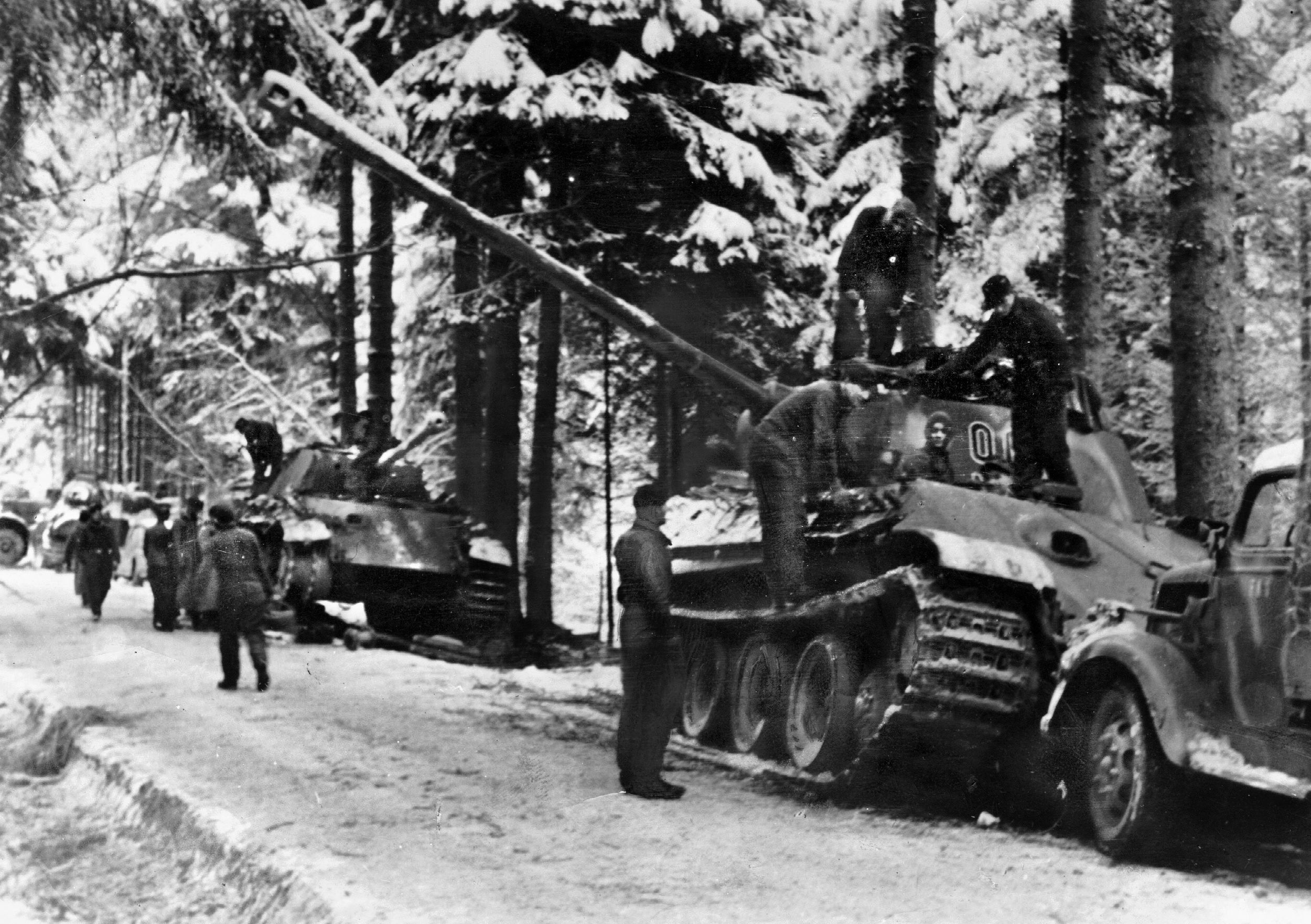
Meanwhile, to the south, Private Sansom watched the sunset. Around 4 p.m., his squad had wounded and captured two Germans who had passed too close to the barn and farmhouse. While Sansom bandaged and guarded the prisoners, he heard the unmistakable sound of clinking and clanking coming from outside the house. He stood up and then went over to the window. Outside, a German tank had rolled into the yard. The tank came from the Panzer Lehr Reconnaissance Battalion. Because of the dogged resistance of the Americans, Kokott had committed the Panzer Lehr Reconnaissance Battalion to clear out the defenders of Holzthum and Consthum west of Sansom’s farmhouse.
This kampfgruppe (battle group) was under the command of Maj. Gerd von Fallois. Now, one of the tanks from Kampfgruppe von Fallois had halted next to the farmhouse on its way to Holzthum. One of the panzer crewmen then shouted something in German at the house.
One of the prisoners hollered back at the crewman in response. Sansom, deciding that it was no longer a good place to hide, scampered downstairs. Before he reached the bottom, a terrific explosion hurtled him into the air before he came crashing down on the floor. Shaking his head, he struggled to his feet.
As he slowly regained his wits, he glanced out the window and watched the tank belch smoke like a dragon. Then, it lurched back and drove away, leaving him unharmed. He decided to abandon the prisoners. When he thought the coast was clear, he sprinted back toward the barn to tell his squad leader, Sergeant Reardon, what had just happened. Some of these tanks would end up in the fight to capture Hosingen.
For the antitank gunners and heavy machine gunners from M Company, the sudden German attack had left them stranded in the southern part of Hosingen. They no longer had contact with the rest of K Company, or for that matter with anybody else. All day long, the battle for the southern edge of Hosingen raged, but the Germans could not breach the defenses. The antitank guns took a fearful toll on German vehicles trying to race down the road. Fortunately, American casualties had been light with only one man sustaining a leg wound.
For Sergeant John Forsell, the situation looked grim as dusk rapidly turned to night. The men could not stay and fight since they were low on ammunition. Together with the platoon leader from M Company, the NCOs decided the best course of action was to sneak through German lines and head west to the battalion headquarters. They probably figured that the rest of K Company was facing the same dire conditions and would do the same thing. Therefore, Forsell and the rest of the NCOs collected the men and conducted a final headcount.
Forsell recalled the incident after the war. “I gave a lieutenant an azimuth by which to lead the men back to headquarters and after a final check, I would bring up the rear with anyone that was left behind.” With that, the platoon leader moved the column out. Forsell then bounded from house to house, ensuring no one was left. At one house, he heard some noise coming from the cellar.
When he wandered down the old stone stairs, he found two soldiers, huddled in a corner and shaking from fear. Forsell grabbed them and hurried them outside like a bouncer kicking out unruly customers. When they stepped onto the street, Forsell saw a house that had its lights on.
“I want you stand by the door and pull security,” Forsell ordered the two soldiers.
Forsell then pulled out his Colt Model 1911 pistol. With a deep breath, he pushed open the front door. Inside, he stumbled on two German soldiers, a man, his wife, and a priest eating dinner around a table. Forsell leveled his pistol, but before he could fire, the priest jumped up, waving his arms. Blocking Forsell’s line of sight, the priest pleaded to Forsell not to shoot the startled German soldiers.
Not wanting to shoot a man of the cloth, the merciful sergeant stepped back with his weapon drawn, and then instructed the priest. “Tell the German soldiers not to make any moves because I have two other soldiers waiting for me outside. Tell them to wait 15 minutes before they even move.” The priest nodded his head and then conveyed the sergeant’s warning to the soldiers who were sitting, frozen in their seats.
One of the GIs ran inside the house, sputtering, “Sergeant, someone’s coming down the street.” Forsell took one last glance at the Germans.
Then, he turned and stepped outside onto the road. Grabbing the two soldiers, they darted west to a nearby field. Using the haystacks in the meadow as concealment, the men scurried to each one until they were beyond the German lines. After several hours, they arrived at their battalion headquarters. They were the last of only a handful of men who escaped from the Hosingen encirclement.
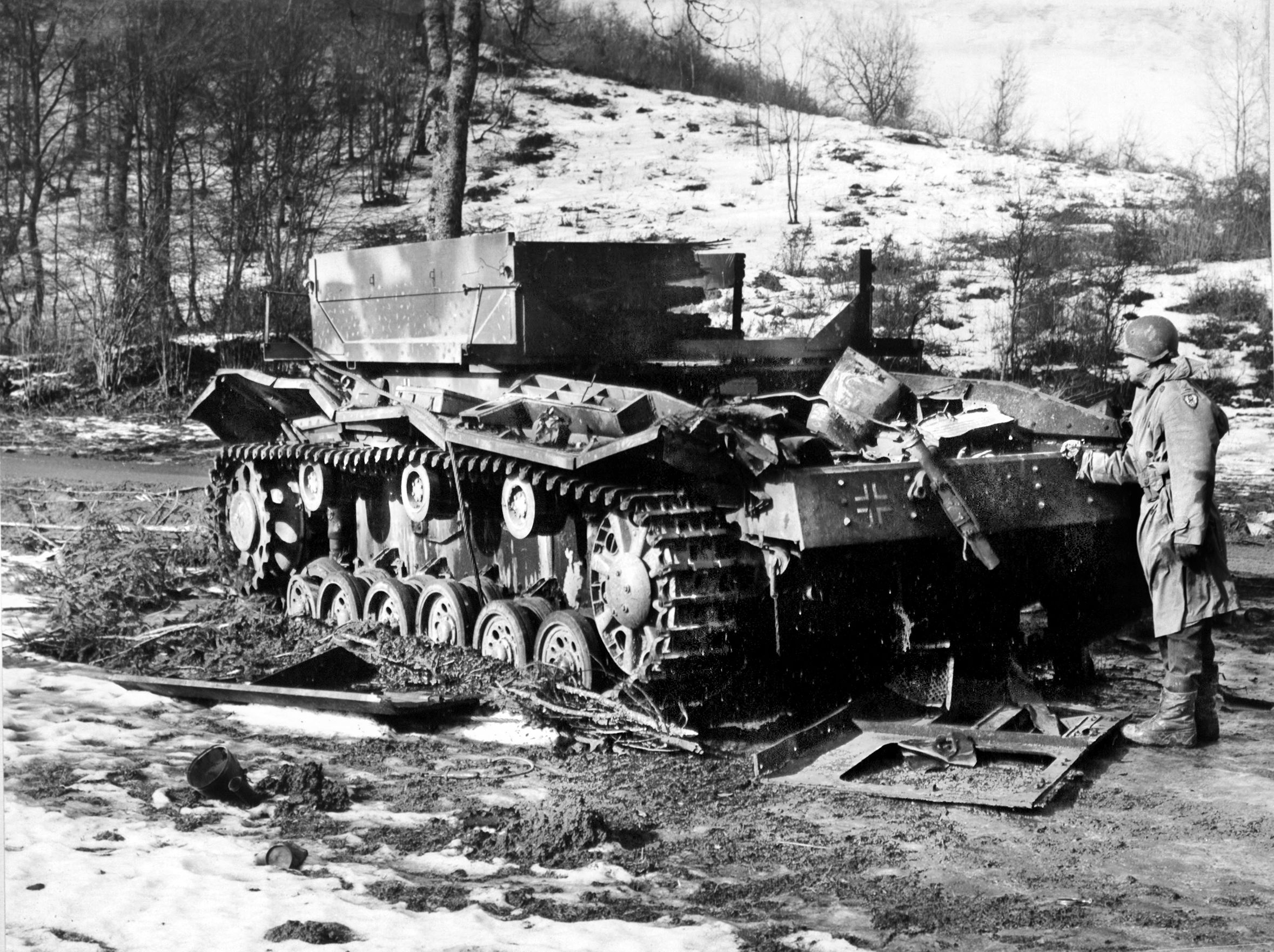
Back in Hosingen, Payne’s tanks were already getting into trouble. Around 5 p.m., two German tanks appeared on the road from Eisenbach. Immediately, the three Shermans on the southeast side of Hosingen opened up with their 75mm guns. Within minutes, the tank commanders realized their position was indefensible, and they requested permission to fall back into the town. Payne approved their request, and the Shermans rolled back into Hosingen. In addition to the tanks, Feiker pulled back the infantry that was with them, allowing German vehicle traffic to resumed along the road.
Around 10 p.m., Feiker contacted Milton to remind him of his supply situation. He informed his commander that Payne’s tanks did not bring more ammunition. Milton reassured him that he would try to get more supplies to Feiker and his company. Unfortunately, the Germans had other ideas.
That night the Germans harassed the defenders of Hosingen, and the Americans returned the favor. On several occasions, German grenadiers would try to run the gauntlet and dash across Skyline Drive south of Hosingen. Feiker’s riflemen, though, saw them and would make the crossing a risky affair. Using their .50-caliber machine guns and rifles, the American soldiers would sit cross-legged in the street and pick them off like ducks at a shooting gallery.
Meanwhile, the Germans peppered the town with desultory small arms fire to remind the Americans they were still there. Furthermore, K Company observers could see that German scouts were edging closer to the town as the night dragged on.
On the morning of the 17th, the 77th Volksgrenadier Regiment settled on harassment attacks to keep the pressure on the Hosingen defenders. In the early morning hours, the grenadiers set up several fighting positions southeast of Hosingen, and from there they engaged targets in the town with small arms fire. These attacks were more of a nuisance than a threat, and after sunrise 2nd Platoon, K Company had a clear line of sight to the German positions. Within minutes, machine guns, BARs, and Garands blasted away at the luckless grenadiers who were now out in the open. The Germans yielded and fell back towards the wood line.
As the morning passed, soldiers in 1st Platoon, K Company began to detect sounds echoing north of town. The gurgling and humming of diesel engines and the clanking of tank treads alerted the defenders that it was only a matter of time before the Germans tried again. The men of 1st Platoon sensed the Germans would bring tanks next.
At 8:30 a.m., reports that German tanks were moving began to filter into Milton’s battalion command post. The report claimed that the Germans had concealed a column of 20 tanks just east of Hosingen in the wood line. Ten minutes later, Major Carl Plitt, the division’s operations officer, reported that the tanks were indeed east of Hosingen and they were not alone. The Germans had an unknown number of infantry with them, and they were “firing point-blank at buildings setting them on fire.” By 9 a.m., the Germans were attacking again, and this time it was from the east. Payne reported back to his battalion that this attack had tanks and infantry, and by 9:35 they were penetrating the outskirts of town.
While the Germans tried to push into Hosingen from the east around 10 a.m., the water tower observers watched as two halftracks approached the town from the north down Skyline Drive. The first halftrack was clearly an American M3, but they could not make out the trail vehicle. No one had received any reports to expect a pair of halftracks. Payne had to make a snap decision since they were now about 1,500 yards from the town and closing fast. He paused for a moment and then ordered the Sherman commander to check fire and remain in its defilade position. It was a lucky move. Waiting for the Sherman to reveal its position were two German tanks hiding in the wood line. The halftrack drivers, realizing that the ruse had failed, swung around to escape. As they turned around, the men in the water tower could see the second vehicle was a German halftrack. The Germans had failed, but they would try again, and soon.
Further south, the remnants of 3rd Platoon were beginning to yield to the overwhelming German attacks. For Sansom, the night had passed uneventfully as he and other soldiers had stayed in the barn’s loft while German tanks and trucks rumbled by the farm.
Fortunately, they had discovered a small room behind a stack of hay bales, which provided them a place to hide. Throughout the morning, various groups of German infantry would walk into the barn, turn over some hay bales, and satisfied no one was hiding in the building, would finally leave. Around 10 that morning, another German patrol stepped into the barn.
This group was far more thorough than the previous ones. Suddenly, one of the grenadiers pulled back the bale of hay and found the entrance to the hidden room. Standing before him was a squad of American soldiers.
Waving his submachine gun, he shouted in German, “Hier! Rause!” Sansom and the rest of the squad then raised their hands and walked out, with Sansom in the lead. They were going to survive, but for them, the war was over.
Kokott wanted Hosingen destroyed, but his intelligence section estimated that the Americans had a reinforced battalion and some armor defending it. It was now almost noon on the 17th, and Hosingen remained in American hands. As a result, Hosingen was seriously jeopardizing the corps’s entire supply system.
As ordered, the German replacement battalion was in position to attack Hosingen from the north, and in addition to that battalion, Kokott had brought his 2nd Battalion from the 78th Volksgrenadier Regiment to provide more firepower. To help these battalions, he authorized the 78th to have additional flamethrowers and antitank guns.
Kokott figured that if he could not get the stubborn Americans to surrender Hosingen, then he would burn and blast them out. The replacement battalion would attack that afternoon, but 2nd Battalion would not be ready until the following morning. As for the 77th, he ordered it to push westward, leaving the 78th and the replacement battalion to deal with Hosingen.
Around 1 p.m., the two German tanks that had been waiting in an ambush position northwest of town began firing at the water tower. Luckily for the American observers hiding in the tower, the builders had constructed it using reinforced concrete. Hence, even if the 75mm rounds breached the concrete walls, the steel that served as the tower’s skeleton frame easily deflected the shrapnel. The water tower was a tailor-made observation bunker, so the observers remained in operation, identifying targets for the mortars and the tanks in the town.
The grenadiers from the replacement battalion began their attack and six more tanks linked up with the original two, bringing their overall strength to eight. Meanwhile, the grenadiers began to advance from the woods to the west. The engineers on the west side of town opened up on them with murderous fire.
To the north, another group of grenadiers appeared. In response, 1st Platoon roared to life, ripping into the pockets of grenadiers with light machine guns and 60mm mortars. The initial results were mixed. 1st Platoon had pinned the grenadiers in the north, but the German infantry from the west was making headway.
The tempest of small arms fire coming from the north prevented U.S. bazooka teams from closing with the troublesome tanks. In response, Feiker decided to support the platoons with some Shermans, and they rolled north to stop the German armor. The tanks traded shots, but neither scored any lethal hits.
Gauging the ferocity of the German assault, Feiker decided that this was the big push. The battle was bitter. As the afternoon dragged on, the grenadiers were beginning to score some successes. The 1st Platoon, contesting each house, lost all its light machine guns, one of its 60mm mortars, and one heavy machine gun. As the Germans continued to hammer away at the water tower Flynn used his radio to report the action. Finally, one round got close and he felt the blast wave suck the air from his lungs as the concussion shook the confined space.
When he returned to his senses, he found his radio was no longer transmitting because the concussion had damaged the crystals. He could still hear Feiker’s voice on the receiver, but he could not respond. He needed to report the Germans were inside the north end of town now.
Flynn had only one option. He climbed down the tower and then dashed into the open street. He could hear the crackles as bullets zinged by him and ricocheted off the building walls. In addition to the bullets, huge 75mm rounds from German tanks whooshed through the air, ripping out chunks of masonry and showered him with flecks of stone. Finally, he reached Feiker at the K Company CP and informed him of the German penetration at the north end of town.
Meanwhile, Jarrett had his men conduct a scorched earth tactic to prevent the Germans from taking advantage of the buildings as cover. Using explosives, they blasted apart the buildings or set them on fire. It was a deliberate process. When the soldiers determined that the house was no longer tenable, they would fall back to the next house, and the engineers would go to work.
At sunset, the German tanks were firing away at the water tower at point blank range and groups of grenadiers had infiltrated into the town and were clearing each section with typical German efficiency.
Feiker gave the order, and the men in the water tower escaped unharmed while the maelstrom swirled around them. Sensing that the Americans were falling back, the grenadiers pressed home their advantage. Using snipers, along with panzerfaust and bazooka-like panzerschreck (tank’s dread) antitank weapons, they blasted their way into each house.
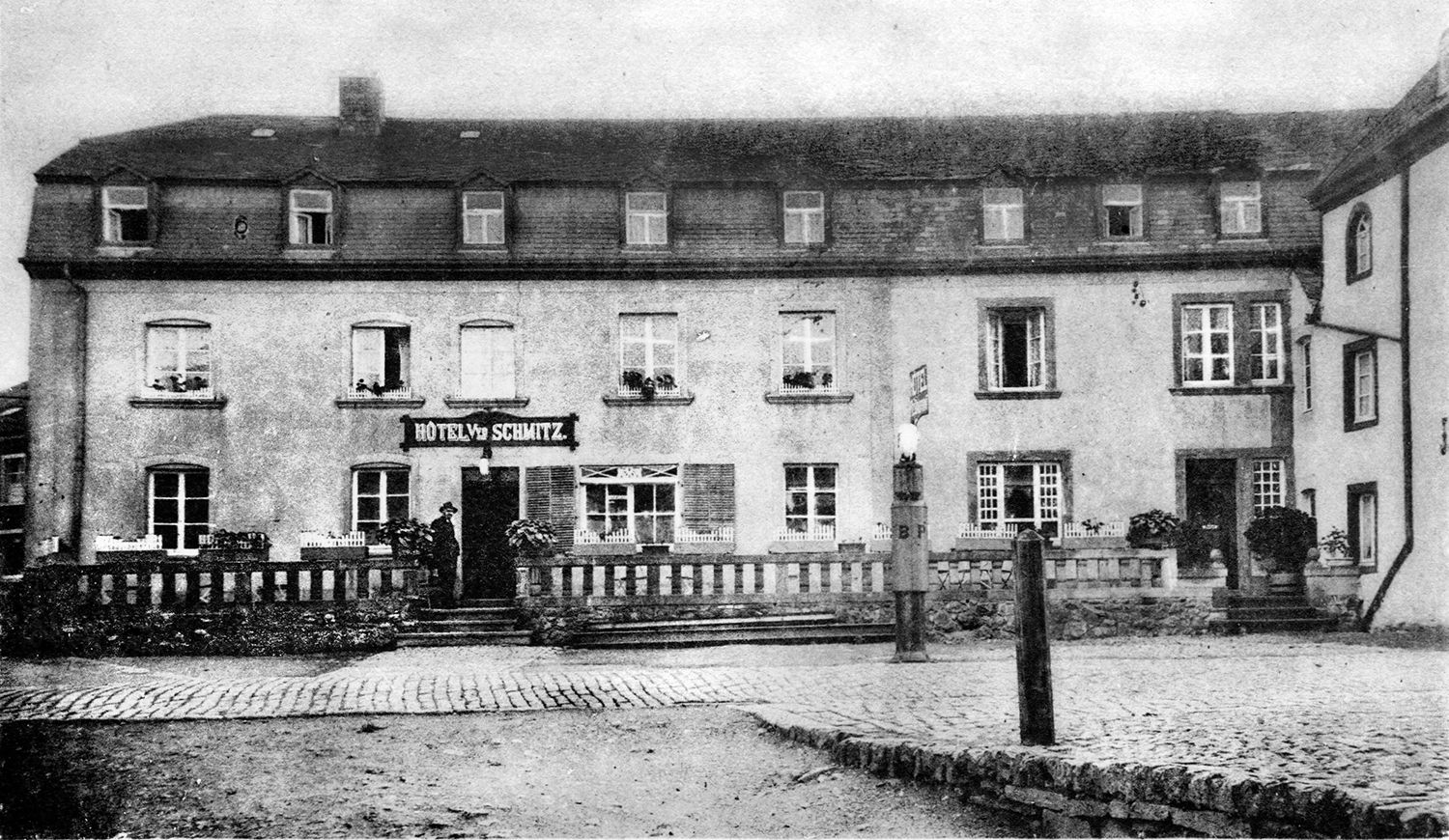
The Americans, though, were waiting for them on the other side. When it looked like their position in a house was untenable, the infantrymen from K Company would sneak out the back door and lie in ambush when the grenadiers appeared at the front door. The GIs were exacting a terrible toll on the Germans. Each house now was a bunker and each floor a mausoleum. No one had given the order, but most of the men from 1st Platoon assumed the rally point was the Company CP at Hotel Schmitz, and that is where they ended up as the fighting continued into the night. However, not all could escape, and isolated pockets of 1st Platoon and 2nd Platoon continued to battle in the northern section of town.
For Payne and his tank platoon, the situation was not much better. When the fighting kicked off, Payne’s tanks supported the K Company infantry in the northern section of town, but eventually they started to suffer losses, too. A panzerfaust knocked out one of the Sherman tanks, and another Sherman was lost to enemy fire. This left Payne with only three tanks. As the Germans squeezed the perimeter, Payne ordered his three remaining tanks to establish a cordon around the K Company CP. To add to his list of woes, Payne no longer had communications with his higher headquarters at the 707th Tank Battalion.
Meanwhile, Feiker continued to request artillery to harass the German units moving along the east-west road and attacking the town. Each time, battalion denied his requests. Milton could no longer provide fire support because his howitzer batteries had retreated further west. In short, Hosingen was far enough behind enemy lines that the 109th Field Artillery batteries could no longer support them except with prayers. They were on their own.
For Milton, K Company’s situation was dire. At 6:02 p.m., Division intelligence confirmed the reports that at least eight German tanks were roaming inside Hosingen. After receiving more disquieting news, Milton reported K Company’s situation to the division headquarters at 6:50. Company K had little ammunition left, and the men resorted to hand grenades. They were still battling building to building, but it was only a matter of time.
Around 7:40 p.m., the division switchboard operator received another message from Hosingen. Feiker’s voice sounded defiant. “We are still making them pay—house to house. We are still in there but don’t know for how long.” As the 17th drew to a close, Feiker kept Milton apprised of his condition. The Germans were tightening the screws on his beleaguered company. All day, Milton had been pestering Fuller to allow K Company to withdraw, but Fuller had refused.
Now, it was too late, as elements of the 2nd Panzer Division had overrun Fuller’s own headquarters in Clervaux earlier that evening. When Milton suggested that Feiker try to infiltrate through German lines to break out of Hosingen, Feiker rejected the suggestion. Feiker’s answer was stoic: “It was impossible; too much heavy stuff around.” Meanwhile, Milton kept trying to help K Company. At 3:05 a.m. on December 18, he called the acting regimental commander, Col. Theodore Seeley. The Germans had overrun the regimental headquarters earlier that night, and now Seeley had taken over. “Is there anything we can do for K Company?” he pleaded.
Seeley’s answer was stark. “There is nothing we can do—all of us are in the same boat.” On the morning of the 18th, the men in Hosingen watched helplessly as the progression of German vehicles and horse-drawn artillery continued their march westward. They had little with which to thwart the German steamroller.
They had only two rounds of smoke for the 81mm mortar, and all their 60mm mortars were out of action. In fact, the men were scrounging around for small arms ammunition for their rifles. In addition, their .50-caliber ammunition was nearly gone. They were saving it for one more worthwhile target. A little after 7 a.m., the target presented itself.
Lieutenant Hutter, one of the engineer platoon leaders, saw four horse-drawn carts, carrying ammunition. As they drew closer to the northern end of Hosingen, they reached a choke point 400 yards from his position, and a traffic jam ensued. He nodded his head and pointed at the congested mass of horses and carts. In response, an M2 machine gun and several other light machine guns opened up a blistering fusillade of steel death, and the rounds tore into the packed columns, tearing apart horse limbs while cleaving apart the wooden carts. The massive burst lasted two seconds, but that was all Hutter needed. The carts exploded into balls of flame that licked the sky. Chaos overwhelmed the column, sending horses and men everywhere.
Jarrett later remarked, “It was a grand sight.” Unfortunately, it did not save them. At 8:25 a.m., Col. Daniel B. Strickler, the executive officer of the 110th Infantry Regiment, reported K Company’s condition to Major Plitt at division.
His words left no doubt as to K Company’s eventual fate. “K Company cannot do what was suggested to them,” he told Plitt on the phone. “They are still holding out and cannot do anything else. They [K Company] reported considerable enemy artillery and trucks at Bockholz. They were at the following grid 814584. [Just west of Hosingen] They are taking care of it with what little they have because they are under observation.”
Several minutes later, Milton reported over the phone directly to the division tactical operations center. “K Co has been pushed in more. They have destroyed all secret documents they have in their possession. Engineers that are also with them have done the same.”
The Germans were closing in on the isolated pockets of Americans in Hosingen, and Jarrett could see that the end was near. His water was gone, his soldiers had little ammunition left, and the Germans had surrounded the town of Hosingen with tanks. Jarrett decided to speak to Feiker about the futility of resistance. Both of them then decided to surrender to the Germans, but only after they had destroyed most of their own equipment so it would not fall into enemy hands. The engineers used thermite grenades, TNT and gasoline to burn out the engine blocks of their vehicles, while they provided their excess TNT to the tankers and the infantry to do the same.
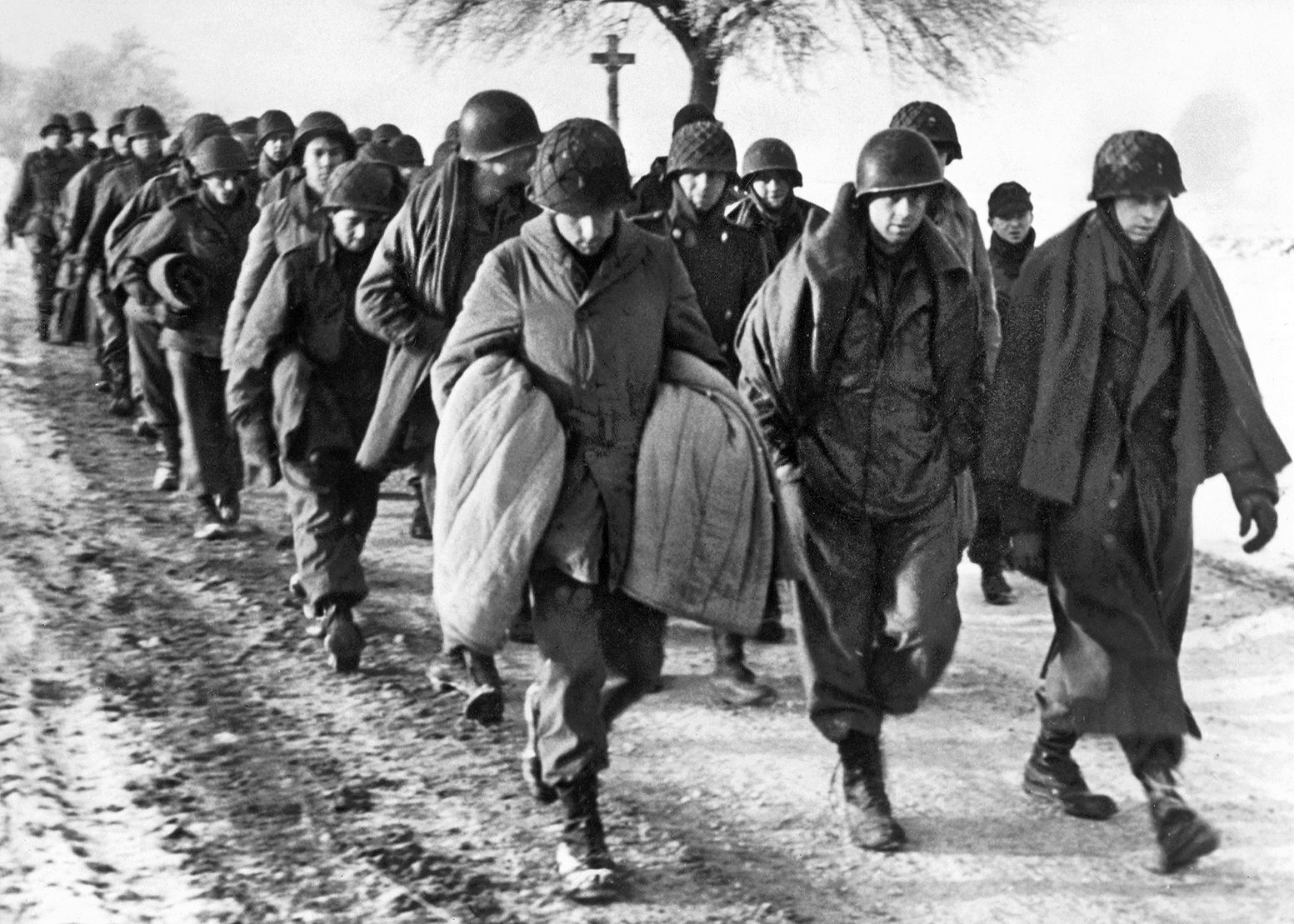
Sometime between 8 and 10 a.m., Feiker and Jarrett cobbled together a white flag made out of cloth and headed out to parley with the Germans while Payne’s remaining tankers hung white panels across the fronts of their tanks. Seeing the panels and the flag, the Germans stopped shooting. After reaching the German lines, the two American officers discussed the terms, and then at 10 a.m., the Germans escorted the two back to Hosingen under guard. Back at the Company CP, the radioman sent his last report to Milton. He told the battalion commander they had completed their mission to best of their ability, and they were now surrendering to the Germans. The time was 10:07. When Feiker and Jarrett got back to the CP, they told the men to line up in columns of three with their hands placed firmly on their helmets.
Flynn estimated that the total number of American prisoners was around 300. When Flynn tallied the wounded and killed that were defending the town, the numbers were remarkably low—ten wounded and seven killed. The German commander who received the town’s surrender was shocked when he learned the number of American wounded and dead. He was even more shocked to learn that only two companies had defended the town. The Germans believed they were facing a reinforced battalion.
The loss of Hosingen opened the east-west road for German military traffic. When Kokott learned of the size of the Hosingen garrison, he was impressed that such a little band had held out against such overwhelming odds. He wrote after the war that Feiker had earned Kokott’s respect, and he singled him out in a post-war interview. Kokott finally had Hosingen, and his division and the Panzer Lehr Division could now push westward to Bastogne.
However, the damage had been done. The Panzer Lehr Division did not reach Bastogne in time. In fact, the U.S. 101st Airborne Division had beaten the German tanks by only a few hours. The consequences were dire for the Germans.
They surrounded Bastogne, but they could never take the crossroads town, and because of that, their supply lines were overextended and when they were within sight of the Meuse River their tanks ran out of gas.
After the war, General Fritz Bayerlein wrote that the failure of the German Army to take Bastogne seriously jeopardized the Ardennes offensive, and he then concluded that the chief reason why his Panzer Lehr Division could not reach Bastogne in time was the dogged defense of Hosingen, which held up the 26th Volksgrenadier Division and the Panzer Lehr for over 36 precious hours, hours they could not afford to lose.
Leo G. Barron served two tours during Operation Iraqi Freedom with the 101st Airborne Division as a rifle company executive officer and as a battalion intelligence officer. He holds a master’s degree in history from Western Michigan University and a bachelor’s degree in history from the College of the Holy Cross. An avid historian, he resides in Sierra Vista, Arizona, where he teaches at the U.S. Army’s Intelligence Center.
Join The Conversation
Comments
View All Comments