
By Mark Carlson
For more than a year and a half, 120 British sailors and Marines led a successful blockade of the French “Sugar Island” of Martinique, birthplace of Gen. Napoleon Bonaparte’s wife, Josephine. That they did so from one of the strangest ships never to sail the seas—HMS Sloop of War Diamond Rock—remains a lesser-known but fascinating chapter in the history of the Royal Navy and the Napoleonic Wars.
The wars were a series of conflicts around the world from 1803 to 1815 between Great Britain and its allies and Republican France and its allies—including, at times, Russia and Denmark, but mainly Holland and Spain. When the French Directory took control of the French government after the French Revolution, Napoleon was tasked with the invasion of Great Britain in the spring of 1798. But he knew invading England would be almost impossible as long as the powerful Royal Navy controlled the seas. Napoleon had the idea of invading Egypt and threatening the crown jewel of England’s colonies, India. What came of this was his year-long campaign in Egypt and Turkey after his battle fleet was destroyed by Adm. Horatio Nelson at the Battle of the Nile in August of 1798.
Eventually Napoleon abandoned his army and made his way back to France, eying military control of Europe and the French throne. The war had taken its toll on both sides, with allegiances coming and going, but always influenced by the powerful Royal Navy and its mighty ships of the line. After Nelson defeated the Danish Fleet at Copenhagen, the short-lived League of Armed Neutrality between France, Denmark, Prussia and Russia was dissolved—a blow to Napoleon.
In March of 1802 Napoleon proffered peace with Great Britain, but no one in London or the Royal Navy was fooled. To consolidate his control of Europe and France, Napoleon needed time to rebuild his forces. King George III, tired of war and the mounting expense—not to mention the loss of life and property—urged Parliament to accept the offer. This led to the “Peace of Amiens.” Signed and ratified in March 1802, the treaty allowed both countries to rebuild their economies and their navies.

Almost immediately food prices dropped and the increased trade with the continent was a boost to the British economy. Prisoners of war were returned home, which further improved national morale. The return of fleets that had spent months, or even years, on blockade duty also lightened the load on the Royal Navy’s purse.
One of the stipulations of the treaty was that Great Britain release controls of most of the territories seized from France and its allies. This included Egypt, Malta, and the Cape of Good Hope at the southern tip of Africa. Others included islands and bases in the rich colonies of the West and East Indies. Only the Former Spanish island of Trinidad in the Caribbean and the Dutch island Of Ceylon in the Indian Ocean were retained.
The Peace of Amiens was only a pause in a war that would go on for more than a decade. But the Royal Navy, under the aegis of the First Lord of the Admiralty (John Jervis, Earl of St Vincent), had drastically reduced the size of the fleet, maintaining only enough vessels to protect Britain’s colonies and merchant ships. It was an austerity measure that ultimately cost more to reverse.
Napoleon used the time to rebuild his shattered fleet and enlarge his army while he consolidated his control of France. This was no surprise to the war-weary people and armed forces of Great Britain. By the spring of 1803, it was obvious the so-called peace was eroding fast and it would be necessary to recall the Royal Navy to arms.
King George III, realizing that France was about to throw away the treaty and resume the war, feared the threat of invasion. He sent a letter to both houses of Parliament stating “as very considerable military preparations are carrying on in the ports of France and Holland, His Majesty had judged it expedient to adopt additional measures of precaution for the security of his dominions.”
Through his ambassadors, Napoleon insisted that France was only building up its forces for the protection of its colonies—an obvious falsehood believed by no one in Parliament, or the Admiralty.
But putting the scores of ships back into service would take time, money, and tens of thousands of men. Few former seamen were eager to rejoin the Navy even in their country’s time of need. So began what was called the “Hot Press,” a massive campaign to force into service the men needed
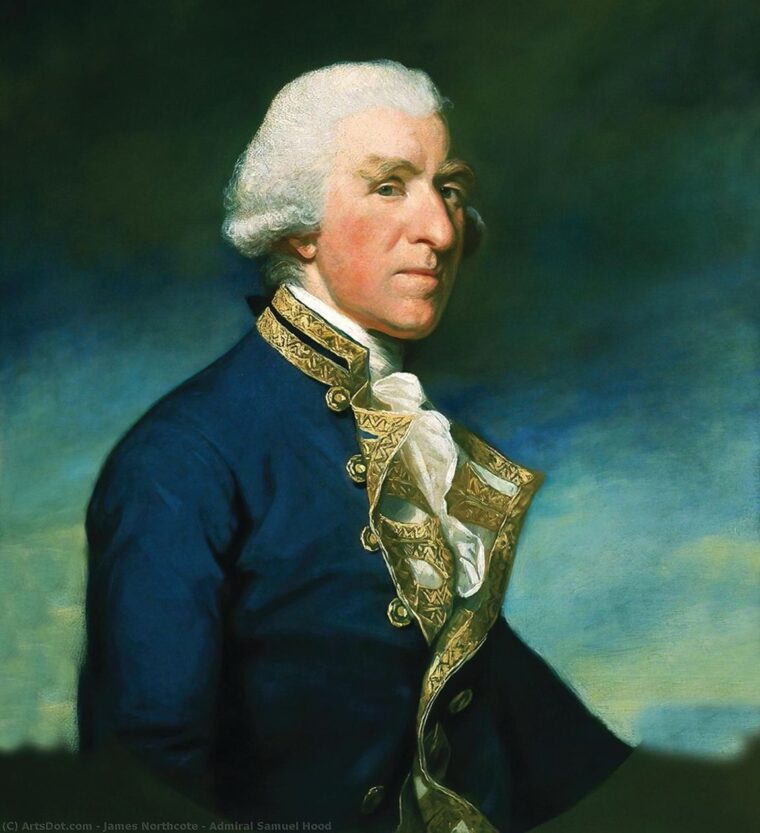
In the Caribbean, the reduced fleet was tasked with reclaiming the islands and territories so recently returned to France. Great Britain was going to get them back, if for no other reason than to increase trade and create problems for France. Among them were what were known as the “Sugar Islands,” in the West Indies. Rich in spices, tobacco, and sugar, they were valuable territories. But the problem was the lack of warships to enforce the retaking of the islands, and even more, holding them against enemy attack. When war was again declared in May 1803, The British Commissioner in Trinidad was Commodore Samuel Hood, an experienced and clever officer. But even Hood’s abilities were severely limited without ships. When his orders from the Admiralty named him Commander in Chief of the Caribbean Squadron, he only had two large warships, HMS Centaur and HMS Blenheim, six small frigates and a handful of sloops and transports. It was hardly enough to capture French islands and protect British commerce in a region more than 800 miles long, stretching from Trinidad off Venezuela and as far as the Virgin Islands to the north.
Built by the French in 1754, the Centaur was a 74-gun ship of the line captured by the British in 1759 during the Seven Years’ War. She served with Adm. Sir George Bridges Rodney at the 1782 Battle of the Saintes and throughout the American Revolution.
Hood’s first target was the island of St. Lucia 40 miles south of Martinique in the Antilles. He was fortunate in that there were few French ships in the area, so in June he was able to take St. Lucia in two days and the neighboring island of Tobago fell only a few days later. He then turned south to take the Dutch islands off Guyana, which he had captured by September. Another small squadron was blockading French ports on the island of Hispaniola. This was where one of Napoleon’s biggest political blunders worked against him. He had decreed that slavery, which had been banned by the British in the region, was to be resumed. The black slaves rebelled at this and supported the British. French troops on Hispaniola were set upon by the slaves and only found refuge by surrendering to the British. By the beginning of 1804, Hispaniola became the free black island of Haiti.

The last French-held naval ports in the Caribbean were on Guadalupe and Martinique, the only islands from which French privateers could still operate against British shipping. This threat forced Hood to divert his limited warships, particularly the frigates, to escort convoys of valuable trade goods to Europe.
With his fleet stretched thin, Hood realized that an effective blockade of Martinique’s primary port of Fort-Royal (renamed Fort-de-France in 1807) would cut off the small French garrison and protect British merchant shipping. He examined charts and made a study of the waters of the St. Lucia Channel at the south end of the island. The prevailing winds and currents forced ships to approach the port from the south, hugging the coast, passing between Martinique’s Pointe du Diamant and a 574-foot pillar of basalt known locally as Rocher du Diamant (Diamond Rock).
Considered unscalable by the French, the Rock looms over the St. Lucia Channel used by ships approaching Fort-Royal. Hood reasoned that a garrison with some heavy guns could virtually cut the French off from Martinique. It was dotted with caves and gullies, and the only safe landing was on the western side away from the channel. Hood, who thought it was about as perfect a natural fortress, would later write that “about thirty riflemen could hold off ten thousand.”
On January 7, 1804 the landing party of 50 sailors and 25 Royal Marines was commanded by Centaur’s First Lieutenant, James Wilkes Maurice, and midshipman John Donaldson. They were all volunteers. It was an excellent assignment and would get them off the ship and away from the tedium of blockade and patrol duty. They were provided with two weeks’ worth of provisions, regularly supplemented from the Centaur. Exploring the small island, they discovered a large natural cave almost exactly opposite the landing site. It was big enough for the forges, carpenters and artificers to work. The only limitation was in fresh water. Diamond Rock had a few natural springs, but not enough for the needs of the garrison. Eventually concrete, some sources say stone, cisterns would be built to collect and store the water from the springs or from the frequent tropical rains. There were soon more than 100 sailors and Marines on the island.
In his journal, Donaldson wrote that “the mirth and fun of the party at getting onshore after long confinement onboard and our very novel employment at fitting out a nondescript vessel as His Majesty’s Sloop Diamond Rock made this evening pass off very cheerfully.”

With a bit of tongue-in-cheek humor, the garrison soon began calling their new post “HMS Sloop of War Diamond Rock,” which eventually became official and was registered with Hood and the Admiralty. The Royal Navy practice of using ship names for shore installations remains to this day—HMS Dryad, or Southwick House, is home to the navy’s Anti-Submarine Warfare School.
As the garrison expanded and fortified their new home, they found the rocky escarpments were difficult to climb, so among their first tasks was to widen natural paths and erect rope ladders.
Other caves were found and explored, some being enlarged to provide shelter from the relentless sun and tropical storms. The caves served as barracks and messes for the sailors and Marines, who hung their hammocks from the ceilings, while the officers slept in tents on the shore.
All supplies were brought by boat from the fleet that remained just over the horizon. And after Maurice had surveyed the rocky escarpments, Hood decided that two 18-pounders would be mounted on the highest point, a larger 24-pound gun would face the channel from a platform halfway up the cliff, and two more 24-pounders would occupy the shoreline, angled so as to cover the widest area. From the heights they could reach a thousand yards. Together they would send a volley of heavy shot into any ship attempting to pass through the channel. The problem for Maurice and his garrison would be in getting the heavy guns onto the island from the Centaur and into place. The barrels of the 24-pounders were about eight feet long and weighed close to two tons.
In February the Centaur was anchored about 400 feet from the cliffs and a cable was looped between the mainmast to a strong foundation drilled into the cliff, with the difference in height from end to end about 500 feet. One of the 24-pounder barrels was slung under the cable and moved toward shore using pulleys and the ship’s anchor capstan, a process that took about seven hours. The barrel was lifted by block and tackle into its carriage and secured with heavy bolts driven into the stone. The gun was christened “Hood’s Battery.” Two more 24-pounders were hoisted up, then the 18-pounders to the highest point.

Diamond Rock was in business by March 4. Provisions, powder and shot for a hundred men for four months were regularly brought to the island by one of Hood’s sloops. This did not go unnoticed by the French, but apparently unwilling to believe their eyes, they did nothing and lost their chance to stop what would soon become a serious problem.
Martinique Governor Pierre de Laussat proposed improving the road from Fort Royal out to the peninsula opposite Diamond Rock, but again Napoleon’s resumption of slavery made the local black population resist, going so far as to smuggle food and information to the British.
A French engineer and troops attempted to bring guns out to the point but Maurice raided the small party and captured them without bloodshed. The French on Martinique did nothing more to interfere with the occupation of Diamond Rock.
A fast six-gun sloop HMS Fort Diamond was available to intercept any ships attempting to enter the harbor. The sloop would also carry messages to Hood at St. Lucia of any French warships spotted. Maurice had a heavy sling run from a block and tackle in the main cave to the summit. Originally intended for the transport of ammunition, it was also used to keep the upper battery supplied with food and water. From the start, Maurice commanded the garrison like a Royal Navy warship, with bells and watches.
A flag bearing the red cross of St. George and the Union Jack flew above the island. When any British warship passed the Rock, salutes were exchanged according to Admiralty regulation. While Maurice ran a tight “ship,” by most accounts he had a very content and devoted crew. They wove broad-brimmed hats from the local grasses, and an indigenous plant resembling spinach proved to be useful in preventing scurvy. In addition, goats, guinea hens and chickens ran wild, further enhancing the diet. Natives in canoes, unheeding of their French masters’ wishes, brought fresh meat, fruit and even rum to the garrison, a welcome change from the salted rations. But Maurice was careful not to let the drinking get out of hand. Life on the Rock was as close to paradise as was possible for a Royal Navy crew in that era.
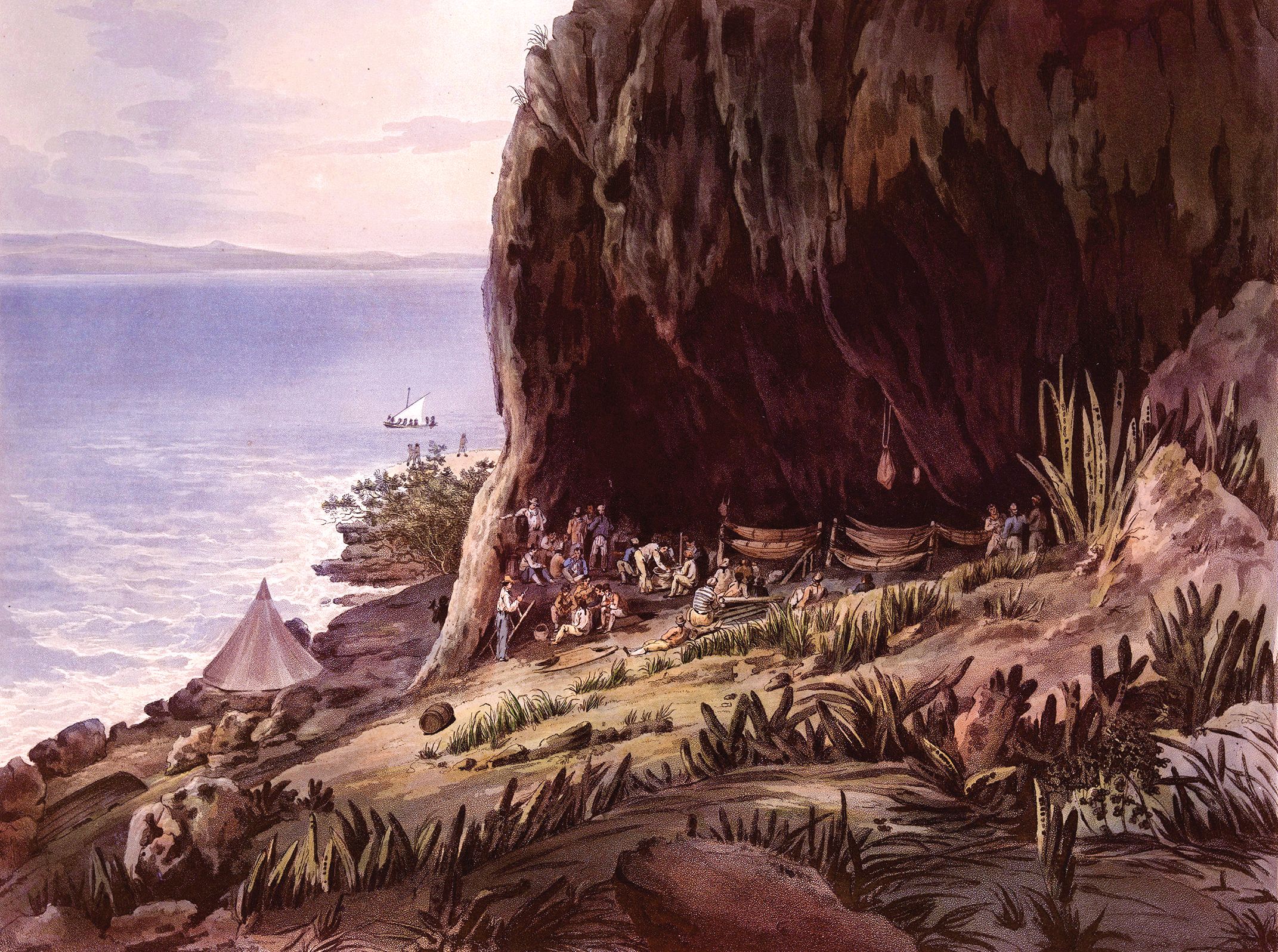
Hood was so impressed by Maurice’s handling of the project that he was promoted to Commander and the island officially commissioned as a sloop of war. Maurice was given a permanent garrison of 120 men, which allowed for 24-hour observation of the channel and rapid firing of the guns. A surgeon ran a hospital in a cave capable of housing 30 men so successfully that British ships would drop off their sick and wounded.
Outlining his progress to the Admiralty, Hood wrote that “I hope their Lordships will approve this measure which will be executed with little expense and may save thousands to the country, independent to its utility in consequence to the enemy and protection of the trade caught in this channel.” Their Lordships did approve, but it must have raised a few eyebrows at such an offbeat scheme.
Sure of the Rock’s ability to handle matters at Martinique, Hood sent the Centaur to find and capture French privateers. With the big warship absent, four boats loaded with French Marines set out from Fort-Royal to capture the Rock. But the contrary currents and long distance soon exhausted the men at the oars. By the time they managed to approach the one landing beach, they could not fight the offshore current and had to turn back. Since this happened at night, Maurice’s lookouts never saw the boat, which returned to the port. After this failed attempt, the French abandoned any hope of capturing the Rock and sent word to France for help.
From its location at the north end of the St. Lucia Channel, the Rock commanded a wide area under the eyes of Maurice’s lookouts. They could see for about 40 miles, meaning no ship could approach the bay unseen. When a French ship did attempt to enter the bay, a few ranging shots, not always intended to hit, forced it to steer close to the shore where the contrary currents and winds meant it had to tack several times. This always made progress slow and Maurice sent the Fort Diamond to move in. Sometimes the prize got away, while others were ransacked by British sailors for useful provisions. But even the ships that got away were considered victories, as they were unable to reach Fort-Royal. This went on through the summer and fall months of 1804, interrupted only by bad weather and the occasional hurricane or tropical storm. By the winter of 1805, Diamond Rock was one of the most successful British outposts in the Caribbean.
Napoleon, perhaps at the urging of Josephine, who had been born on Martinique and still had relatives there, decided to do something about the island’s blockade. He had crowned himself Emperor of France in May 1804 and brought Spain into war against Britain. His invasion fleet was assembled at Boulogne on the Channel Coast, but until the Royal Navy’s blockading fleet was destroyed or decoyed away, it languished in harbors.
An opportunity arrived in January 1805 when a storm disrupted the Royal Navy blockade, allowing Adm. Pierre Charles Villeneuve and some of the French fleet to escape. His orders were to disrupt British shipping in the Caribbean, and to capture Diamond Rock. Napoleon assumed Nelson, in command of the blockading fleets, would chase Villeneuve, leaving the Channel unguarded for the rest of the French fleet to escape. The plan was for Villeneuve to rejoin the combined French and Spanish fleets and block Nelson’s attempts to halt Napoleon’s invasion of Britain, but it proved impossible.

Villeneuve knew Nelson was probably not far behind him, but hoped to capture the Rock and then attack a British convoy headed for Europe. His squadron reached Martinique on May 14 where he assessed the situation. He had plenty of firepower, but it’s a fact of naval warfare that ships can do little real damage to an armed fortress. The Rock was hardly a fortress, but his ships would be vulnerable to its cannons.
His orders also stipulated that he wait for the squadron commanded by Vice Adm. Honoré Joseph Antoine Ganteaume, which Napoleon had sent with reinforcements for the French occupation of the West Indies. However, Ganteaume was delayed by a storm and never arrived. On May 27, 1805, Villeneuve detached the 74-guns ships of the line Pluton and Berwick, the 36-gun frigate Sirène, a corvette, a schooner and 11 gunboats, with 300-400 soldiers, to bombard and capture Diamond Rock. The bombardment lasted almost two hours. While Maurice’s gunners did sink at least two of the gunboats, the heavy guns of the warships forced him to spike and abandon the two 24-pounders on the lower battery. Their crews retreated to the large cave where they continued to support the upper guns. More than 300 French troops under the command of Capt. Julien Cosmao made it ashore under fierce defensive fire from Maurice’s sailors and Marines. Pluton and Berwick kept up a steady fire on the upper batteries, limiting their ability to provide defensive fire, while the French troops climbed the rock walls without scaling ladders. Maurice’s Marines and sailors continued to put up a vigorous defense.
Unfortunately for the British, the stone cistern they used for drinking water had been damaged by a recent earthquake, creating a leak that expanded under the heavy bombardment. At first Maurice made allowances by collecting rainwater and reducing each man to one pint per day. An attempt to send the sloop Fort Diamond to St. Lucia was thwarted when it was intercepted by the French fleet. It was only a matter of time before the Rock’s men ran out of water.
After almost three days of savage fighting during which the bombardment never ceased, Maurice’s men were so weak they could hardly load and fire their muskets. The store of ammunition and powder was almost depleted. With few options, Maurice consulted with his officers and Marines. They would have to surrender. After lowering the shot-rent Cross of St. George flag, they raised a white flag, and the bombardment ceased just after five on the afternoon of June 2, 1805. The commander of the French landing forces met with Maurice and accepted the British surrender.
The British found their French conquerors to be congenial, bringing fresh water from Fort-Royal. As to casualties, accounts vary, with French dead and wounded estimated to be 50 or 100, the former being more likely. Maurice’s casualties were two dead and one wounded.
He and his men had successfully interdicted French shipping for 17 months, a remarkable feat for a small and isolated garrison. For Villeneuve, who had not been in favor of the assault from the beginning, it was his only military victory.

Surprisingly, the French paroled Maurice and his men, allowing them to leave Martinique on board the Fort Diamond. They sailed to Barbados, where Hood learned of the defeat. Pursuant to Royal Navy regulation, since Maurice was in command of a “vessel” of His Majesty’s Navy, he had to appear before a court-martial board.
Maurice did write a letter to Admiral Nelson, who was in command of the fleet. “Barbados, June 6, 1805. My Lord, It is with the greatest sorrow I have to inform you of the loss of the Diamond Rock, under my command, which was obliged to surrender on the 2nd, inst., after three days’ attack from a squadron of two sail of the line, one frigate, one brig, a schooner, and eleven gunboats, and from the nearest calculation 1,500 troops. The want of ammunition and water was the sole occasion of its unfortunate loss. Although I shall never cease to regret the accident, yet it is of some consolation to think so many valuable lives are saved to His Majesty’s service, having only two killed and one wounded. The enemy, from the nearest account I have been able to obtain, lost on shore 30 killed, and 40 wounded, independent of the ships and boats: they also lost three gunboats and two rowing boats. Allow me to speak in the highest terms of the officers and men under my command; and I trust when the Court Martial shall have taken place, that their hardship, fatigue and gallantry will merit your Lordship’s approbation, having been 19 nights under arms, and some of them obliged to drink their own water [their own urine]. I beg leave to enclose the Articles of Capitulation, I have the honor to remain Your Lordship’s most obedient and humble Servant, J. W. Maurice”
The Court martial was held on June 24 aboard HMS Circe in Carlisle Bay, Barbados. There are no surviving transcripts of the trial, but it was obvious that Maurice and his men had performed valorously. Their surrender was unavoidable.
One account, printed in the Naval Chronicle, reads: “The Court cannot dismiss Captain James W. Maurice without expressing their admiration of his conduct in the whole of the occasion; and also they express the highest approbation of the support given by the officers and men under his command; a circumstance that does high honor to them; does no less credit and honor to the discipline of Captain J. W. Maurice; and therefore we do unanimously and honorably acquit the said officers and ship’s company.”
Exonerated, Maurice was given command of the Danish island of Anholt in the Kattegat, where he was acting governor from 1810 to 1812.
Villeneuve, whose orders were to return to Europe for the invasion of Britain, found himself bottled up with the Spanish fleets in Cadiz, Spain, where they waited for an opportunity to break out and head north to the Channel. Lurking just over the horizon was the fleet under Admiral Horatio Nelson. When Villeneuve did finally emerge on October 21, it was to be defeated at the Battle of Trafalgar.

Great information about a little-known episode of the Napoleonic Wars.!
It reads like something from Horatio Hornblower.