By Daniel R. Champagne
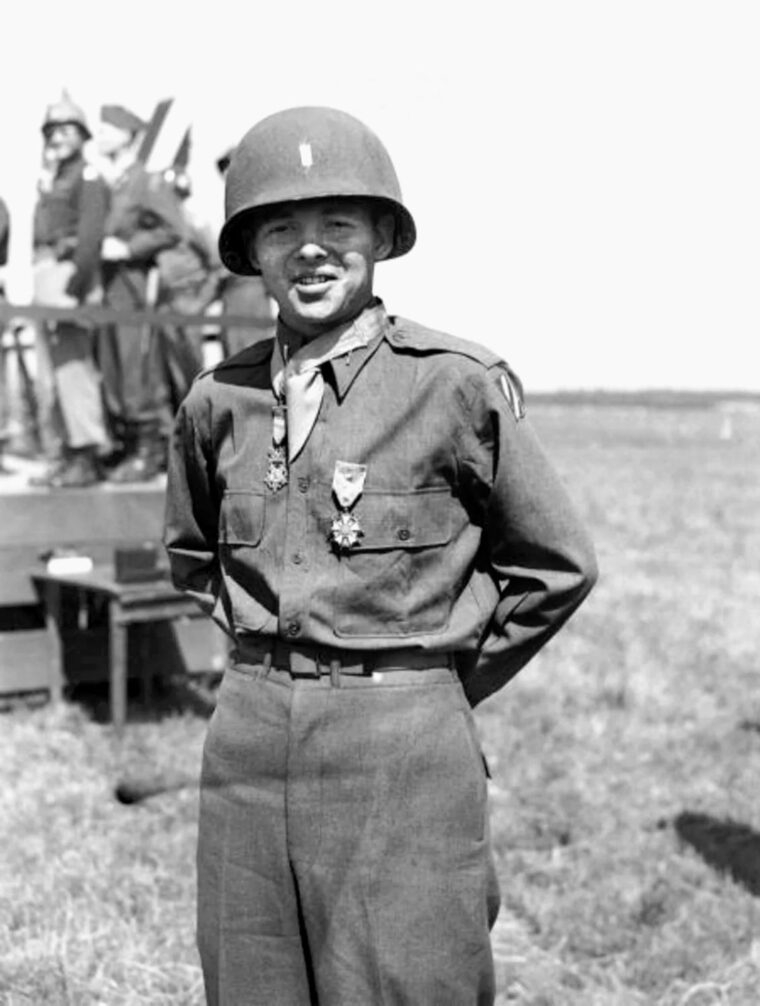
Staff Sergeant Audie Murphy advanced inland from the beaches of southern France with his rifle platoon until, near the small town of Ramatuelle, intense machine-gun and small-arms fire from a boulder covered hill forced them to hit the dirt.
Murphy jumped back up and sprinted 40 yards under blistering fire to a draw. Alone and outgunned, Murphy climbed back down the depression to take a light machine gun from a GI reluctant to move forward. Up the rocky hill, he placed the machine gun 150 yards from the enemy and began firing, killing and wounding several enemy soldiers to silence the German machine gun. As Murphy advanced further up the draw—bullets whizzing around him—he destroyed the last two enemy machine-gun emplacements in the area. Murphy’s extraordinary heroism on the morning of August 15, 1944, resulted in the capture of the hill and the annihilation or capture of the entire enemy garrison by soldiers from the 15th Regiment, 3rd U.S. Infantry Division.
As early as August 1943, the Allied Combined Chiefs of Staff had considered a diversionary landing in southern France (Operation Dragoon) to support the major Allied invasion in Normandy (Operation Overlord). Generals George Marshall and Dwight Eisenhower, with the support of President Franklin D. Roosevelt, maintained that a landing in southern France would “protect the southern flank of the Normandy invasion forces and provide another critically needed supply port at Marseille.”
The Allied forces assigned to assault the coast of southern France consisted of the U.S VI Corps and the French II Corps. These two corps comprised the Seventh Army under the command of Gen. Alexander Patch. The primary landing force consisted of the 3rd, 36th, and 45th U.S. Infantry Divisions of the VI Corps commanded by Gen. Lucian Truscott. The XII Tactical Air Command, Fifteenth Air Force was responsible for air support, and the Western Task Force provided naval support. Opposing the Allied force was the German Nineteenth Army commanded by Gen. Walter Wiess. Coastal defenses, while formidable, were not as strong as those on the coast of Normandy and in northern France.
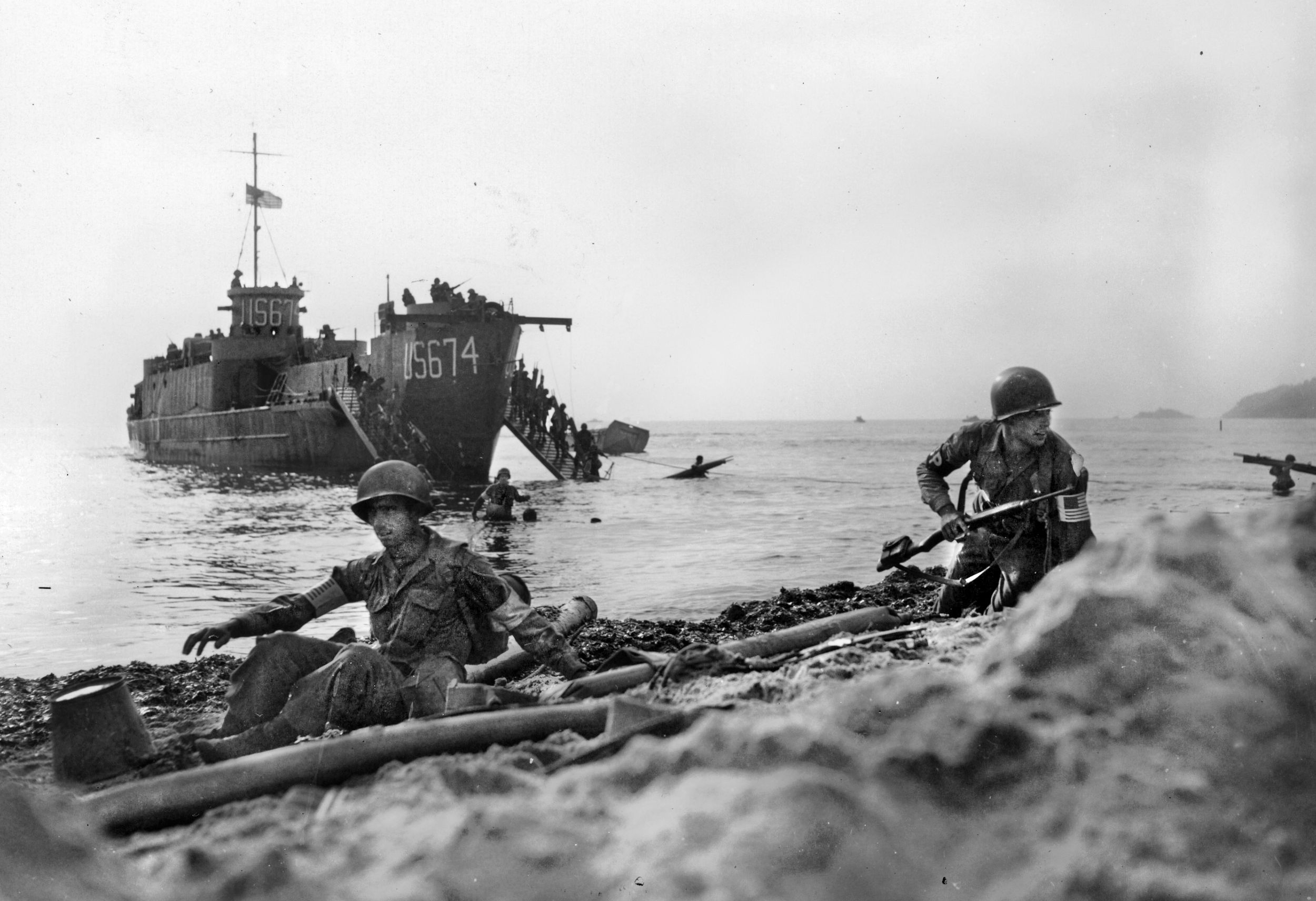
The 3rd Division’s mission in southern France was to land on beaches in the vicinity of St. Tropez and Cavalaire, approximately 30 miles east of Toulon. The mission called for two battalions of the 15th Regiment to land on Yellow Beach, which was positioned between Cap (cape) de St. Tropez and Cap Camarat, and two battalions of the 7th Regiment to land on Red Beach (Gulf of Cavalaire). Once ashore, they were to clear the enemy from the beaches and the adjacent high ground, advancing rapidly inland to assist in the Seventh Army’s attack to the west against the ports of Toulon and Marseille. By the early morning hours of August 15, all units of the 3rd Division flotilla were in place off the coast of Cavalaire and St, Tropez. H-Hour was set for 0800.
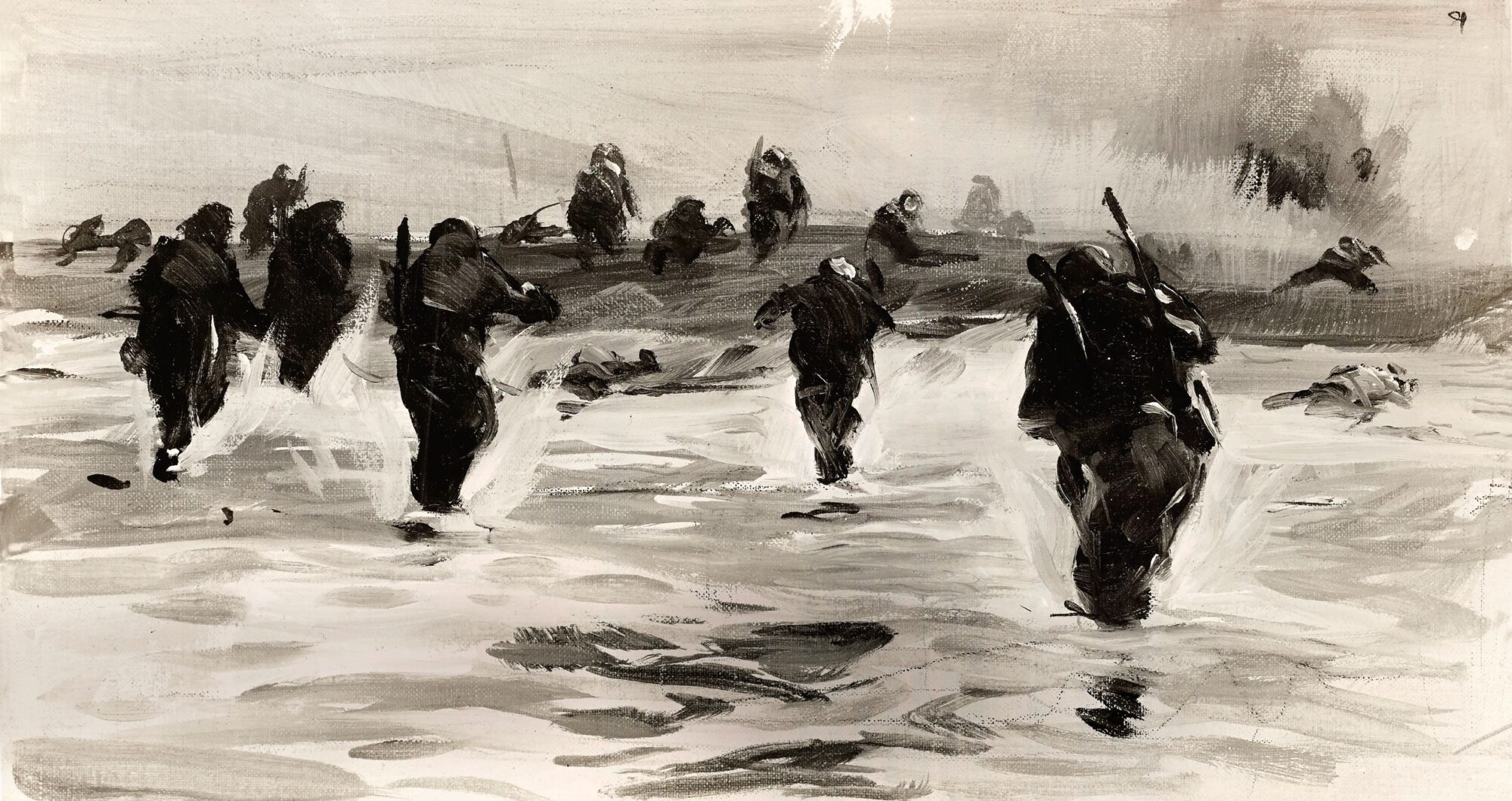
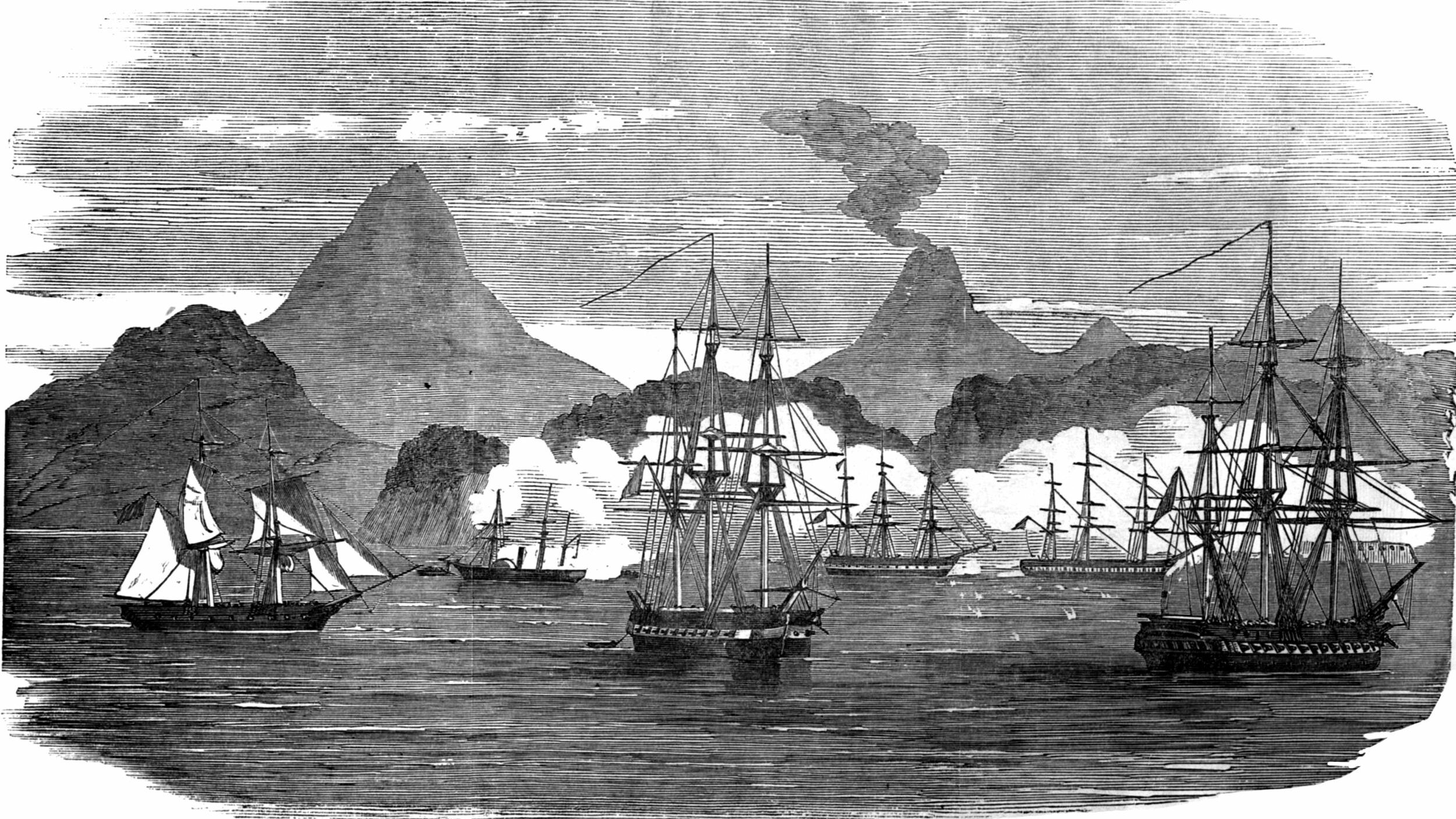
On the evening of August 14, 1944, allied naval guns pounded the flanks of the landing area near Ramatuelle. The Germans knew an attack was going to take place, but they were not prepared for the magnitude of the operation. The next morning, an intensive barrage consisting of aerial and naval bombardments preceded the landings. Leading 3rd Platoon, B Company, Murphy witnessed the spectacular scene aboard one of the many landing craft advancing toward the beach. After the “battleships gave the beach a thorough pounding, the rocket boat guns took over,” he recalled. “[They] fired in batches their missiles sailed hissing through the air like schools of weird fish. They hit the earth, detonating mines, blasting barb-wire entanglements, and unnerving the waiting enemy.” He went on: “The old fear that always preceded action grappled with my guts. Seeking to distract my mind, I glanced at the men huddled in the boat. They looked as miserable as wet cats. Although the water was smooth enough, several were seasick, and others had the lost, abstract expression of men who were relieving their bowels.”
Major Keith Ware’s 1st Battalion, 15th Regiment was in the first wave with Murphy’s B Company when it hit the beach at 0800 on August 15. The 1st and 3rd Battalions of the 15th Regiment landed just east of Ramatuelle and south of St. Tropez, while the two battalions of the 7th Regiment landed ashore on Beach Red. As soon as the men jumped off the landing craft, they waded ashore through the swirling water.
Sergeant Richard Robinson remembered the frustration: “I was carrying my machine gun when we jumped off. The moment we hit the beach, I fell into a shell hole full of water and lost my weapon. To this day, there’s probably a perfectly good machine gun at the bottom of the Mediterranean Sea.”
From the hills beyond the beachhead, the German guns rained fire on B Company as they advanced nervously along the mine-infested beach. Suddenly, an “…explosion sounded on my left,” Murphy recalled, “and when the smoke lifted, I saw the torn body of a man who stepped on a mine. Directly ahead of us was a strip of thick scrub and matted grass. We moved quickly toward it for cover, stepping gingerly as if walking on eggs. We discovered that the beach was loaded from end to end with mines, which a few pounds of pressure will detonate.” Pfc. Coker Price, who had joined B Company in Naples added: “We had to be careful of the mines. Thank God it was daylight. When we jumped off, I stepped into somebody else’s footprints so I wouldn’t set off a mine.”

Then the Germans began pounding the beach with heavy artillery and mortar fire, forcing the Americans out of the thick scrub. They raced across the meadows toward scattered farmhouses and vineyards a few hundred yards inland, each building a potential enemy stronghold. From the windows of the house nearest B Company came a volley of rifle fire. One hundred guns answered and six Germans ran from the building with their hands up. The enemy’s defenses on Beach Yellow were reduced within 40 minutes, however, the 1st Battalion suffered 10 percent casualties. Once the resistance was shattered, B Company —along with other members of the 15th Regiment—reassembled to begin the assault on Ramatuelle and St. Tropez.”
Reflecting on the landing years later, several members of B Company recalled the success of the operation. “Technically it was called the perfect landing,” wrote Murphy. “The vast operation designed to crack the enemy coastal defenses in southern France had been calculated and prepared to the smallest detail and it moved with the smooth precision of a machine.”
Staff Sergeant Albert Pyle credited air and naval support for much of the operation’s success, noting that “after battleships, cruisers and heavy bombers pummeled the area first, rockets detonated many of the mines planted in the sand as well as destroying other beach defenses.”
“The French Patriots did a wonderful job helping make the invasion a success,” Pfc. Vert Enis wrote in his diary. “When we hit the beach, they had signs telling us where the minefields were located. And, in some cases, they had removed some of the mines.”
Once the 15th Regiment reorganized, the troops advanced inland toward their objectives on the high ground. About a mile in from the beach, they encountered a sheer cliff topped by a wooded hill strewn with boulders. Crowning the hill was a large concrete reinforced pillbox with a coastal gun protruding toward the beachhead. According to the French Underground, the Germans had converted the hill into a strongpoint. The rocky promontory stood smack in the face of the 15th Regiment’s advance, hence it had to be destroyed at all costs. That unenviable assignment fell upon the 1st Battalion and B Company was selected to lead the assault.
The engagement to capture “Pillbox Hill” commenced at 1000. The route to the objective was a steep incline shrouded with thickly covered brush, scrub oaks, boulders, and pine trees, which reduced visibility and offered excellent concealment for enemy snipers and machine guns. The 1st Battalion struck the enemy’s right flank from the coastal side.
“We were spread out through the vineyard as we approached the hill. When we were about 250 yards from the hill, enemy among the boulders started firing at us with a machine gun and small arms; we all hit the dirt,” recalled Staff Sgt. Norman Hollen, a member of Murphy’s 3rd Platoon. “So long as we remained quiet the enemy didn’t fire, but as soon as we tried to move forward, they would fire on us.”
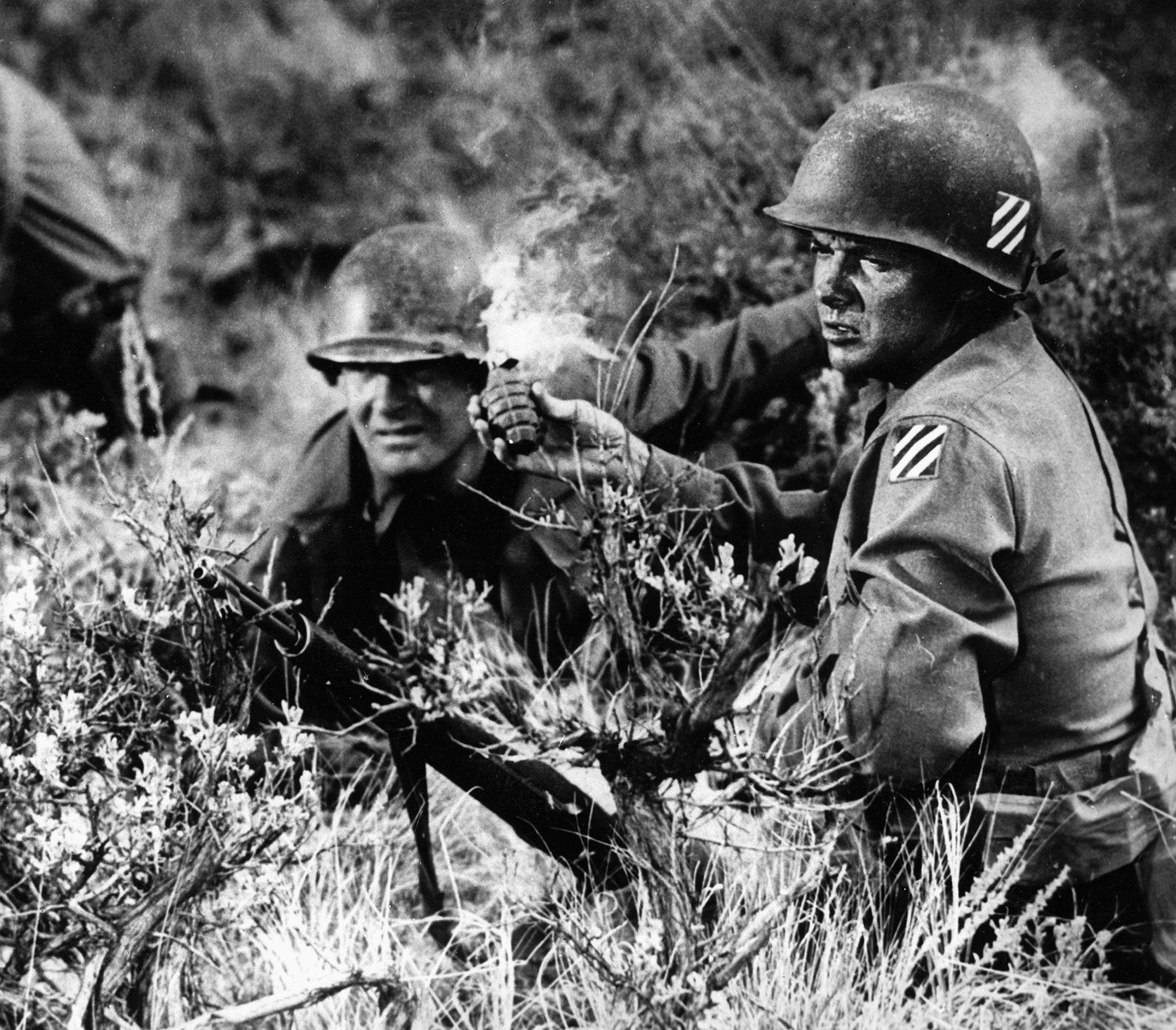
Without warning, Murphy advanced alone to clear the way, ordering his 3rd Platoon—the lead element of the advance—to take cover. Once Murphy’s platoon took shelter, the rest of B Company followed suit and covered him as he moved forward. Carrying an M-1 carbine and loaded down with grenades, Murphy advanced up the hill.
“I was alone now, and the Germans had discovered me,” he wrote later. “They laid a blistering crossfire directly over my head. I rolled into a ditch that ran parallel to a thick canebrake leading up the hill.”
A German machine gun crew had waited in ambush until the Americans reached open ground. The gun was located beneath a cork tree 15 yards up the slope, with a swath cut to allow the weapon to cover the vineyard. Two Germans with their heads barely visible were operating the gun. Three other enemy soldiers sprawled flat on the ground were feeding the ammunition to the gunners and firing their rifles at the Americans. It was a formidable obstacle for the 15th Regiment. With the complete picture in mind, Murphy decided that the enemy machine gun had to be eliminated. He knew that it was impossible to knock the enemy position out of action without more firepower, so he proceeded back down the ditch to get it.

As he rounded a slight bend, Murphy ran head-on into two Germans. Before the enemy realized what hit them, Murphy dropped them with his carbine. “For an instant they recoiled in surprise,” recalled Murphy, “and that was their mistake. My combat experience had taught me the value of split seconds.” Near the edge of the forest, he encountered a group of Germans in a series of foxholes and “outdueled them until his ammunition was exhausted.”
Murphy continued his withdrawal down the ditch in search of an automatic weapon to knock out the enemy machine gun. He finally located a light machine gun and commandeered it from a crew that was pinned down by enemy fire.
“No amount of arguing or cursing on my part could get them to stir from the spot,” said Murphy. “It was perhaps best that way. I reasoned that if one man could do the job, why risk more.” He dragged the gun into the open field and placed it downhill approximately 150 yards from the enemy’s position. A seasoned veteran, Murphy realized he had the advantage: “I was firing uphill and could lie flat upon the earth. But the Germans, in order to shoot down the slope at me, had to expose head and shoulders over the embankments fronting their foxholes.”
Raking the top of the enemy stronghold with machine-gun fire, Murphy silenced the German positions, killing one or two in each of the several foxholes. As he continued to advance up the hill, another enemy machine gun opened on him. “I hit the dirt,” Murphy said, “but couldn’t locate the gunner. The fire, however, was coming from my left. I set up my gun and raked the area with lead until my last cartridge was spent.” With machine-gun fire converging on him, Murphy again raced back to the ditch for cover and retreated down the slope to retrieve his carbine.
On his way down, Murphy met up with his foxhole buddy Pfc. Lattie Tipton from Ervin, Tennessee, who was carrying several clips of carbine ammunition. Tipton and Murphy had been in combat together since landing in Sicily more than a year earlier. The two men were like brothers. “He was as solid as the earth,” Murphy wrote. In Italy, Tipton turned down a promotion so that he could stay with Murphy as a runner. “Foxhole buddies were closer than friends, closer than brothers. Their trust in and knowledge of each other was total. They got to know each other’s life stories, what they did before the Army, and what their parents, brothers, and sisters were like… Without thinking about it, they would share their last bite or last drink of water or a blanket—and they would die for one another.”
Tipton was cool, brave, and reckless under fire—attributes that made him an exceptional combat soldier. The two men confided in each other, expressing their deepest feelings. Whenever they talked about women, “Murphy complained that he didn’t have time to fall in love and besides he’d been too damned proud to let a girl see the patches on his pants.”
Murphy was moved whenever Tipton talked about his nine-year-old daughter Claudean, whose letters he would often read aloud: “Dear daddy i am in school but the teacher is not looking… when are you coming home i miss you.” Murphy said that every time he went into battle with Tipton, he couldn’t help but visualize the little girl, “I can see the eyes, eager with life, her pert freckled nose, her pigtails with bows of ribbons at the ends.”
Murphy immediately noticed that Tipton had a portion of his ear cut off and was bleeding profusely. Sergeant Tom Godfrey, who was pinned down with the rest of B Company, recalled that “Lattie was shot in the ear and bleeding like a stuck pig. We all tried to get him back to the rear to get it patched up but he refused saying ‘I’ll be alright.’ Then he advanced to a forward position where he met up with Murph.”
Murphy wanted help but not from Tipton. He had made a secret vow a long time ago that his best friend was going home in one piece to his daughter.
“Go back, Lattie,” shouted Murphy. “Get back and have that ear fixed.”
“I’m going too,” said Tipton.

“I’m going up, Lattie,” said Murphy. “Now I’m telling you again, fall back and get that ear fixed.”
Murphy set off and noticed that Tipton was following him. “You shouldn’t have come up,” Murphy remarked in a scolding manner.
Reluctantly, Murphy nodded his approval and crouching low they made their way back to the ditch. Two Germans popped out of the canebrake and opened fire. Turning quickly in the direction of the blasts, Tipton fired two rapid shots from his carbine, killing both of them. As the two men quickly moved up the ditch, hand grenades and automatic-weapons fire converged on them. Miraculously, they were able to escape the explosions and bullets without any harm. Finally, they located the enemy machine gun near the large cork tree on a knoll to their left. Charging the gun emplacement, the two men blasted away with their carbines, killing the enemy gunners.
“They never knew what hit them,” Murphy wrote. “We shot them carefully in the head and dived in on top of the bodies just as a second machine gun opened up.”
Peering cautiously above the enemy foxhole, Murphy and Tipton drew fire from the other machine gun. “The bullets popped at least two feet above us,” recalled Murphy. “At ground level, we decided that our heads were relatively safe.” After tossing two hand grenades, they rose up in the foxhole and emptied their carbines into the machine-gun emplacement, forcing the Germans to surrender.
Tipton noticed that one of the enemy gunners was waving a white handkerchief—a token surrender in any language on any battlefield—and decided to step out of the foxhole to assess the situation.
“Lattie, keep down,” yelled Murphy.
“They want to surrender,” said Tipton. “I’m going to get them.”
“Keep down,” Murphy shouted again. “Don’t trust them.”
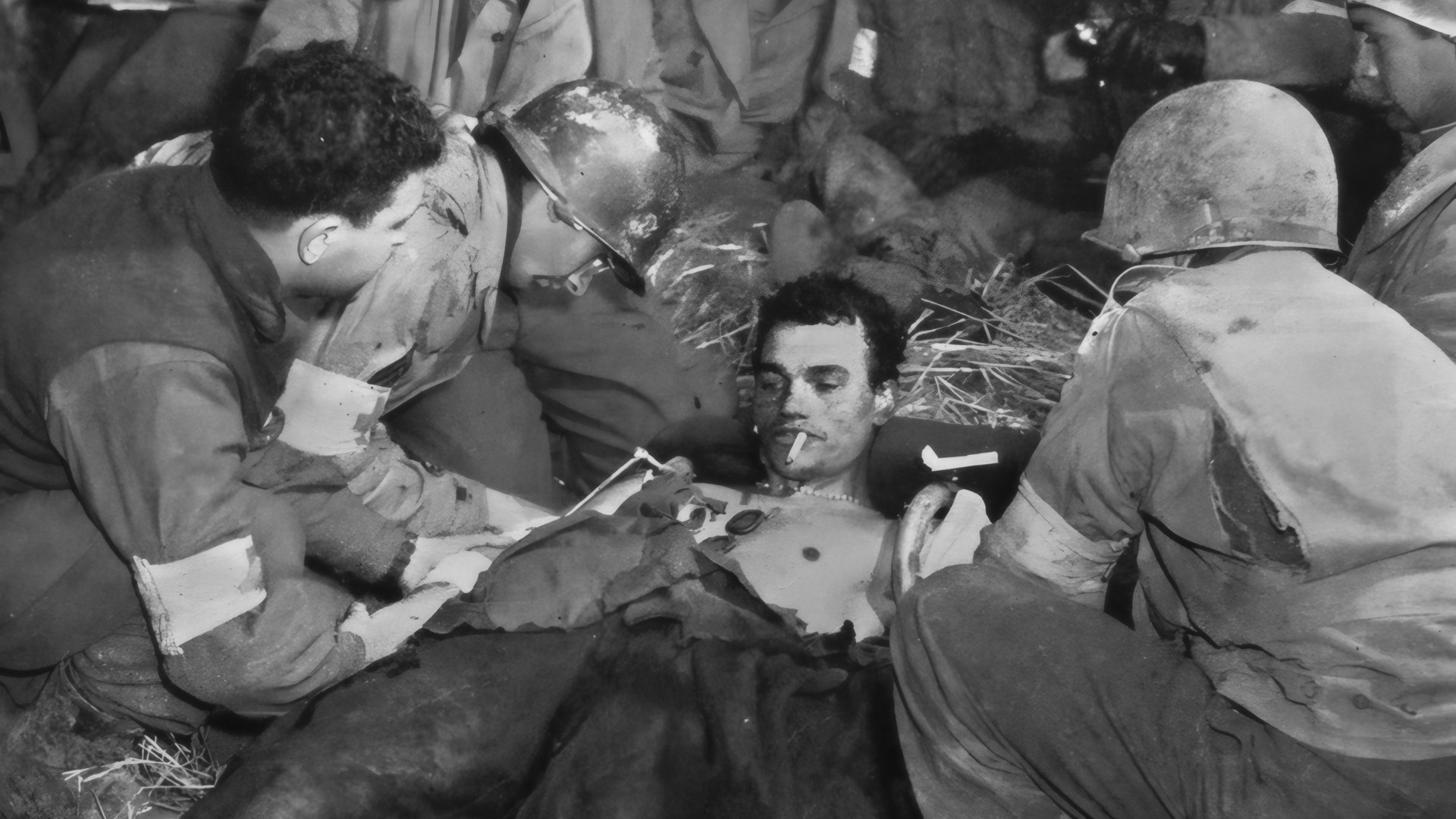
But the warning was too late. A sniper’s bullet hit Tipton in the chest. Toppling back into the foxhole, he choked out, “Murph,” as his body fell across his grief-stricken friend. “I never saw one drop of blood on Lattie,” Murphy recalled years later. “But I knew he was dead. The sniper bullet must have gotten him in the heart. He died so fast.”
For the moment, Murphy had no time to mourn the loss of his friend. He was in a tight predicament; the Germans knew exactly where he was. Instinctively, he tossed a hand grenade at the machine gun, finishing off its crew. Upon inspection of the damage, Murphy found one of the Germans with his chest torn open; the other soldier was killed by a fragment that pierced his eye. Fortunately, the blast didn’t damage the enemy gun.
Seizing the machine gun, Murphy quickly checked it, then held it against his hip like a Browning Automatic Rifle. Disregarding his personal safety, he advanced up the hill, shooting from the hip at anything that moved. With bullets flying all around him, Murphy assaulted the last two enemy machine-gun emplacements in the area. “I think the Germans were shocked to see just one man attacking them,” Godfrey said. “Murph just lost his head. When you lose a buddy like that it’s really tough.”

Once “Pillbox Hill” was neutralized, Murphy went back and dragged Tipton out of the foxhole, laid his body under a cork tree, and put a pillow beneath his head. As he checked Tipton’s personal effects he looked at the photograph of Claudean and cried. Godfrey recalled, “That was the first time and only time I ever saw Murphy cry.”
For his actions on “Pillbox Hill,” near the small town of Ramatuelle, France, Murphy was awarded the Distinguished Service Cross—the second-highest U.S. military combat award for valor. “He would’ve traded it for Lattie Tipton’s life in a heartbeat.”
This was the last resistance facing the 1st Battalion, 15th Regiment on “Pillbox Hill.” Murphy’s actions saved many lives, enabling 1st Battalion to quickly capture its objective.
Ironically, both the concrete pillbox and protruding coastal gun proved to be dummies. That afternoon, B Company and other elements of the 1st Battalion advanced on the village of Ramatuelle and bivouacked in the woods. The 3rd Battalion, 15th Regiment captured the town of St. Tropez on the night of August 15, and the 1st Battalion entered the town of Ramatuelle the following morning.
Murphy reorganized his 3rd Platoon and moved on. “Once again I saw the war as it was,” he remembered. “It was an endless series of lethal problems, some big, some small, that involved blood and guts of men. Lattie was dead, and I was alive. It was simple as that. The dead would lie where they had fallen; the living would move on and keep fighting. There was nothing else to do.”
Retired history teacher Daniel R. Champagne is the author of Dogface Soldiers: The Story of B Company, 15th Regiment, 3rd Infantry Division. He lives in Salem, New Hampshire.
I’m of the generation that came after these incredible soldiers. Murphy and his colleagues were stunningly capable — and I’m grateful.