By Gene Eric Salecker
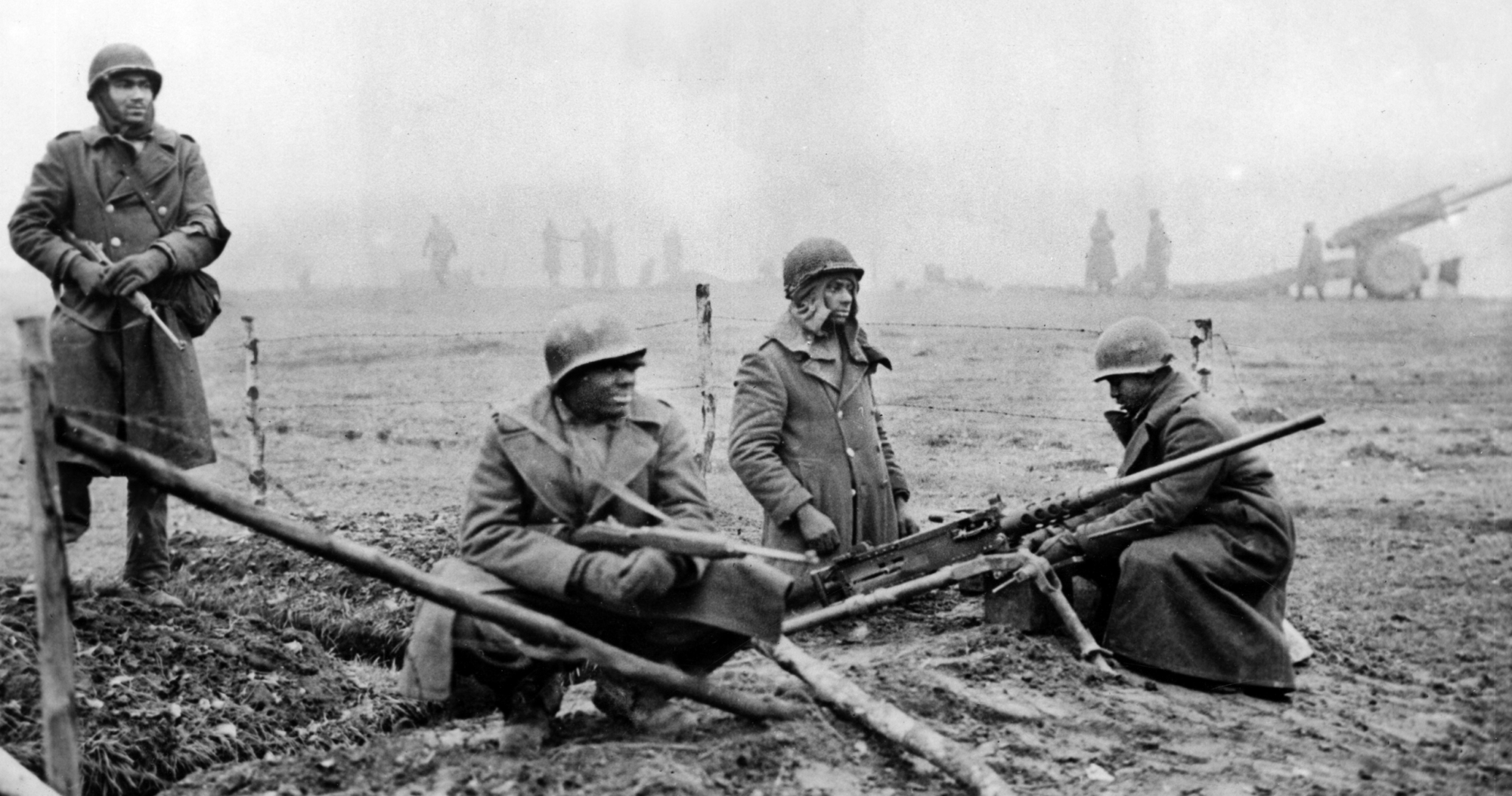
The 500 soldiers of the 333rd Field Artillery Battalion, an all-Black unit with white officers, held their positions in Schönberg, Belgium, along the Our River, six miles east of St. Vith, as shells pounded all around them from the Schnee Eifel—a central ridge in Western Germany that was heavily fortified as part of Germany’s Siegfried Line.
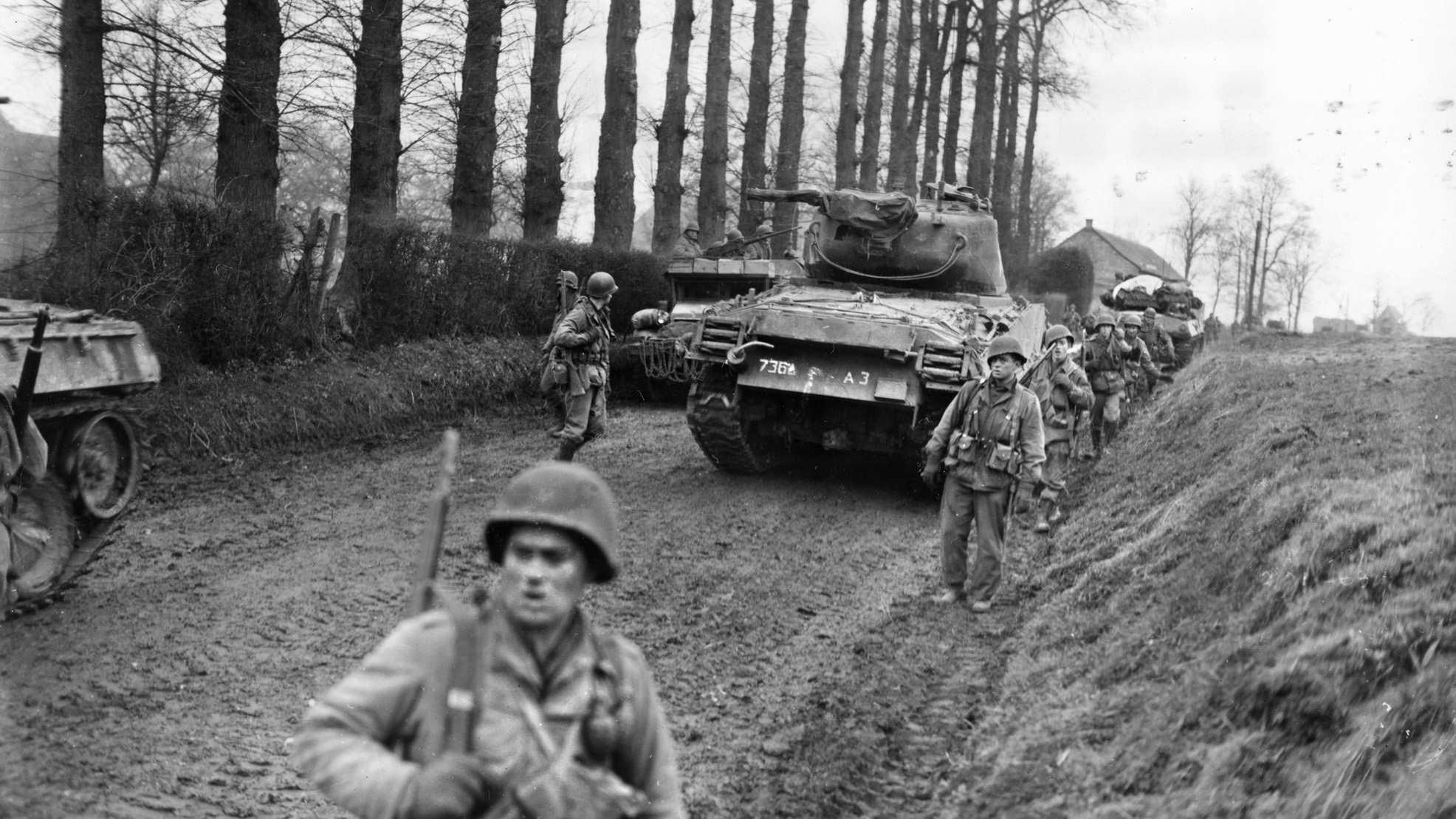
Unlike all of the other previous shelling by the Germans, which had been nothing more than harassing fire, this heavy bombardment in the early morning hours of December 16, 1944, felt like something different. Little did the hard-pressed soldiers huddled low in their foxholes realize that they were witnessing the start of what history would term the Battle of the Bulge.
The 333rd Field Artillery Battalion was originally formed as the segregated 333rd Field Artillery Regiment on August 5, 1917, during World War I and assigned to the 161st Field Artillery Brigade, 86th Infantry Division. Although sent to France, the unit saw no action and was returned to the United States and demobilized in early 1919. Ten years later, the regiment was reconstituted in the Organized Reserve, but in 1937 was deactivated once again.
After the United States entered World War II, the 333rd Field Artillery Regiment was activated as a “colored unit” at Camp Gruber, Oklahoma, on August 5, 1942, and assigned to the U.S. Third Army. On March 10, 1943, when the United States military reorganized the structure of its artillery units, the Headquarters and Headquarters Battery of the 333rd became the headquarters unit of the 333rd Field Artillery Group, the 1st Battalion became the 333rd Field Artillery Battalion, and the 2nd Battalion became the 969th Field Artillery Battalion. Both battalions were equipped and trained on the truck-drawn M114 155-mm howitzer.
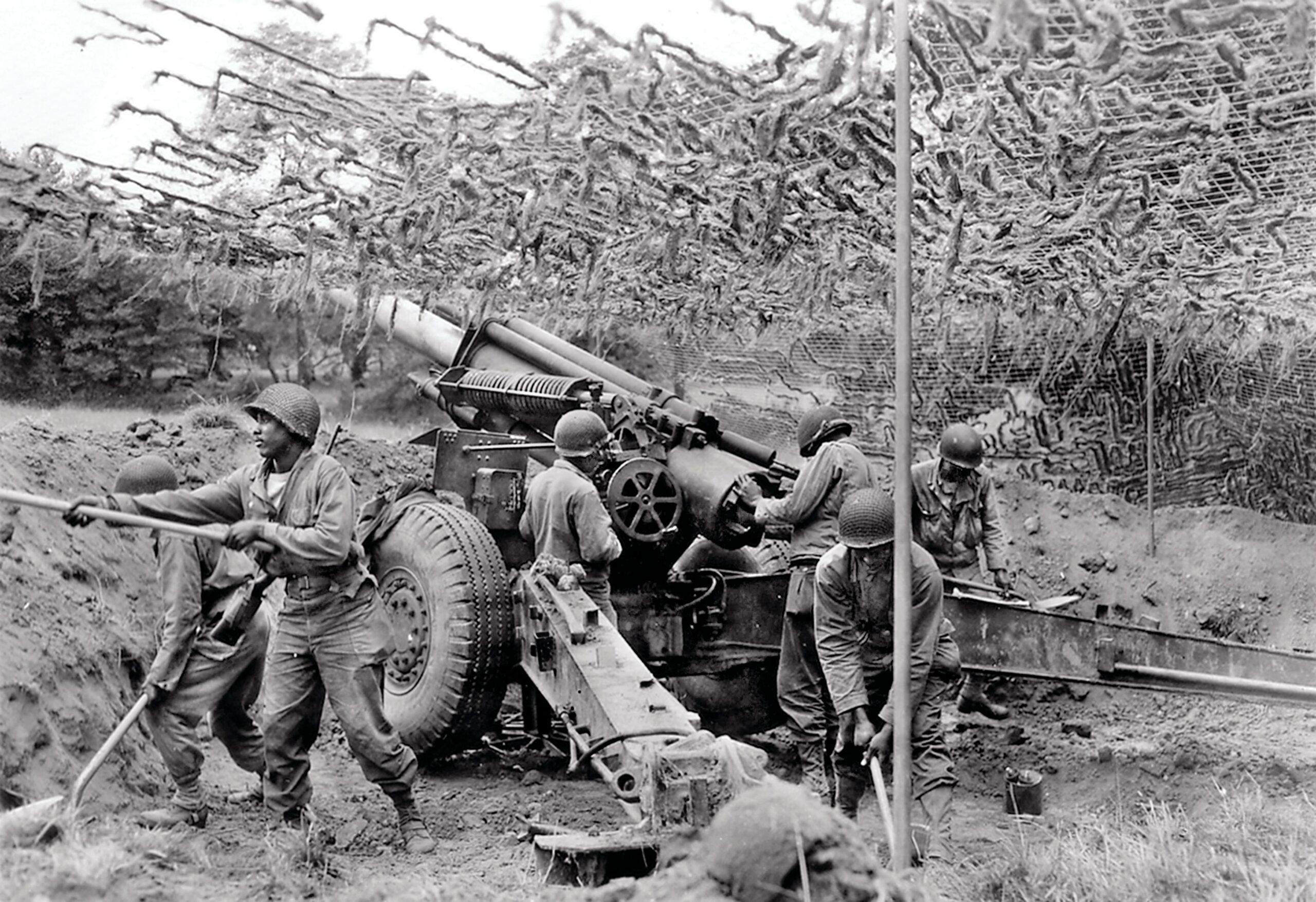
The 333rd Field Artillery Group (HQ and HQ Battery, 333rd Battalion, and 969th Battalion) arrived in England in February 1944 and was assigned to Maj. Gen. Troy Middleton’s VIII Army Corps. The group was shipped across the English Channel to Normandy on June 29, three weeks after D-Day, landing on Utah Beach. The baptism of fire for the men of the 333rd FAB came three days later, on July 1, when they were ordered to shell a German sniper/observation post in the tall steeple of a church in the French village of Pont-l’Abbé in support of the 82nd Airborne Division. The men took four shots at the tower, hitting it with three. For the rest of the day, they provided well-placed artillery fire in support of the attacking airborne and infantry.
Working in conjunction with the 90th Infantry Division, the 333rd Field Artillery Battalion was engaged in the fighting along the northwest coast of France, known as Brittany, and in the siege for the important port city of Brest at the end of August and into September. On September 28, two weeks after the fall of Brest, the 333rd Field Artillery Group began a trek across France toward Belgium, passing through the recently liberated French capital of Paris on the last day of September. On October 1, as the weather began to deteriorate with cold and rain, the Group moved into Houffalize, Belgium, a small village several miles northeast of the important crossroads town of Bastogne.
Over the next few days, the 333rd Field Artillery Battalion was separated from the Group and sent toward the town of St. Vith, 22 miles northeast of Houffalize and about 12 miles from the German border and the West Wall, or Siegfried Line. Houffalize was located within the Ardennes Forest, a heavily wooded and rugged area, and although Germany had men, vehicles, and artillery stationed throughout this area, the Ardennes was considered a quiet front. Typically, American units were sent there to rest and recuperate from the grueling campaigns of the summer or gain valuable experience before being sent to a hot sector.
During the first week of October, the 333rd Field Artillery Battalion was moved to Schönberg, Belgium, on the Our River, about six miles due east of St. Vith and only a few miles from the German border. To the immediate front of the 333rd FAB and Middleton’s VIII Corps was the heavily forested mountainous area known as the Schnee Eifel. The 333rd FAB and the other VIII Corps artillery units were stationed behind the quiet front lines to provide fire support for the 2nd Infantry Division, VIII Corps, which had been stationed along the border.
While the Headquarters and part of Headquarters (Service) Battery of the 333rd set up on the west side of the Our River, Able, Baker, and Charley Batteries and the other half of Service Battery set up on the east side. A few members of the battalion crossed into Germany and set up two observation posts near the small American-held hilltop village of Bleialf, just southwest of the Schnee Eifel and about 10 miles almost due south of Schönberg.
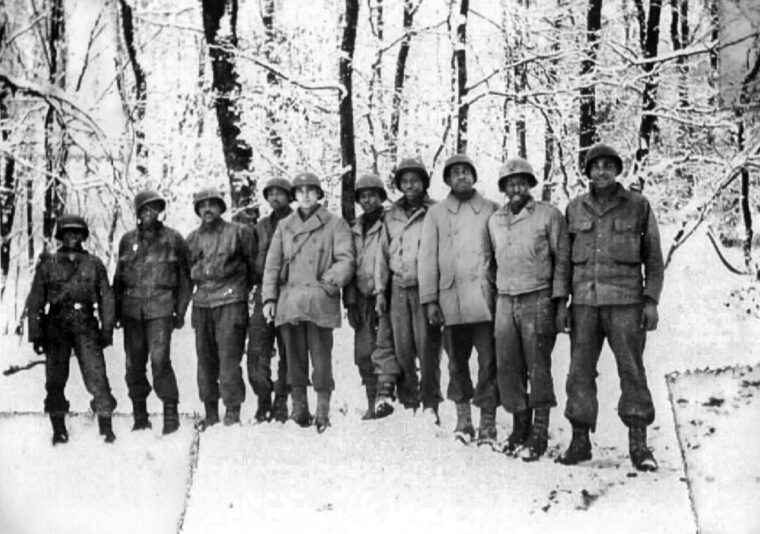
Throughout October and November, the Black artillerymen of the 333rd FAB fired almost daily support missions for the 2nd Infantry Division. The firing was light, averaging only 150 rounds per day. More than anything, the Black soldiers, mostly men from the southern United States and lacking winter coats, gloves, and especially boots, had to learn how to cope with the chilling, dropping temperatures and the deepening snows of the Schnee Eifel. In early December, the 2nd Division was transferred north to V Corps, out of the Schönberg area, and was replaced by the untested, green troops of the 106th Infantry Division. The 106th had arrived in England in mid-November and in France on December 6. On December 11 it began replacing the 2nd Division on the eerily quiet “Ghost Front,” quickly taking up positions along the German border as the green soldiers hoped to acclimate themselves to the front line.
Unfortunately, the new troops had no time to get ready. At dawn on December 16, 1944, Adolf Hitler began his Ardennes Campaign, trying to push a wedge through the American Army units in the Ardennes, retake the Belgian port city of Antwerp, and deal the Allies a crushing defeat. At 3 a.m., hundreds of German artillery rounds began pounding the northern sector of the Ardennes front preparatory to the attack by SS-Oberstgruppenführer (Colonel General) Josef “Sepp” Dietrich’s Sixth SS Panzer Army. After two-and-a-half hours, the shelling stopped and the German tanks and infantry surged forward.
In the center, around the Schnee Eifel, General Hasso von Manteuffel’s Fifth Panzer Army waited until 5:30 a.m. to start its artillery bombardment, sending his frontline troops forward as the artillery rounds were walked westward toward St. Vith. Instead of announcing his attack with the 3 a.m. bombardment, Manteuffel had reasoned that a short artillery strike followed by an immediate advance would catch the Americans in his sector off guard and unprepared.
Almost immediately, the small hilltop village of Bleialf came under heavy infantry attack. Besides the two observation posts of the 333rd FAB, Bleialf was occupied by troops of the 423rd Infantry Regiment of the 106th Division. Able, Baker, and Charley Batteries’ 155-mm howitzers responded quickly to calls for fire support, staving off repeated attacks throughout the day and preventing the village and the forward observation posts from being overrun.
North of Bleialf, atop the Schnee Eifel, the 422nd and the 423rd Infantry Regiments of the 106th Infantry Division met with little pressure as small groups of German troops from the 18th Volksgrenadier Division simply pinned them down with sporadic fire and half-hearted attacks while most of the division circled north and south of the Snow Mountain in an attempt to cut off and surround the green troops. All day long, the howitzers of the 333rd FAB fired upon the Germans attacking the front of the 106th Division lines and occasionally into the Wehrmacht troops encircling the mountain.
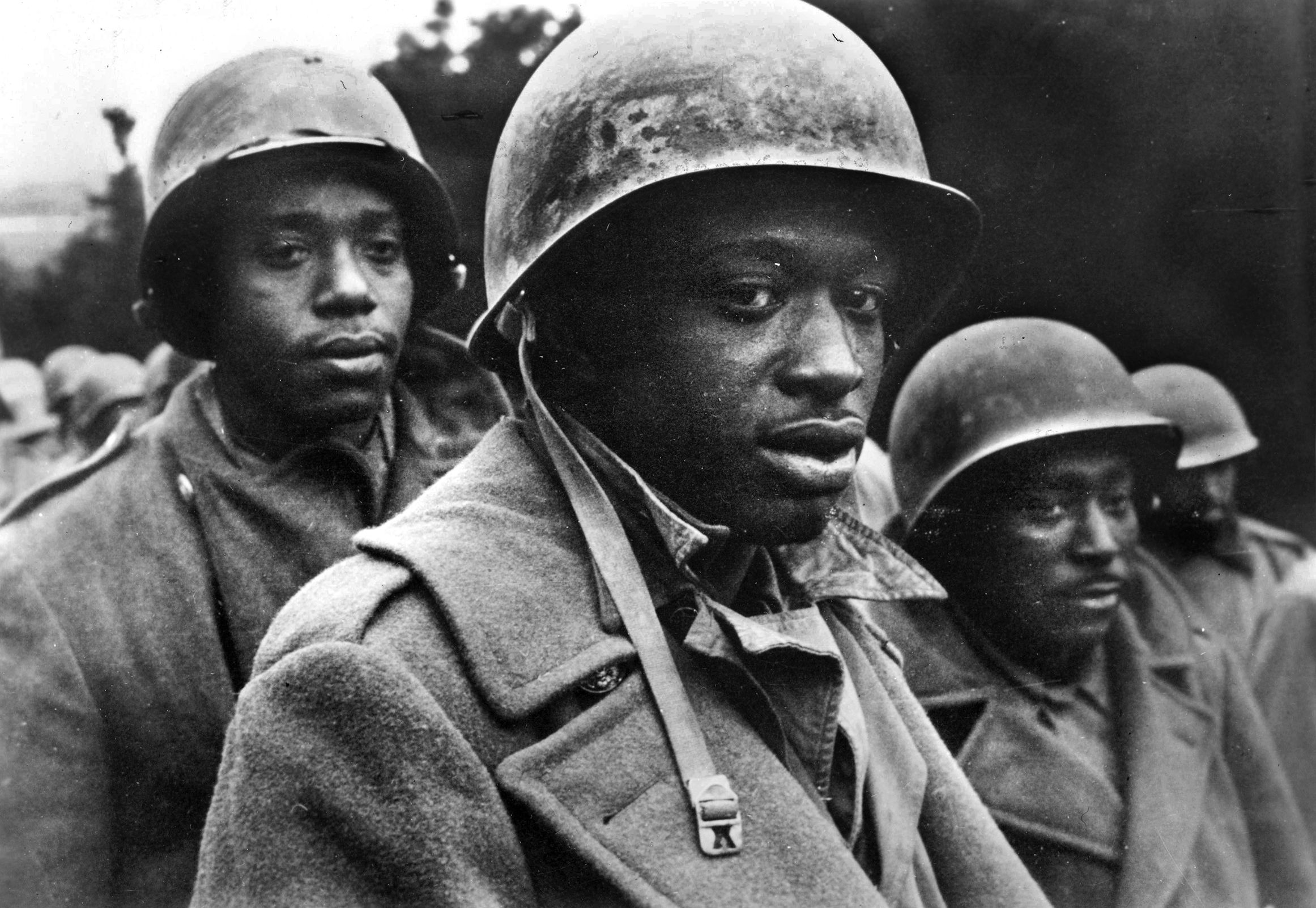
At the same time, German shells began to rain down upon the 333rd FAB, set up on both banks of the Our River. A few of the men were hit by shrapnel, and Private Curtis Adams, a Black medic from South Carolina, did his best under the circumstances to stop the bleeding and bind up the wounds. Although the German fire caused only a few casualties, it nevertheless tore up most of the telephone lines the Americans used for communications.
When Major General Alan W. Jones, commander of the 106th Infantry Division back in St. Vith, learned that German troops were encircling his two regiments entrenched on Schnee Eifel, he called Middleton, who had set up his headquarters in Bastogne. Jones asked for permission to pull his troops back, including the supporting artillery units. Unsure of the scope of the enemy attack at such an early hour, Middleton refused, instructing Jones to have his men hold tight.
The German troops advancing around the northern and southern edges of the Schnee Eifel had pressed hard throughout the morning and afternoon but had failed to capture the vital bridges over the Our River at Andler in the north, Schönberg in the center, and Steinebrück in the south. Small pockets of American defenders had held firm and put up stiff resistance, especially at the villages of Andler and Bleialf.
In Schönberg, Lieutenant Colonel Harmon S. Kelsey, commander of the 333rd FAB, was worried about the pincer movement and the heavy shelling he had been receiving throughout the day. Just after midnight he got permission to withdraw his battalion with the exception of Charley Battery and Service Battery back toward St. Vith. At the request of the 106th Division, Charley Battery and Service Battery, with one section on the west side of the Our River and one section on the east, would remain in place and continue to support the surrounded infantry.
It was already dark when Jones contacted Middleton a second time and once again asked for permission to pull his green infantrymen off the Schnee Eifel and from the Schönberg area. Speaking on an unsecured, improvised, crackling telephone line, the two generals tried to talk in coded language. In the end, all it managed to do was cause confusion. While Middleton ended the conversation believing that he had told Jones that he could finally withdraw his troops, Jones came away still believing that Middleton expected him to hold his position. The confusion would lead to the second-largest surrender of American troops in World War II, second only to the surrender at Bataan in the Philippines.
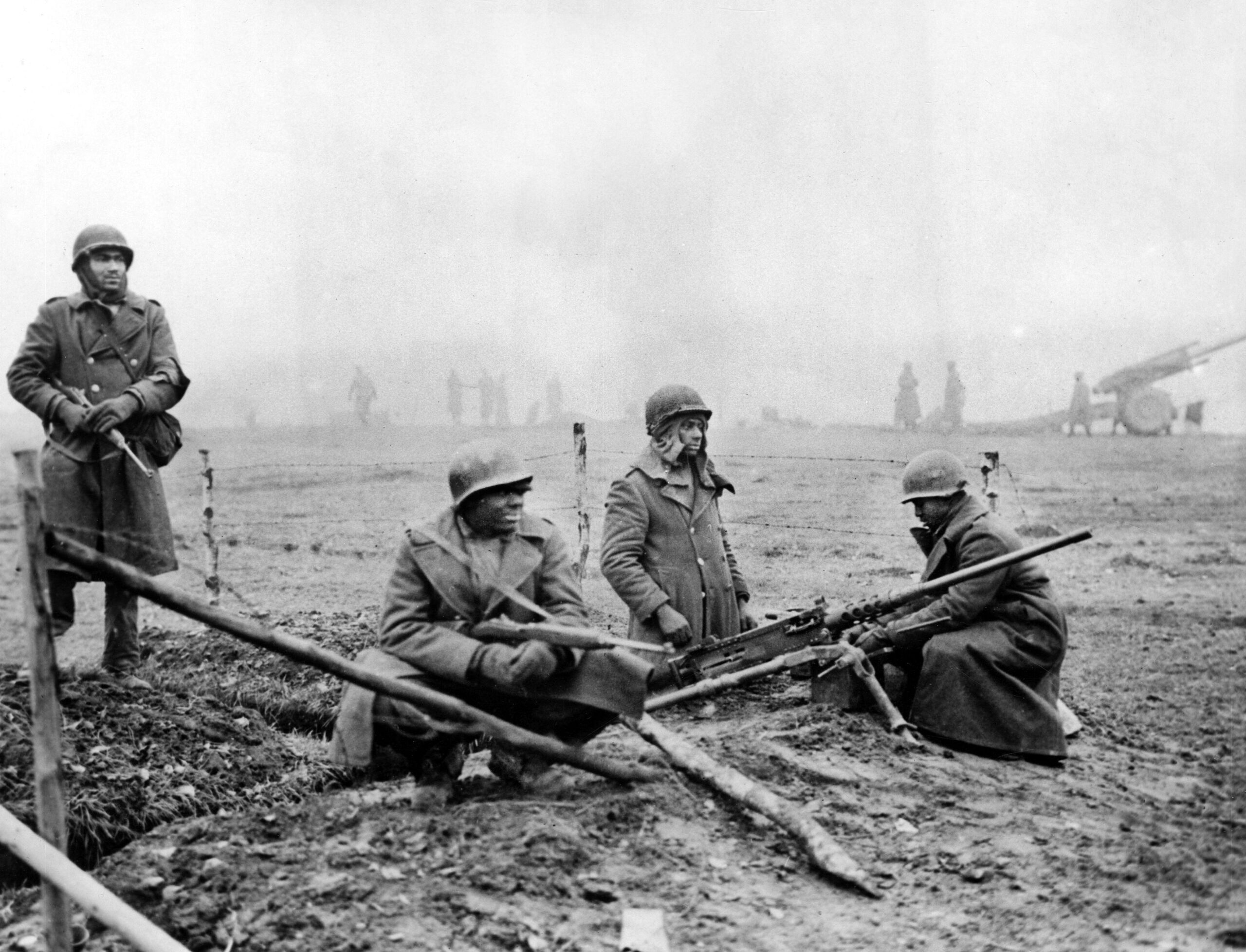
While units of the Sixth SS Panzer Army to the north stopped for the night to consolidate their gains, Manteuffel kept his tanks and infantry going, hoping to make up for lost time. By midnight his 18th Volksgrenadier Division finally captured Andler and one vital bridge across the Our River. Turning southward now along the western bank of the river, the Volksgrenadiers headed directly toward Schönberg.
All night long, Charley Battery and Service Battery fired shell after shell toward the German positions in response to calls from the 422nd and 423rd Infantry Regiments. At daybreak, they were almost totally out of ammunition. Near daylight on December 17, Kelsey received word that the village of Bleialf and the two observation posts of his 333rd FAB had finally fallen. At almost the same time, he was told to pull the section of Service Battery on the west side of the river out of Schönberg and send it back to St. Vith. Wasting no time, the Black artillerymen destroyed their 155-mm guns with thermite grenades and began racing west.
The Germans were pressing in heavily from the north, down the Andler–Schönberg Road, when Kelsey finally got orders to pull Charley Battery and the rest of Service Battery out from the east side of the river. In talking with Capt. William E. McLeod, the commanding officer of Charley Battery, Kelsey told him that he would personally be bringing trucks across the river to pick up the stranded artillerymen. Within minutes, Kelsey had three two-and-a-half ton trucks racing across the Schönberg bridge over the Our River.
The three trucks had just reached the position of Charley Battery and were loading the vehicles with wounded men when German infantry suddenly appeared and opened fire on the evacuating Americans. Although only partly loaded, Kelsey and the three trucks immediately raced off toward the Our River bridge while McLeod and his remaining men grabbed up their small arms and began fighting back against the approaching Volksgrenadiers. Knowing the way the German troops felt about Black Americans, the artillerymen fought stubbornly. “The fighting was very hard, very fierce. It was like Custer’s last stand,” Sergeant George E. Shomo of Charley Battery recalled: “I knew … what the German mind was as far as Black troops … we all figured we were gonna die so what the hell, die fighting.”
After several minutes of heavy fighting, however, McLeod knew that further resistance was futile. Hoping to save himself and his men, he waved a white compress bandage in the air and surrendered his position. Although roughly treated, McLeod, a white officer, and his Black artillerymen were rounded up and sent off to a German prisoner-of-war camp. Any wounded men, however, were shot dead on the field.
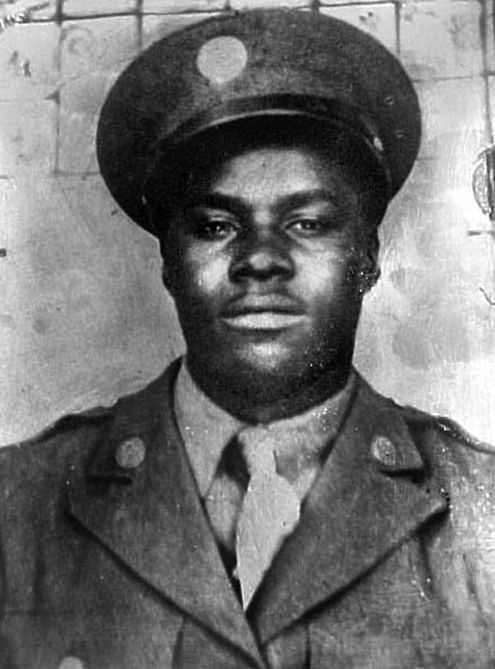
Having gotten away from the sudden German attack, the three Army trucks carrying Kelsey, most of the wounded, and a few able-bodied artillerymen raced westward across the Schönberg bridge. Somewhere on the road to St. Vith, the three trucks rounded a curve and unexpectedly ran into German infantry, halftracks, and tanks, troops that had advanced down the Andler–Schönberg Road. Almost immediately the three trucks came under heavy small-arms fire. “Jump! Run!” Kelsey shouted. As the able-bodied and the lesser-wounded artillerymen sprang out of the halted vehicles, a German tank plowed into the front of the lead truck.
With only a handful of weapons, resistance was futile, and the Germans quickly surrounded the fleeing men. Then, suddenly, a lone American P-47 Thunderbolt fighter plane appeared. Because of the heavy overcast, most of the American planes had been sidelined for the first two days of the Bulge, allowing the Germans to race over the frozen roads of Belgium almost unmolested. When the lone P-47 suddenly appeared in the sky over the halted American trucks and advancing German vehicles, it was totally unexpected. In the confusion caused by the ground fire from the Germans as they turned their rifles and machine guns toward the attacking plane, and the sustained bursts from the P-47 as it circled overhead once or twice, several of the surrounded American artillerymen disappeared into the snow-covered forest. The rest, including Kelsey and most of the wounded, wound up as prisoners and would spend the rest of the conflict in German POW camps.
Traveling in small groups or alone, many of the fleeing men headed north, away from the path of the advancing Volksgrenadiers. Eventually, 11 men, including Adams the medic, came together and pushed onward. Between them they had only two M1 carbines. Moving continually northward through deep snow until 3 p.m., the men reached the nine-house hamlet of Wereth, about five miles north of Schönberg. Wet and exhausted, with their hands, feet, and faces beginning to freeze, the men halted in the woods to decide what to do next.
Unfortunately, in their trek north, the eleven refugees from the 333rd and 969th Field Artillery Battalions had advanced out of the Fifth Panzer Army sector and into the Sixth SS Panzer Army sector under Dietrich. At the time that the 11 Black artillerymen were trudging through the knee-deep snow toward Wereth, forward elements of Dietrich’s advancing army, members of Obersturmbannführer (lieutenant colonel) Jochen Peiper’s Kampfgruppe Peiper, were massacring 84 surrendered American soldiers, mostly from Baker Battery, 285th Field Artillery Observation Battalion, near the town of Malmedy, 15 miles northwest of Wereth.
Once at Wereth, the 11 artillerymen decided that they would attempt to seek shelter in one of the village houses, hoping to thaw out their frozen hands and feet, get a little rest, and perhaps get something to eat before pushing on toward the American lines. Unfurling a white compress bandage, Adams held it aloft as he and the others moved slowly toward one of the houses. Inside was Mathias Langer, his wife Maria, seven children, and a neighbor lady and her daughter. Hidden in the basement were two Belgian deserters from the German Army. Although the 11 Americans were welcomed into the Langer house, this area of eastern Belgium had been a part of Germany until the end of World War I, and many of the inhabitants still considered themselves German. While the Langer family was quick to help the escaping Americans, others were not.
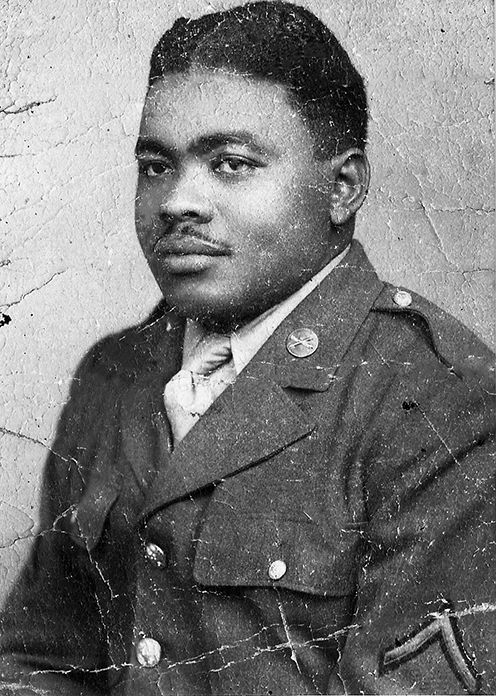
Once inside the warm house, the 11 men were given hot coffee, bread, and jam as they tried to warm their frozen extremities. Maria Langer bandaged the injured hand of Staff Sgt. Thomas J. Forte of Mississippi and gave a small crucifix to Adams, perhaps after noticing the small Bible that he was carrying in one of his field jacket pockets. In return, T/4 James Aubrey Stewart from West Virginia gave some gum to the Langer children and Cpl. Mager Bradley of Mississippi gave a bar of sweet-smelling soap to Maria.
Within an hour after their arrival, an amphibious Schwimmwagen (swim car) stopped in front of the Langer house and four Waffen SS soldiers quickly jumped out. Someone in the village had tipped the Germans off to the presence of the fleeing Americans.
Although the Langer family urged the men to try and escape out the back and into the woods, T/4 Stewart told the Langers that they did not wish to endanger the people within the house. The 11 men surrendered without a fight. Immediately, the Americans were paraded outside and forced to sit in the snow with their backs against a wall of the house. While a couple of the SS soldiers, later identified as members of Schnelle Gruppe Knittel (Fast Group Knittel), the reconnaissance battalion of the 1st SS Panzer Division Leibstandarte SS Adolf Hitler, sat in the warm schwimmwagen guarding the prisoners, two others went for reinforcements. A half hour later, with the sun almost down, a few more vehicles and SS men arrived, and the artillerymen were forced to get to their feet and begin running down the road out of town in front of the vehicles.
While the exact sequence of events remains uncertain, the people of Wereth and the Langer family suddenly heard shots once the American and German soldiers were out of sight. For a long time, single shots and bursts of machine-gun fire reverberated against the snow-covered pine trees encircling the little hamlet of Wereth. After 15 minutes or so, it was quiet again. The atrocity of the Malmedy Massacre had been repeated at Wereth.
As well as can be surmised, it appears as though the first American to be killed was T/4 William Edward Pritchett of Alabama, hit by one of the German vehicles which then ran over his legs multiple times. As he lay on the ground, he was shot in the shoulder and then had his head bashed in by a rifle butt.
The next to die may have been Sergeant Forte. He, too, was hit and run over multiple times by one of the German vehicles. Perhaps in raising his hand in a defensive move, four fingers were sliced off. Medic Adams, T/4 Stewart, and T/5 Robert Leroy Green of Georgia, all “had their skulls bashed in, hit with a hard object from behind.” The bodies of Pfc. George Davis Jr. from Alabama, Pvt. Nathaniel Moss and Pfc. George Washington Moton, both from Texas, and Pfc. Due William Turner, of Arkansas, were shot multiple times. Two of the artillerymen, Pfc. James Lee Leatherwood and Corporal Mager Bradley, both from Mississippi, tried to make a run for it. Shot multiple times, their bodies were found in a cow pasture near the road.
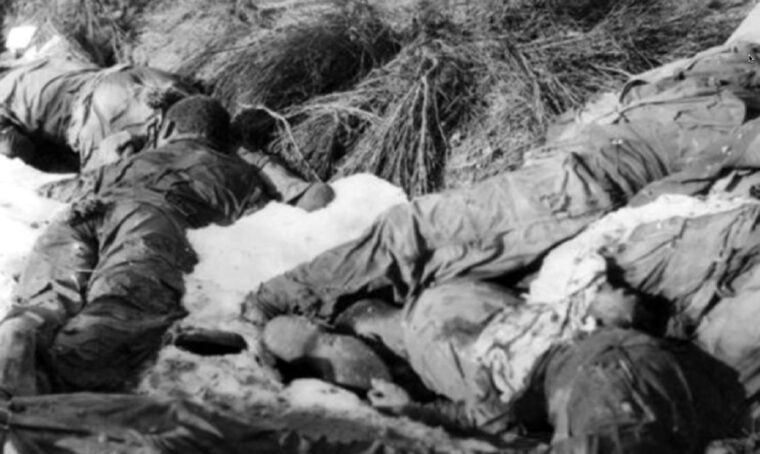
In February 1945, after lying hidden under snow for two months, the 11 bodies were recovered by the United States Army. Captain William Everett examined each body and reported: “Many of the men’s eyes have been bayoneted out, and their heads and bodies stabbed multiple times. Most have suffered fractures to their skulls, believed to have been made by rifle butt blows to the head. Tire marks on their bodies indicate some of the men have been run over by vehicles before dying. All the men have been shot, the bullet wounds designed to inflict pain and anguish, rather than cause immediate death.” It was evident according to Everett’s examination that the men had suffered terribly at the hands of the racist SS soldiers before dying.
Although much of Charley Battery had been captured around Schönberg, a few men made it all the way back to Bastogne, where they joined other survivors of the 333rd Field Artillery Battalion. Incorporated into their sister battalion, the 969th FAB, in the defense of Bastogne, both segregated units received the Presidential Unit Citation, the Army’s highest unit award, for their part in defending the beleaguered city.
Because the 333rd FAB had been overrun in those first few days of the Battle of the Bulge, it bears the distinction of having suffered the highest losses of any artillery unit in VIII Corps. Six officers, including battalion commander Lt. Col. Kelsey and Charley Battery commander Capt. McLeod, and 222 enlisted men were either killed or captured during the Bulge. The battalion lost nine 155-mm howitzers, 34 trucks, and 12 weapons carriers. The 286 remaining men were reassigned to either the 969th FAB or another all-Black unit, the 578th Field Artillery Battalion. The 333rd Field Artillery Battalion was not reconstituted until April 1945, and finally deactivated on June 10, 1945, in Germany.
Although eleven Black American soldiers had been butchered near Wereth, Belgium, on December 17, 1944, no German officer or unit was ever held accountable. While all 11 men were buried shortly after their bodies were found, four bodies (Bradley, Green, Leatherwood, and Pritchett) were reclaimed in 1947 and reburied in the United States. The other seven (Adams, Davis, Forte, Moss, Moton, Stewart, and Turner) all rest in Henri-Chapelle American Cemetery and Memorial in Plombières, Belgium, along with nearly 8,000 other American war dead.
Although the Wereth Massacre was almost forgotten for 50 years, one person remembered—Hermann Langer, the son of Mathias Langer. Only 12 years old in 1944, Hermann never forgot the African-American artillerymen, the first Black people he had ever met. On September 11, 1994, Langer erected a small stone cross at the spot where the 11 men had been murdered. On May 23, 2004, the Belgians erected a beautiful new monument to the Wereth 11, as well as to all the African-American soldiers and sailors that fought in the European Theater. It is thought to be the only memorial specifically dedicated to African-American servicemen of World War II in Europe.
In 2006, members of the Worcester, Massachusetts, chapter of the Veterans of the Battle of the Bulge dedicated the first memorial to the Wereth 11 on United States soil at Massachusetts Veterans Memorial Cemetery in Winchendon. Ten years later, a small monument was erected in Miller Park in Bloomington, Illinois. The monument is inscribed with the names and states of all eleven soldiers. An inscription at the top states, “In Memory of the 11 African American Soldiers Massacred, Known as the ‘Wereth 11.’”

Join The Conversation
Comments
View All Comments