By Kevin O’Beirne
The warm spring breeze blew the still-new green of the trees about Falmouth, Virginia, as the last of three rousing cheers echoed into the sky. Formed in a hollow square was the Army of the Potomac’s Irish Brigade, and at their center was their famous commander, Brig. Gen. Thomas Francis Meagher. It was May 19, 1863, and the cheer was the last that would be raised for Meagher, as he was taking leave of his command, which was now merely a shell of its former self. The battle of Chancellorsville was barely a week past and, as usual, the Irish Brigade had again suffered heavy casualties. Meagher had made enemies in high places and again was refused permission to return to New York City to recruit for the Brigade’s depleted ranks. Only five days earlier, he had tendered his resignation in disgust and protest—an action that he would later regret. As Meagher rode off, command of the Brigade, now numbering barely half of a single full regiment, passed to the senior colonel, Patrick Kelly of the 88th New York.
Kelly, 42, was a native of County Galway, who possessed a quiet demeanor and a calm assurance under fire; he was an ideal man to take charge after Meagher. Kelly took stock of his command, consisting of the 63rd, 69th, and 88th New York, 28th Massachusetts, and 116th Pennsylvania. The Brigade consisted of seasoned veterans, but had been reduced to only 530 men by more than a year of hard fighting in battles such as Fair Oaks, Gaines’ Mill, White Oak Swamp, Glendale, Malvern Hill, Antietam, Fredericksburg, and Chancellorsville. Without replacements, there was nothing to do but pick up the pieces and carry on.
For almost a full month after Meagher’s departure, the Irish Brigade returned to the routine of life along the Rappahannock River, including picket duty and fatigue details. On June 14, the Brigade quit their camps and began a long trek north. The Army of the Potomac, commanded by Maj. Gen. George Meade, had two-and-a-half weeks of hard marching ahead in their effort to catch up with Gen. Robert E. Lee’s Confederate Army of Northern Virginia at the small Pennsylvania town of Gettysburg.
The Irish Brigade was part of the 1st Division of the II Corps. Before the Gettysburg campaign, command of the corps, considered perhaps the best unit in the Union army, had passed to Maj. Gen. Winfield Scott Hancock. The Irish Brigade’s division commander was Brig. Gen. John C. Caldwell, a 30-year-old lawyer from Maine.
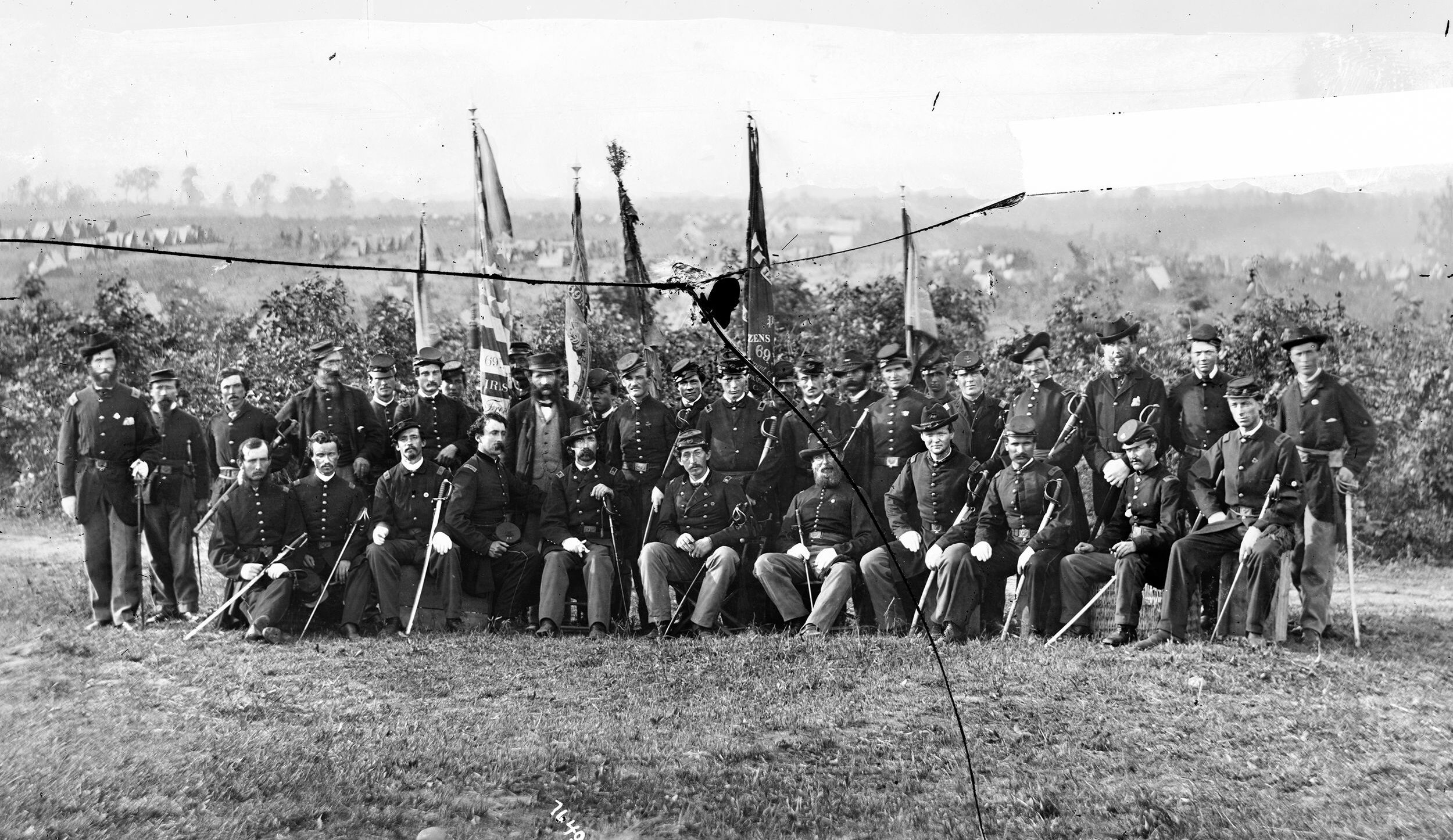
Kelly’s veterans were ostensibly organized into five regiments, but only one, the 28th Massachusetts, had enough men, 224, to actually be called a regiment; the 28th was commanded by Col. Richard Byrnes a native of Ireland’s County Cavan. The 116th Pennsylvania had only 66 men in four companies, reportedly making it the smallest battalion in the whole army; the 116th was led by Maj. St. Clair Mulholland, who hailed from County Antrim. The three New York regiments were so fearfully reduced—the 63rd New York mustered 75 men, the 69th had just over 70, and the 88th had about 90 in its ranks—that, earlier in June, they had been officially redesignated “battalions,” each with only two companies. The three New York battalions essentially functioned as a single regiment under the command of Lt. Col. Richard Bentley of the 63rd, a native of Albany, New York. The 69th was commanded by Capt. Richard Moroney of Lockport, New York, and the 88th was led by Capt. Denis Burke of County Cork.
After a series of hot, dusty marches, Kelly reported, “About 10 p.m. on the 1st [of July], we arrived within 2 or 3 miles of Gettysburg, [and] bivouacked in an adjacent field.” Kelly ordered pickets posted and the footsore soldiers bedded down along the Taneytown Pike. In less than six hours, the men were awakened, placed in line, weapons inspected and, “at 4:30 a.m. the next morning [July 2], marched toward Gettysburg.” The II Corps arrived behind Cemetery Ridge by 7 a.m., where they waited to be assigned a place in the Federal line; at this location, an order from General Meade was read to the men of the Brigade. The order read, in part,“The commanding general requests that previous to the engagement soon expected with the enemy, corps and all other commanding officers will address their troops, explaining to them briefly the immense issues involved in this struggle…. Corps and other commanders are authorized to order the instant death of any soldier who fails in his duty at this hour.”
After an hour, the II Corps was ordered to fill a hole between the I Corps on Cemetery Hill and Maj. Gen. Daniel Sickles’ III Corps, farther to the left (south). The Irish Brigade arrived on the crest of Cemetery Ridge, a half-mile or so south of Evergreen Cemetery (near the present-day site of the Pennsylvania State Monument), probably at about 8 a.m.
On Cemetery Ridge, General Caldwell formed the division in columns of brigades, with each brigade in column of battalions closed in mass. Caldwell’s men were on the II Corps left, and Plum Run creek was about 300 yards to the Federals’ front. Two small hills, Round Top and Little Round Top, loomed a little more than a mile or so off to the left of the Irishmen. Arms were stacked and the colors furled and placed on top, the command, “Rest!” was given, and the men were allowed to fall out to boil coffee and eat while officers congregated in small groups. The day’s fighting had not begun and for a time the air was quiet. A member of the 116th Pennsylvania recalled, “in the woods back of our line, the birds caroled and sang…our horses quietly browsed in the rich grass.”
As the morning wore on, the sun climbed higher in the sky and the July heat became intense. From their slight eminence on Cemetery Ridge, the Irishmen strained to look west, past the high ground along the Emmitsburg Road, to the Confederate army’s positions over a mile away on Seminary Ridge. Everyone knew that the calm would not last through the day.
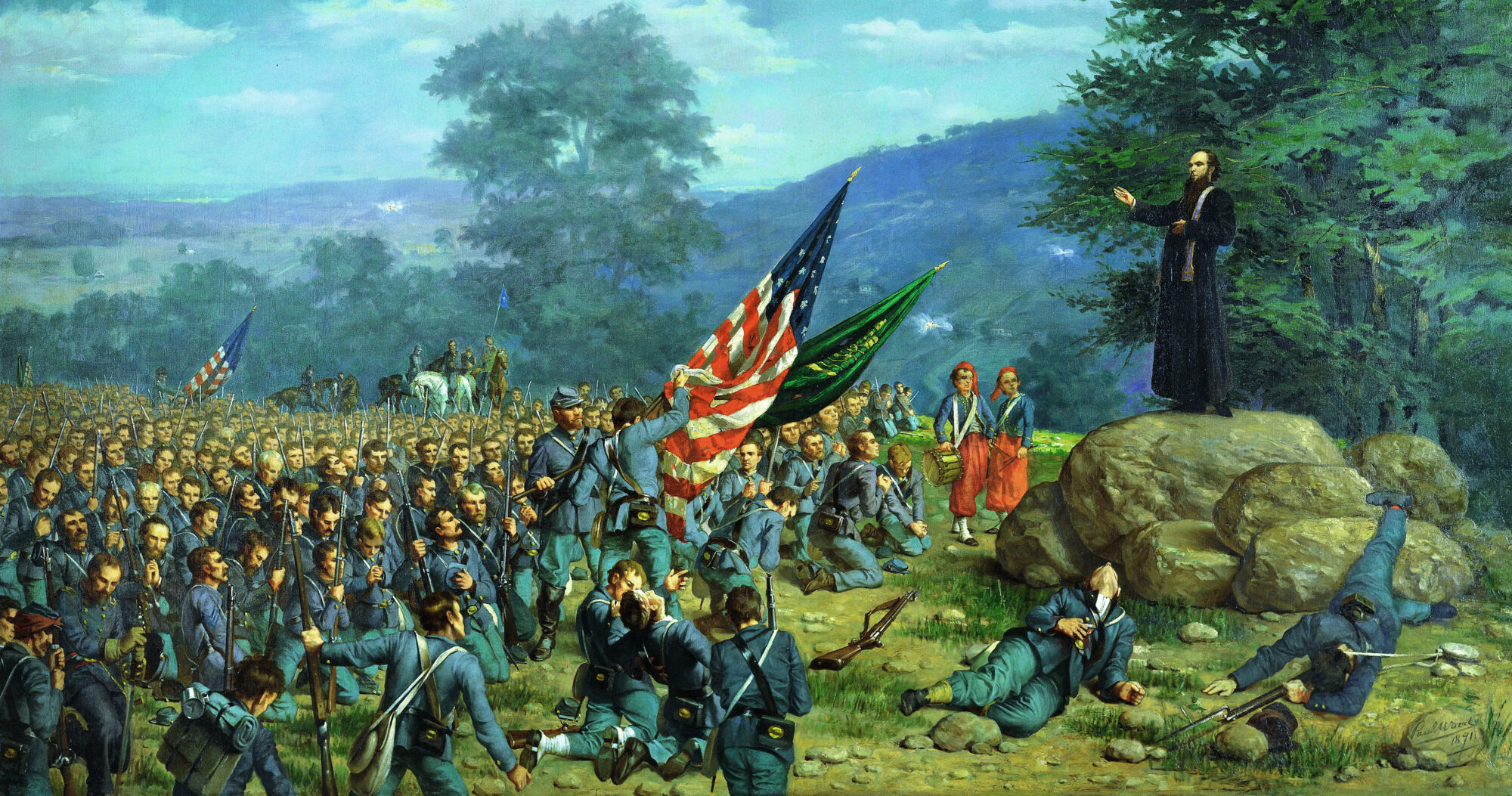
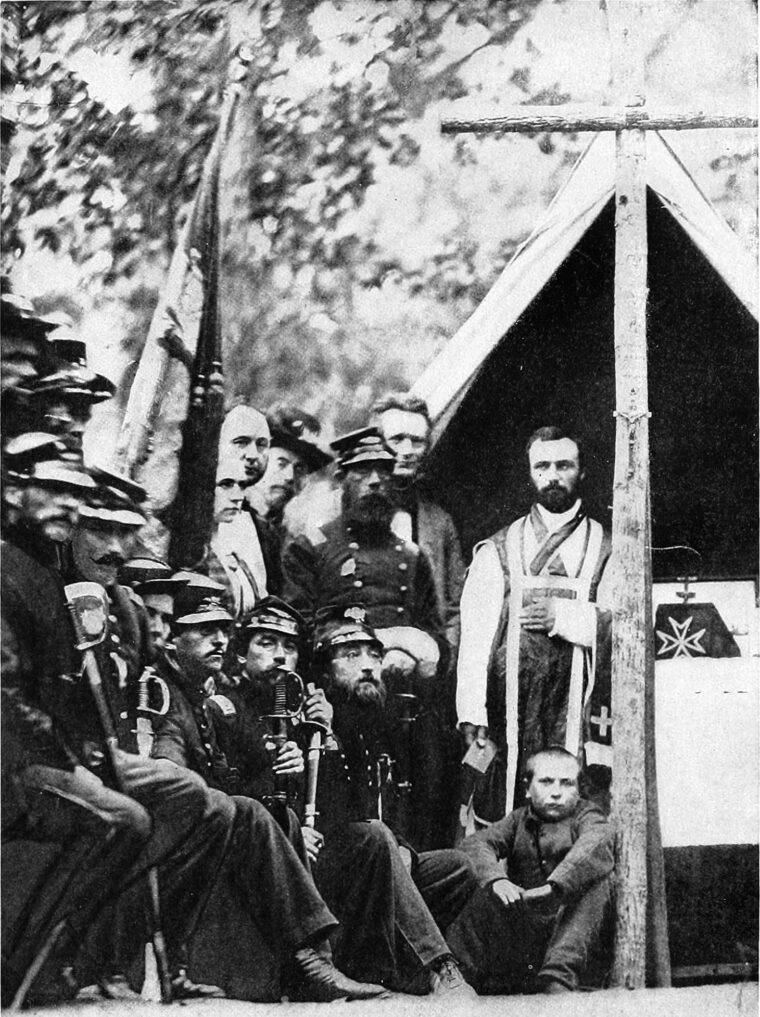
About 10 a.m., off to the Irish Brigade’s left, the sound of picket firing started over on the III Corps’s front, beyond the Emmitsburg Road. The “pop-pop” intensified into occasional volleys and soon artillery shells were falling in the vicinity of Caldwell’s men. The Irish Brigade’s Catholic chaplain, a 28-year-old Detroit native named Father William Corby of the 88th New York, thought that the unit was soon to be committed to battle. Receiving permission from Colonel Kelly, Corby mounted a “large rock” in front of the Brigade and prepared to give the Catholic rite of General Absolution to the men.
Battalion commanders ordered the men to their feet. The 116th Pennsylvania was in the first line and was closest to Corby, followed by part of the 28th Massachusetts in a second line; the third line comprised the balance of the 28th and all of the 69th New York, and the fourth line included the 88th and 63rd New York. Corby had given General Absolution to the Brigade before, most notably while under fire at Antietam the previous September, but never before had he done so in public with so many witnesses. Major Mulholland, who stood directly in front of Corby, later wrote of the Absolution, “the scene was more than impressive, it was awe-inspiring.” The distant skirmish fire continued unabated as artillery shells continued to drop on Cemetery Ridge.
Corby first told the men what he was about to do, and noted that the benefit of Absolution would be valid only if each man made a sincere Act of Contrition. Corby further urged the men to do their duty well and ominously warned that the Church would “refuse Christian burial to the soldier who turns his back upon the foe or deserts the flag.” With the priest’s preparatory concluded, the 530 men of the Brigade fell on their knees, as Corby stretched out his hand and uttered the Latin words of Absolution. One officer recalled, “I do not think there was a man in the brigade who did not offer up a heartfelt prayer. For some it was their last—they knelt there in their grave-clothes.” The act was witnessed by the entire II Corps, and even the usually-profane Hancock reportedly doffed his hat. The scene moved at least one minister in a nearby brigade to begin preaching to his own men. However, the artillery fire soon slackened and the order to stand down was received. The Irish Brigade would have to wait several more hours before again falling in.
Throughout the afternoon, some of the Irish “indulged in a quiet game of euchre, while others toasted their hardtack or fried a little bacon at the small fires in the rear of the lines.” About 3 p.m., sensing that something was coming, the men dropped their cards and congregated on the crest of the ridge just as Sickles’ III Corps began its fateful, unauthorized advance toward the Emmitsburg Road. After consulting with one of his division commanders, Brig. Gen. John Gibbon, General Hancock rode over to the Irish Brigade—always one of his favorite units—dismounted, kneeled down, and leaned on his sword. Hancock smiled tightly and said to Colonel Kelly, Colonel Byrnes, Lt. Col. Bentley, Major Mulholland, and the other Irish commanders, “Wait a moment, you will soon see them come tumbling back.”
Hancock’s smile must have belied some apprehension, as the Irish Brigade and the rest of the division was ordered to fall in, take arms, and was marched off toward Little Round Top, within supporting distance of Sickles. Kelly later reported that the Irish Brigade marched about a half-mile in this movement. Nothing happened and, when Federal troops of Brig. Gen. James Barnes’s V Corps division were seen advancing to Sickles’ support, Caldwell ordered the division back to its starting point on the crest of Cemetery Ridge. Anticipating action at any moment, the Irishmen resumed their wait.
About 4:15 p.m., as the Irishmen watched, “someone called out,‘there’…where a puff of smoke is seen arising out of the dark green woods across from the Emmitsburg Pike. Another and another, until soon the whole face of the forest is enveloped…the shells are seen bursting in all directions along the lines.” Immediately after, the first wave of Confederate Lt. Gen. James Longstreet’s assault broke on the left of the III Corps. Sickles had 10,000 men in two divisions, supported by Barnes’s division, and fought stubbornly but was slowly forced back. Longstreet’s attack rolled northward en echelon along the Federal line, as successive Rebel brigades moved to the assault in a series of shattering blows.
At 5 p.m., as the III Corps’s situation worsened and fighting began to move toward the crucial position of Little Round Top, Hancock ordered his left-most division, Caldwell’s, to reinforce the III Corps. The battalions fell in and reclaimed their weapons from the neat stacks of muskets. “Left, Face!” was ordered and the division moved off southward in columns; Col. Edward Cross’s brigade led, followed by the diminutive, regiment-sized Irish Brigade marching in four parallel columns, each four abreast and about 35-men long; the brigades of Col. John Brooke and Brig. Gen. Samuel Zook brought up the rear. All told, Caldwell’s division numbered only 3,300 men.
The division moved by the left flank at the “quick time”—an average rate of marching— along the west face of Cemetery Ridge toward the fighting that raged in Devil’s Den and around the Rose farm to the southwest. The left flank of Maj. Gen. Birney’s III Corps division was being pushed northward through Devil’s Den toward Little Round Top, while his right flank, Col. Philip de Trobriand’s brigade supported by Barnes’s V Corps division, was located in the woods near the northern boundary of the Rose farm—at the south edge of a large Wheatfield. De Trobriand’s men beat back an assault by Brig. Gen. George Anderson’s Confederate Brigade (Hood’s Division) while Barnes fretted. Barnes had qualms about the position because his right flank, which stretched toward but did not touch the Peach Orchard, was unsupported, although Confederate troops had not yet appeared on that part of the field. Barnes’s misgivings about his position would prove nearly disastrous for the Federals.
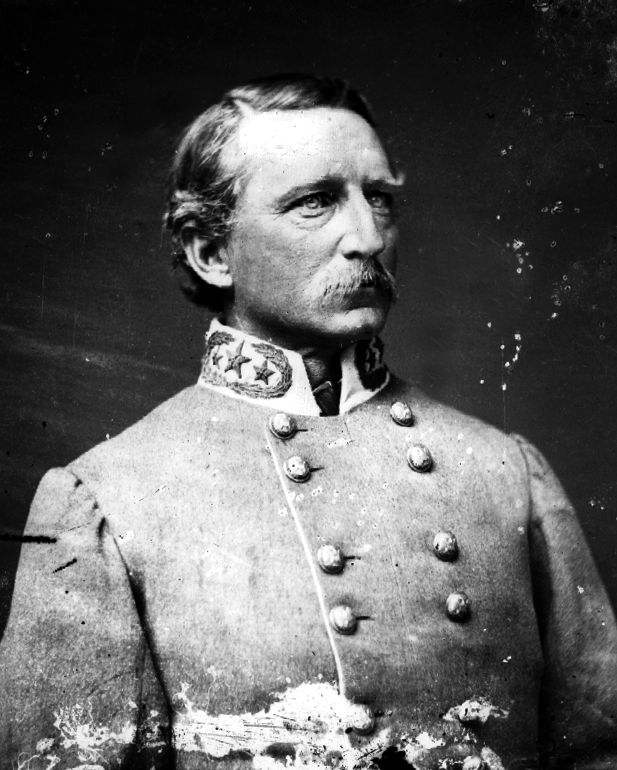
To Anderson’s left, the next Confederate unit in line was Brig. Gen. Joseph Kershaw’s South Carolina brigade of Maj. Gen. Lafayette McLaws’s division. After falling back, Anderson’s men rallied and with Kershaw’s brigade, advanced and pitched into de Trobriand’s and Barnes’s line. DeTrobriand’s men held their ground but, as Kershaw’s right wing approached Barnes’s division in the woods, Barnes inexplicably ordered a retreat. Unsupported and heavily engaged with Anderson, de Trobriand’s men were forced to fall back fighting. Around this time, the Federal position in Devil’s Den, to the east/southeast of the Wheatfield, crumbled. In the vicinity of the Wheatfield, a gaping hole had been opened in the blue coats’ line. If the Federal position were to avoid total collapse, Caldwell’s II Corps Yankees could not arrive too soon.
Caldwell’s men continued their southward march toward the scene of the crisis. Unbeknownst to Caldwell, a III Corps staff officer intercepted Zook’s brigade and diverted it southwest into Trostle’s woods, northwest of the Wheatfield. Just as Caldwell’s division came within sight of Weikert’s farm, a staff officer from Federal V Corps commander Maj. Gen. George Sykes ordered Caldwell to bolster the Federal line south of the Wheatfield, where de Trobriand’s and Barnes’s men had just given way. As the Irish Brigade marched on, Rebel shells rained down and “threw the earth in showers over the men”, wounding Lt. Col. Bentley of the 63rd New York.
Caldwell’s brigades were ordered, “By file right, double-quick, march!” Led by Cross’s brigade, the division turned west, splashed across Plum Run, and entered Trostle’s woods at a jog, moving parallel to the north edge of the Wheatfield. Cross began to place his men into line in the eastern portion of Trostle woods and the Irish Brigade, next in line, marched around Cross’s rear and emerged at the center of the north end of the Wheatfield. Upon Kelly’s order, the Irish Brigade’s tiny battalions halted, formed a single column, and fronted but, due to their initial alignment on Cemetery Ridge, they were facing the wrong way. The Irish commanders ordered “About face!,” so that the battalions were faced toward the south; the file closers (sergeants and lieutenants who normally marched directly behind the two ranks of privates and corporals) moved to the new rear and the lines were straightened and aligned.
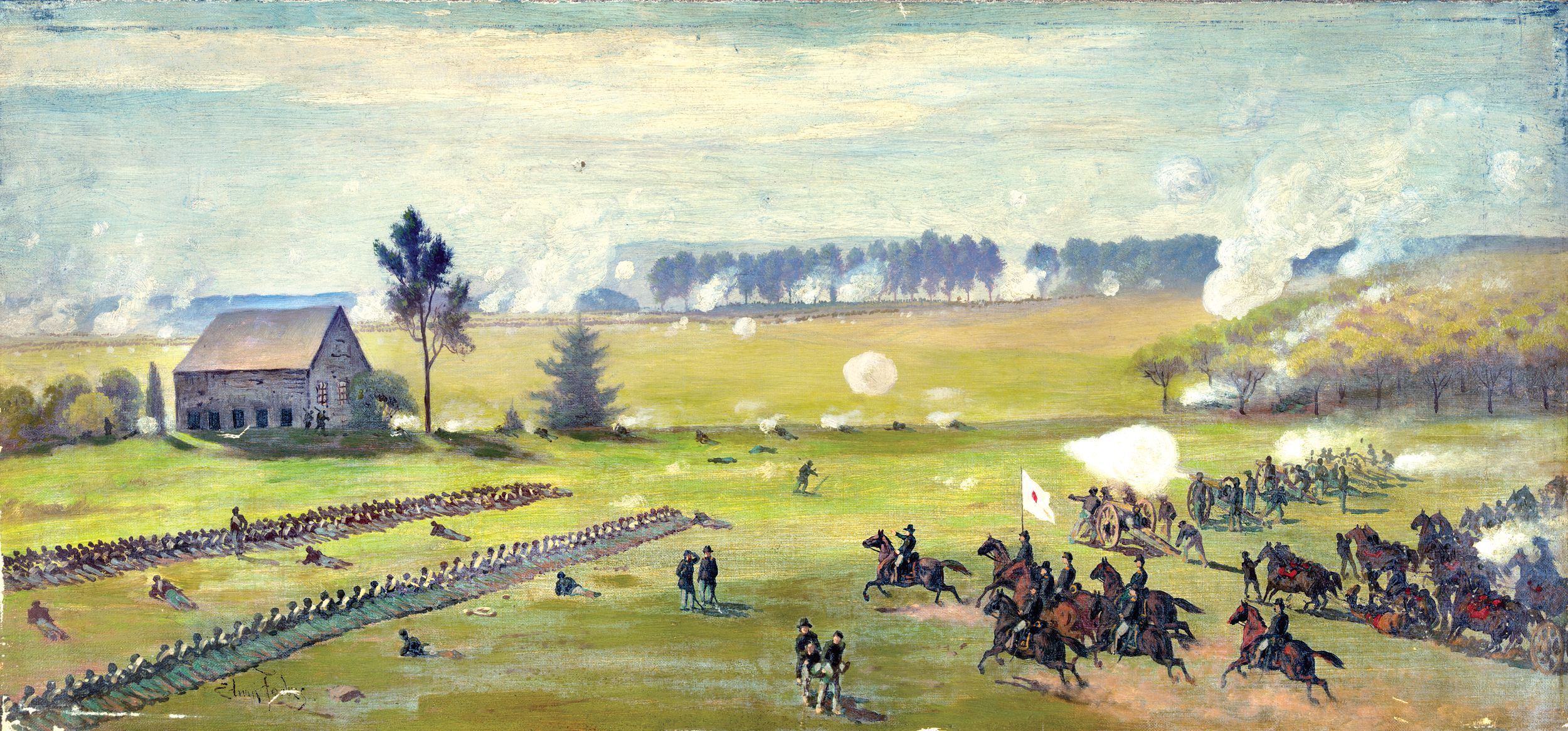
The Irish Brigade was arranged in a single two-rank battle line on a front that was barely 150 yards long, with the 63rd New York on the left, followed by the 88th, 69th, 28th, and 116th. The Irish formed at the center of the north edge of the Wheatfield, on Cross’s right; to the west, Zook’s wayward brigade was already advancing across the Wheatfield, and Brooke’s brigade formed behind Cross and Kelly. Apparently, no skirmishers were thrown forward from the Federal line. As soon as their lines were formed, Cross and Kelly commenced their advance into the golden field of wheat.
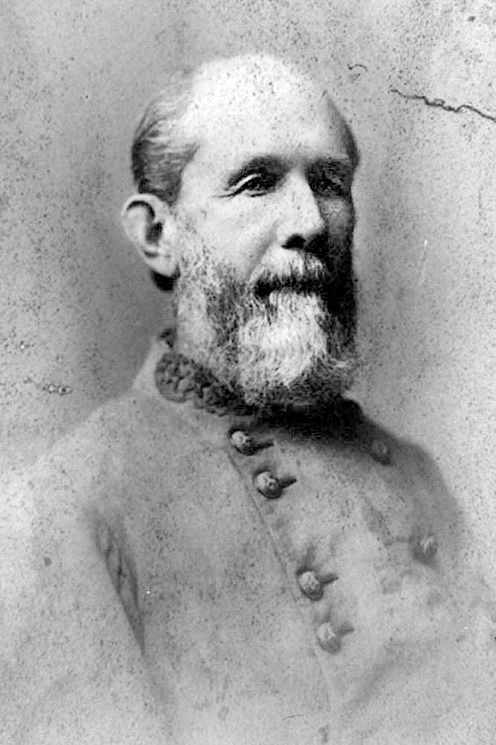
Five hundred yards or more to the south, the 1,800 Confederates of Kershaw’s brigade were advancing north from the Rose House toward the Wheatfield. Kershaw was supported on his right (east) flank by Anderson; Brig. Gen. Semmes’ and William Wofford’s brigades of McLaws’ Division were advancing to support Kershaw’s left. Kershaw detached the left wing of his brigade to deal with some troublesome III Corps artillery to the northwest of the Wheatfield near the Peach Orchard, while the 800 men of the 3rd and 7th South Carolina finished chasing off the last of Barnes’s Yankees. Kershaw ordered the Carolinians forward into the woods that separated the Rose farm from the Wheatfield beyond. The tired Rebels clambered through the trees up a local topographical high point described by General Kershaw as, “a stony hill, covered with heavy timber and thick undergrowth, interspersed with bowlders [sic] and large fragments of rock”; this outcropping, more-or-less an extension of the rugged terrain of Devil’s Den to the southeast, was known forever afterward as simply, “the Stony Hill.” The time was about 5:30 p.m.
To the north, the Irish Brigade and Zook’s brigade marched southwestward on a collision course with Kershaw’s men. One officer of Kelly’s command remembered, “As we advanced, portions of the Third Corps retired, passing through the intervals in our line.” Caldwell’s men were now the Federals’ front line. The ripening wheat was almost to the middle of the men’s chests, and the Irish battalion commanders ordered their men to “Right shoulder shift arms.” The 28th Massachusetts was armed with modern 1857 .577-caliber Enfield rifle-muskets, but the rest of the Brigade, more than half of the men, carried .69- caliber 1842 Springfield smoothbores. The smooth bore weapons were of little use at extended ranges but, because their “buck-and-ball” ammunition comprised a .64-caliber slug and three .30-caliber buckshot, the weapons were deadly at the type of close-range fighting in which the Brigade was soon to be engaged. An officer of the 63rd New York recalled that each man went in with 60 rounds of ammunition.
Kershaw’s 3rd and 7th South Carolina became jumbled in the advance to the Stony Hill and were not properly positioned when they began to climb up over the boulders to the crest. The Rebels gained the top of Stony Hill while the Irish Brigade was still 200 yards away. At this point, Zook’s brigade was closer to the Stony Hill than Kelly’s brigade, and much of the 3rd South Carolina opened fire on Zook’s men. As the Irish approached, the South Carolinians identified the familiar green flags—Kershaw’s men had helped defend the stone wall of Fredericksburg against the Irish Brigade the previous December—and the 7th South Carolina let loose the first volley. Kelly remembered, “they poured into us a brisk fire while [we were] advancing.” The 116th Pennsylvania’s Major Mulholland later recalled, “their shots, for the most part, passed over our heads.” Knowing that most of his men’s weapons were ineffective at this range, Kelly ignored the Southern volleys and kept his men moving forward.
The Irish Brigade marched on, finally halting at the west edge of the Wheatfield at the very foot of the Stony Hill, less than 100 feet from the South Carolinians. A member of the 116th Pennsylvania, looking up into the trees, spied gray movement and yelled, “There they are!” Reportedly without waiting for orders, the Irish aimed and let loose a deadly volley of .69-caliber buck-and-ball. Standing atop the Stony Hill, Kershaw remembered, “the advancing Federals…poured into us from their whole line.” Because they had to stand and lean over the boulders to fire downward, the men of the 7th South Carolina were exposed and vulnerable. One Irish officer grimly noted, “the effect of our fire was deadly in the extreme, for, under the circumstances, a blind man could not have missed the mark.” A man in the 69th New York wrote, “after our line delivered one or two volleys, the enemy were noticed to waver.” Kelly called for the Irish to charge up the Stony Hill to close with the enemy. The Brigade scrambled up the steep, rocky slope with muskets at “right shoulder shift.” One Irish participant remembered that there was “a cheer, a few quick strides, and we were on the crest among the enemy.”
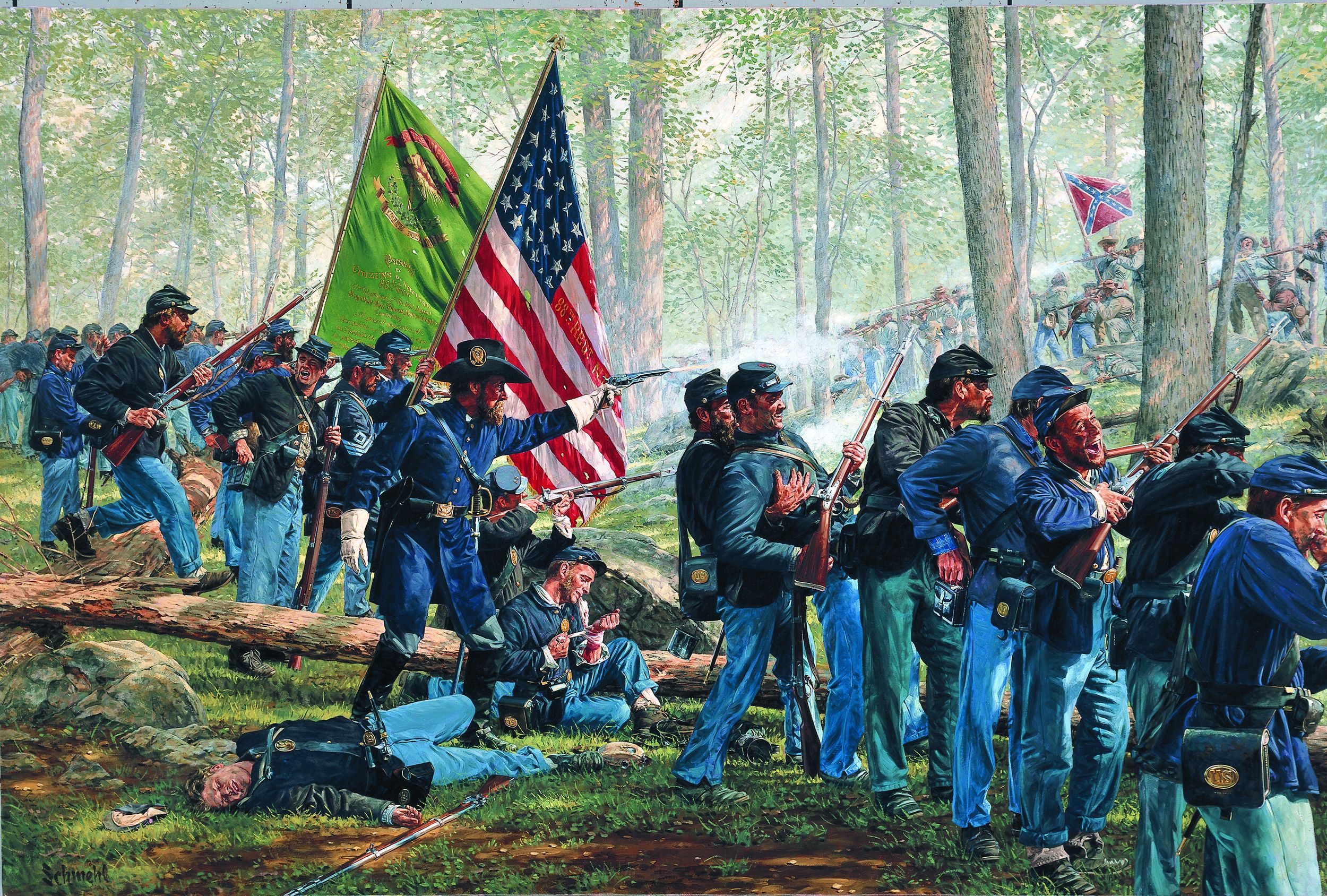
At the top, hand-to-hand combat ensued amongst the rocks in the woods in a whirling melee as bayonets and musket butts were used with effect, while officers fired pistols at targets less than 10 feet away. Kershaw later wrote, “I was never in a hotter place.” The bearer of the 28th Massachusetts’s green flag wrote, “it was a hot place[—]our little brigade fought like heroes.” Dozens of men on both sides fell in the clash, and soon the Confederates, who were in numbers more-or-less equal to the Irish, began to give way. On the Brigade’s right, Major Mulholland later claimed that he jumped on a boulder and yelled, “Confederate troops! Lay down your arms and go to the rear!,” which was supposedly obeyed by a large number of Rebels. Under pressure from Zook’s brigade and threatened with flanking fire by the 116th Pennsylvania and the 28th Massachusetts, Kershaw’s 3rd South Carolina also withdrew and a brief calm descended on Stony Hill.
As the survivors of the 3rd South Carolina’s right wing took off southward toward the Rose House, the Pennsylvanians and Massachusetts men quickly examined the height they had gained. The effect of the Irish Brigade’s fire had been devastating and one Federal later remembered that the crest of the Stony Hill was, “covered with [Rebel] dead, nearly every one of them being hit in the head and upper body. Behind one large rock five men lay dead in a heap.”
Lieutenant Charles Grainger of the 88th New York related an amusing incident in which, “a captured Confederate colonel was sitting comfortably sheltered behind a rock and laughing until tears rolled down his cheeks, while a private of the 88th and one of the 69th N.Y. had dropped their muskets and were hammering on each other with their fists in order to decide which took the prisoner.” Grainger himself, on his way to the rear with a “shattered elbow,” escorted the Rebel officer away while the two men pummeled each other.
Meanwhile, to the Irish Brigade’s left, Cross’ Federals had engaged Anderson’s Confederate brigade on the east end of the Wheatfield and, to the Irish right, Zook’s men turned their attention to Kershaw’s left (west) wing. Soon, Brooke’s Yankees, who were Caldwell’s only reserve, were committed to a gap between Cross and the Irish. Caldwell called for support from Col. Jacob Sweitzer’s V Corps brigade.
On the left flank of the Irish Brigade, the New York battalions were steadily driving the 7th South Carolina’s right wing back through the woods, threatening to flank Kershaw’s entire brigade. A member of the 88th New York wrote, “officers and men….[were] cheering and encouraging their comrades in the thickest of the fight.” The firing was hot and dozens of Irish veterans went down dead and wounded. Kelly later wrote, “We…drove them a considerable distance, and sent a great many prisoners to the rear.”
The Irish continued to advance, driving the Carolinians southward as bullets and cannonballs continued to fall thickly. Near the center of the line, Colonel Byrnes of the 28th Massachusetts reported, “We…advanced over the top and almost to the bottom of the other side of the [stony] hill, being all the time exposed to a very severe fire of musketry.” Zook’s brigade continued to press Kershaw’s left wing. Afterward, Kershaw related that both his flanks were turned but the Carolinians continued to fight doggedly; the 3rd and 7th South Carolina lost 197 men that day, many of them in combat with the Irish Brigade.
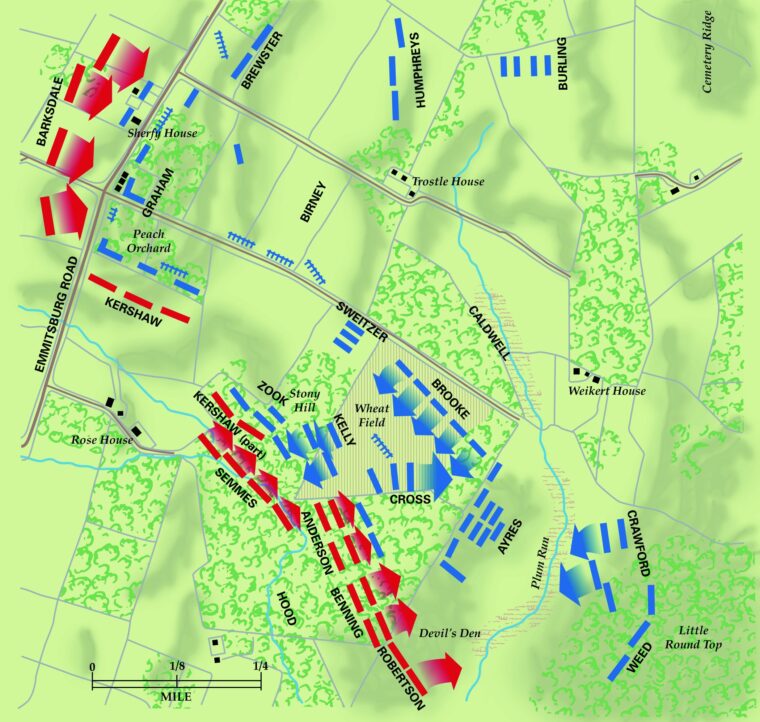
While the New Yorkers and Byrnes’s men were engaged, firing in front of the 116th slackened for almost 15 minutes. Mulholland scouted off to his right and was alarmed to see to the west “what I believed to be a column of the enemy passing through the peach orchard and to the rear of our division.” Kelly was notified, but smoke from the fighting near the peach orchard and from Zook’s brigade to the right-rear prevented a clear view. Mulholland had, in fact, seen Wofford’s Confederate brigade advancing on the right flank of Caldwell’s division. To the south, the New Yorkers of the 69th, 88th, and 63rd observed elements of Semmes’ Confederate brigade coming up to reinforce Kershaw’s right flank in front of the Irish Brigade. The 50th Georgia of Semmes’ brigade assaulted Kelly’s New York units and the Irishmen “again opened fire, the enemy having rallied to oppose our further advance.”
Wofford’s 1,400 Georgians were bearing down inexorably on the right flank of Kelly and Zook, while a renewed assault by Anderson and Semmes drove back Brooke’s brigade and the Irish left. Soon, the Irish Brigade became the front tip of a salient that was rapidly being pinched off from both flanks. Kelly dryly remembered, “Finding myself in this very disagreeable position, I ordered the brigade to fall back, firing.” The rest of Caldwell’s division also retreated, first in a semblance of order and then in an urgent running mass.
Unsupported on both flanks, the Irish line collapsed like the rest. A member of the 69th New York reported, “It was impossible after falling back to rally the men” and “great confusion” reigned in the Federal ranks. On Kelly’s left, the 63rd, 88th, and 69th New York broke for the rear at the double-quick. On the Irish right, Mulholland remembered, “I quickly told the men of my own command [the 116th] the danger and for each one to look to his own safety.” The Major told the men to make for an area just north of Little Round Top and recalled, “I rolled up the colors and with some thirty men ran through the woods to the Wheatfield; here we were in a trap.” The men of the Irish Brigade tumbled back down the Stony Hill, emerged from the forest, and re-entered the Wheatfield.
Anderson’s and Semmes’ Rebels advanced from the south, Wofford’s Georgians bore in from the west, and Kershaw’s men advanced from the south/southwest back up the Stony Hill. All these units poured lead into Caldwell’s Federals, who were retreating through the wheat. The Irish had to run a deadly gauntlet back through the Wheatfield where, noted a survivor, “we encountered the full sweep of the enemy’s fire, which…was very destructive.” Kelly averred, “we…encountered a most terrific fire and narrowly escaped being captured.” Years later, recalling the horror of running back through the Wheatfield, Mulholland shivered, “we caught it from both sides, the slaughter here being appalling, but we kept on, the men loading and firing as they ran.” With the colors, Mulholland reached safety with only 10 of the 30 men with which he had started the dangerous race. The fact that any of the Irish Brigade escaped at all is probably down to the fact that, as the Federal retreat started, Sweitzer’s V Corps brigade (Barnes’s division) advanced into the wheatfield in belated support of Caldwell, and wound up not only covering Caldwell’s retreat, but also suffering heavy casualties for their trouble.
Kelly’s survivors finally made it through Trostle’s woods, kept going past Little Round Top, and reformed on the Taneytown Pike in back of Cemetery Ridge. Miraculously, the Irish Brigade brought all of its flags safely back to Federal lines. The tiny brigade had been virtually destroyed, losing 36 percent of its strength. Going into the fight with 530 men, the Irish Brigade lost about 193 of them in that hour; Byrnes’s 28th Massachusetts bore the brunt of the loss, suffering 91 dead, wounded, and missing out of 224 who started the charge. Overall, Caldwell’s division suffered as badly as the Irish, losing almost 1,300 men out of 3,300 in less than an hour of fighting.
Aside from the casualties, in the confusion of the hasty withdrawal, the Irish battalions were further scattered and reduced. When they emerged from the wheatfield, many officers of the Brigade later recounted, they had scant numbers of men with them—two to ten men per company was common. After rallying on the Taneytown Pike in the last hour or so of daylight, and while the fury of Longstreet’s assault washed against the crest of Cemetery Ridge and then subsided, the remnant of the Brigade marched back to the center of Cemetery Ridge as full darkness fell, arriving back at the position where they had spent most of the day.
The Irish Brigade spent the morning of the next day, July 3, building breastworks from stones and rails, behind which they took shelter when the Confederate artillery bombardment that preceded Pickett’s Charge commenced; only one man of the Brigade was wounded in the barrage. Kelly’s men took no active part in repelling Pickett’s assault, because they were posted about 500 yards south of the copse of trees that was ably defended by the Irish 69th Pennsylvania and the rest of Gibbon’s II Corps division. However, several members of the 28th Massachusetts, armed with long-ranged Enfield rifle-muskets, took potshots at the gray brigades of Brig. Gen. Cadrius Wilcox and Colonel David Lang (Hill’s Corps), and several surrendering Confederates entered captivity through the Brigade’s lines in the aftermath of the Rebels’ doomed assault. After helping to bury the dead on July 4, the Irish Brigade and the rest of the II Corps took up the southward pursuit of the retreating graybacks on the 5th.
Gettysburg would be another entry in the Irish Brigade’s history of gallant actions. Though its ranks were sadly decimated, it was the bravery of the Brigade and Caldwell’s division that stalled the Confederates’ July 2 attack toward the undefended Federal center on Cemetery Ridge for that crucial hour—making an important contribution to the ultimate Union victory in the battle.
After Gettysburg, the Brigade would soldier on for almost two more years. Under Kelly’s command, the small band of Celts would fight at Bristoe Station, Auburn, and in the Mine Run campaign prior to the close of 1863. In early 1864, recruited up to a strength of over 2,000, the rejuvenated Brigade saw furious action in the Overland and Petersburg campaigns. Kelly was killed in battle at the head of the Irish Brigade at Petersburg on June 16, 1864; many others who lived through Gettysburg would likewise not see the Confederate surrender at Appomattox Court House in April 1865.
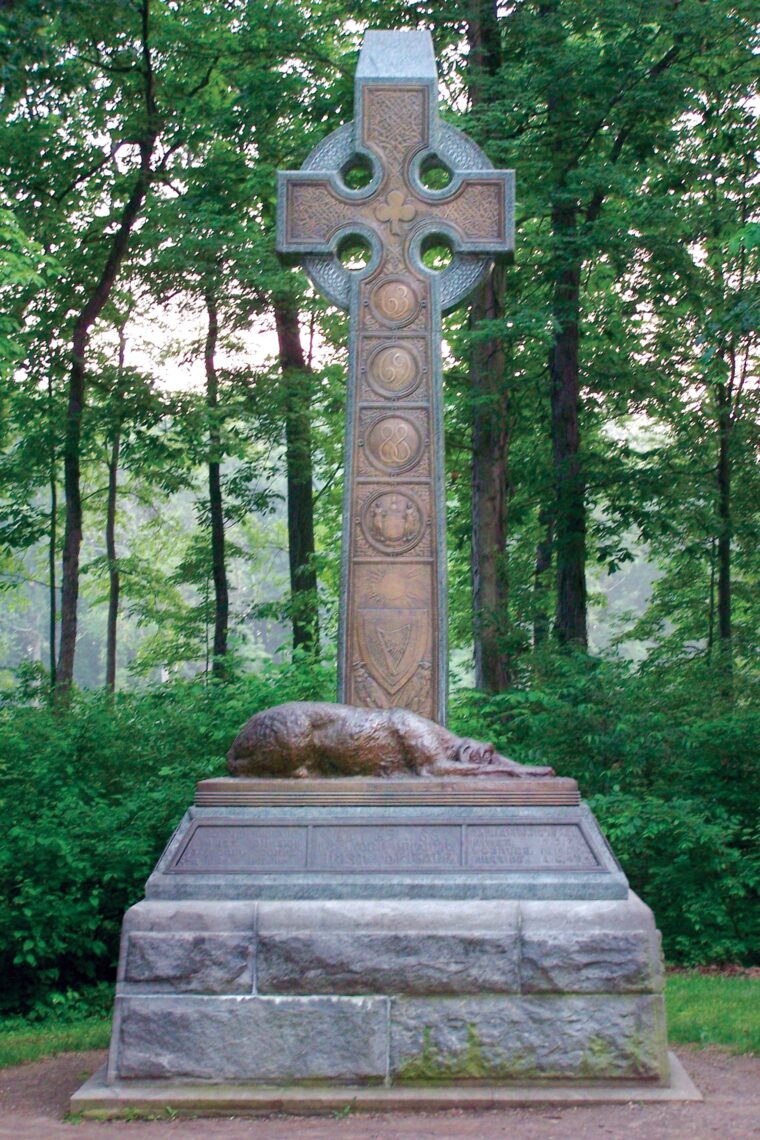
The survivors of the Irish Brigade never forgot their valor at Gettysburg. Their charges in the 1862 battles of Fredericksburg and Antietam were more the stuff of legend but, in the post-war years, the old veterans nevertheless elected to build their monuments on the Stony Hill. Between 1888 and 1910, a total of four monuments to the Irish Brigade—the famous Celtic cross of the three New York battalions (which, oddly enough, was sculpted by an Irish immigrant who fought at Gettysburg in the Confederate ranks), the 28th Massachusetts monument, the poignant 116th Pennsylvania monument, and a statue of Father Corby giving Absolution on Cemetery Ridge-were placed on the field at Gettysburg. Until the 1990s, they would be the only monuments to commemorate the Irish Brigade, aside from the hundreds of smaller monuments-graves that Meagher’s and Kelly’s heroes left scattered across the fields of Virginia, Maryland, and Pennsylvania.

Join The Conversation
Comments
View All Comments