By John E. Spindler
High-level bombing raids, a dive-bombing raid, and a ground assault had all previously failed to destroy the sluice gates of the Hwachon Dam some 50 miles northeast of the South Korean capital of Seoul.
Lieutenant-Commander Harold Gustave “Swede” Carlson and a few pilots from Naval Squadron VA-195 had undertaken that dive-bombing raid the day before. In their Douglas AD-4 Skyraiders, they had fired “Tiny Tim” rockets and dropped a pair of 2,000-lbs. bombs, managing to breach one spillway gate.
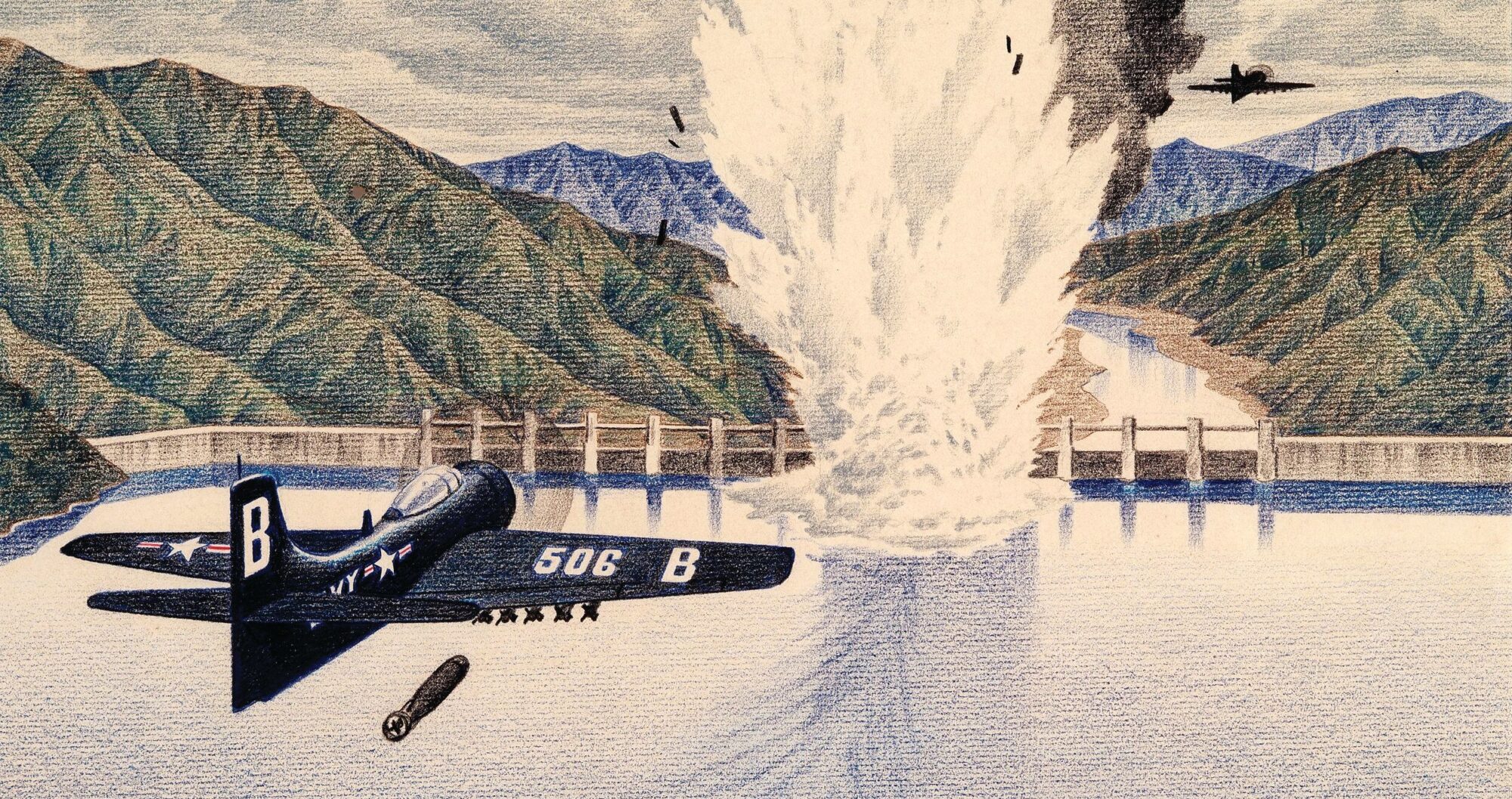
Now the Skyraiders were back, flying at the dam with the latest, and most unorthodox, idea—employing aerial torpedoes. Carlson knew about the famous 1943 British “Dambuster” raid over Germany that used unconventional munitions, and he knew that, like the British bomber pilots, the ordinance he carried had to be released at a specific height and an exact speed.
Leading the second group of four Skyraiders, Carlson prepared to line up on the required heading as he crossed the reservoir towards the dam. As with the previous day’s sortie, escorting Vought F-4U Corsairs effectively suppressed the Communist anti-aircraft fire. These eight pilots had to successfully complete their mission or else the Communist Chinese and North Koreans would continue to use the dam to influence battle conditions in central Korea.
Unknown to Carlson or any involved in the Korean campaign, this strike on May 1, 1951 would be the last time aerial torpedoes were used in combat. For launching off the aircraft carrier U.S.S. Princeton required an enormous effort and quick learning by pilots and ordinancemen. Save for a handful of men aboard the carrier, no one had ever seen a Mark XIII Aerial Torpedo, much less installed one on an aircraft or launched one in battle. Against enormous odds, Carlson and his fellow pilots would return to the U.S.S. Princeton successful well beyond their expectations.
Constructed by the Japanese during the Second World War as a source of hydroelectric power, the Hwachon Dam used the combined flow of the Han and Pukhan rivers northeast of Seoul. At the beginning of April 1951, units from the North Korean People’s Army (NKPA) and Chinese Communist Forces (CCF) controlled the region containing the dam. At midnight on April 8, United Nations (U.N.) troops learned the strategic implications of Communist control of the dam—with disastrous consequences. When the enemy opened up the spillway gates, water levels on the Han River rapidly rose four feet, causing the destruction of one U.N.-built pontoon bridge. Several others had to be dismantled to avoid irreparable damage. U.N. commanders and engineers realized that if CCF could release water levels to cause havoc, they would most likely shut the gates to lower river levels, thus allowing the Communist troops to easily ford it.
Quickly deciding that the dam had to be retaken or neutralized to prevent future use against U.N. forces, a land assault commenced the next day. The 2nd Battalion of the U.S. 7th Cavalry Regiment attacked from “Line Kansas” and battled northwards up a peninsula on the dam’s western side. With no armor support and limited artillery backup, the American soldiers were unable to get to the dam’s gates. A pair of CCF companies used the rugged terrain to their advantage with the attacking force hindered by poor roads.
The 7th Cavalry’s battalion resumed its assault on April 11. This time the 4th Ranger Company conducted an amphibious operation across the Hwachon Reservoir. Poor logistics—only four engines for nine plywood assault boats—caused delays in getting the Rangers completely across before daybreak. The Chinese not only contained the land attack but stymied the Rangers. Holding out until nightfall, the amphibious attacking force was withdrawn.
After a five-day fight, the U.S. 1st Marine Division was able to retake the region on April 21. South Korean Marines arrived at Hwachon Dam on the morning of April 22 and began inspecting the sluice gates for demolition. Unfortunately, the Chinese and North Koreans renewed their offensive, forcing the withdrawal of the overextended Marine division, and retook control of the dam.
With the failure to maintain control of the dam, U.N. command decided to use air power to eliminate the dam as a threat by destroying or crippling as many of the sluice gates as possible. Intelligence forces looked at the design. A concrete gravity-type, the Hwachon Dam was 256 feet tall and 1,427 feet wide, with a pair of operational generators for its power plant. The Japanese had built the dam with a thickness of 240 feet at its base. For additional protection against attack, the Chinese and North Koreans reinforced both sides of the base with boulders. The steel sluice gates were 40 feet wide by 20 feet tall and 2.5 feet thick. Built during wartime, the designers had overhead protection against aerial bombs for the gates in the form of reinforced structural concrete.
The first attempt to destroy the sluice gates was assigned to the Boeing B-29 strategic bombers of the Far East Air Force. Dropped by an unspecified number of aircraft, the bomb load, which included some radio-guided bombs, failed to penetrate the overhead protection of the gates. A second aerial attempt using a precision dive-bombing strike from U.S. Navy Carrier Air Group 19 (CVG 19) was assigned to attack the dam on April 30.
Led by Commander Richard C. Merrick, CVG 19 consisted of several squadrons, ranging from fighters to attack to reconnaissance. Squadron VA-195, based on the U.S.S. Princeton, was selected to supply six aircraft for the strike. Nicknamed the “Tigers,” the squadron had been operating in the Korean theater since arriving in November 1950. Providing crucial close-air support during U.N. offensive operations as well as during the retreats caused by CCF offensives, VA-195 had performed well. From February to April 1951, they took part in the interdiction campaign against the enemy’s railroad and bridge infrastructure. Their attack on the bridge at Toko-ri would be forever memorialized in the 1954 film, The Bridges at Toko-ri.
Merrick commanded the mission force with VA-195’s Swede Carlson in charge of the strike force. Five Corsairs from VF-193 would accompany them for escort and flak suppression. To eliminate the sluice gates, each Skyraider carried a pair of 2,000-lb. bombs and twelve 11.75” diameter Tiny Tim rockets. This dive-bombing attack would be VA-195’s first dam-busting mission. The Corsairs carried both 500-pound and 100-pound bombs for their assignment of eliminating enemy anti-aircraft cannons.
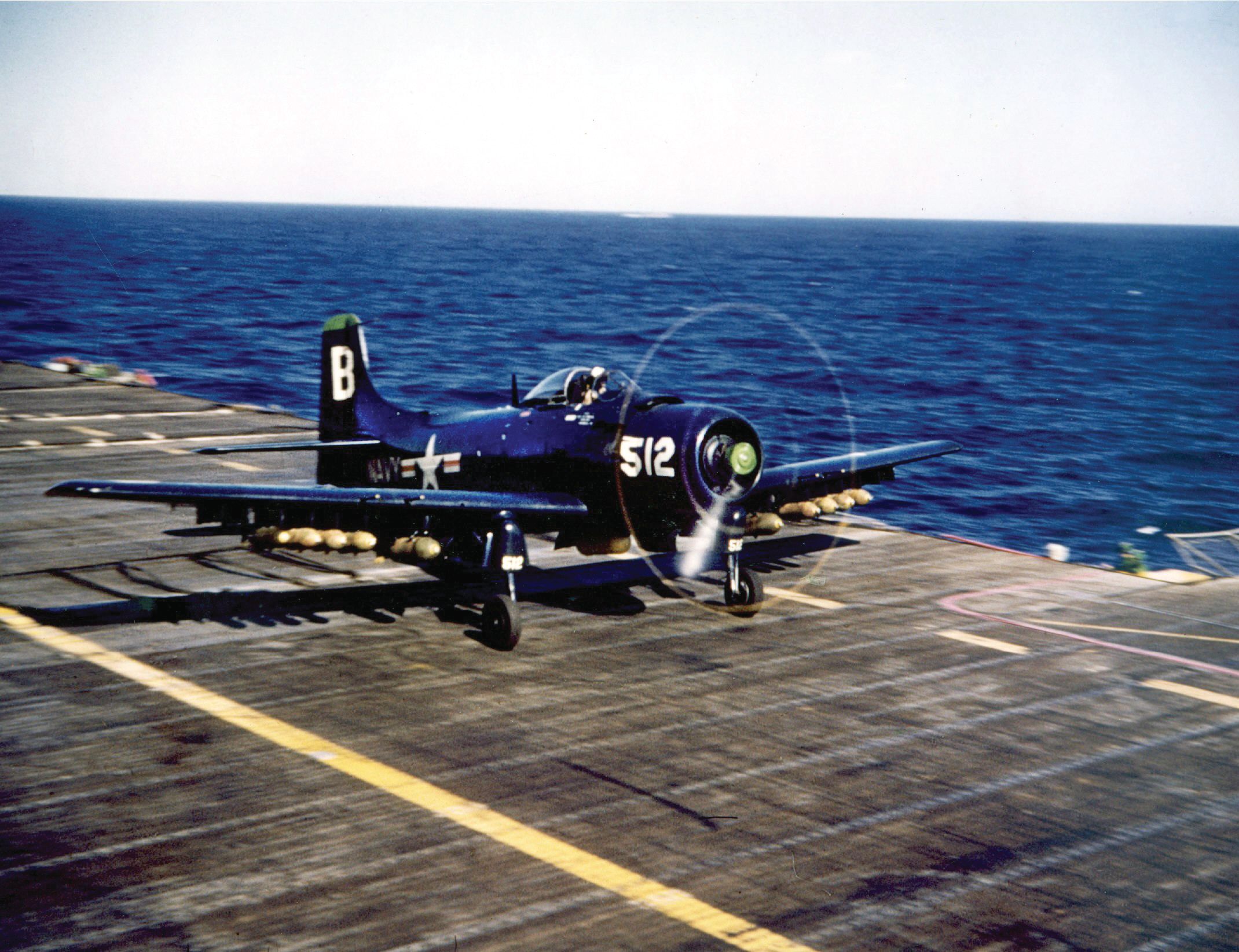
The Douglas Skyraider, known as the “flying dump truck,” was designed during World War II as the replacement for the Grumman TBF Avenger, but the war ended before it could see action. From 1945 to 1957, Douglas Aircraft Company built 3,180 aircraft and went through seven versions, each having variants built for specific roles such as night-attack, electronic countermeasures, and airborne early warning. The aircraft flown by the “Tigers” was the fourth version, which began production in 1949. With 1,051 produced, the AD-4 would be the most numerous version of the Skyraider.
Powered by a 2,700-hp Wright R-3350 18-cylinder engine, the aircraft could carry 8,000-pounds of ordinance, almost equivalent to the bomb load of the World War II Boeing B-17 Flying Fortress heavy bomber. Internal armament increased from two to four 20mm cannons. Other upgrades to the AD-4 from previous versions included improved radar and strengthened landing gear. But these improvements came at a cost—its climb rate was noticeably less than the AD-1 and its top speed decreased to 320 mph.
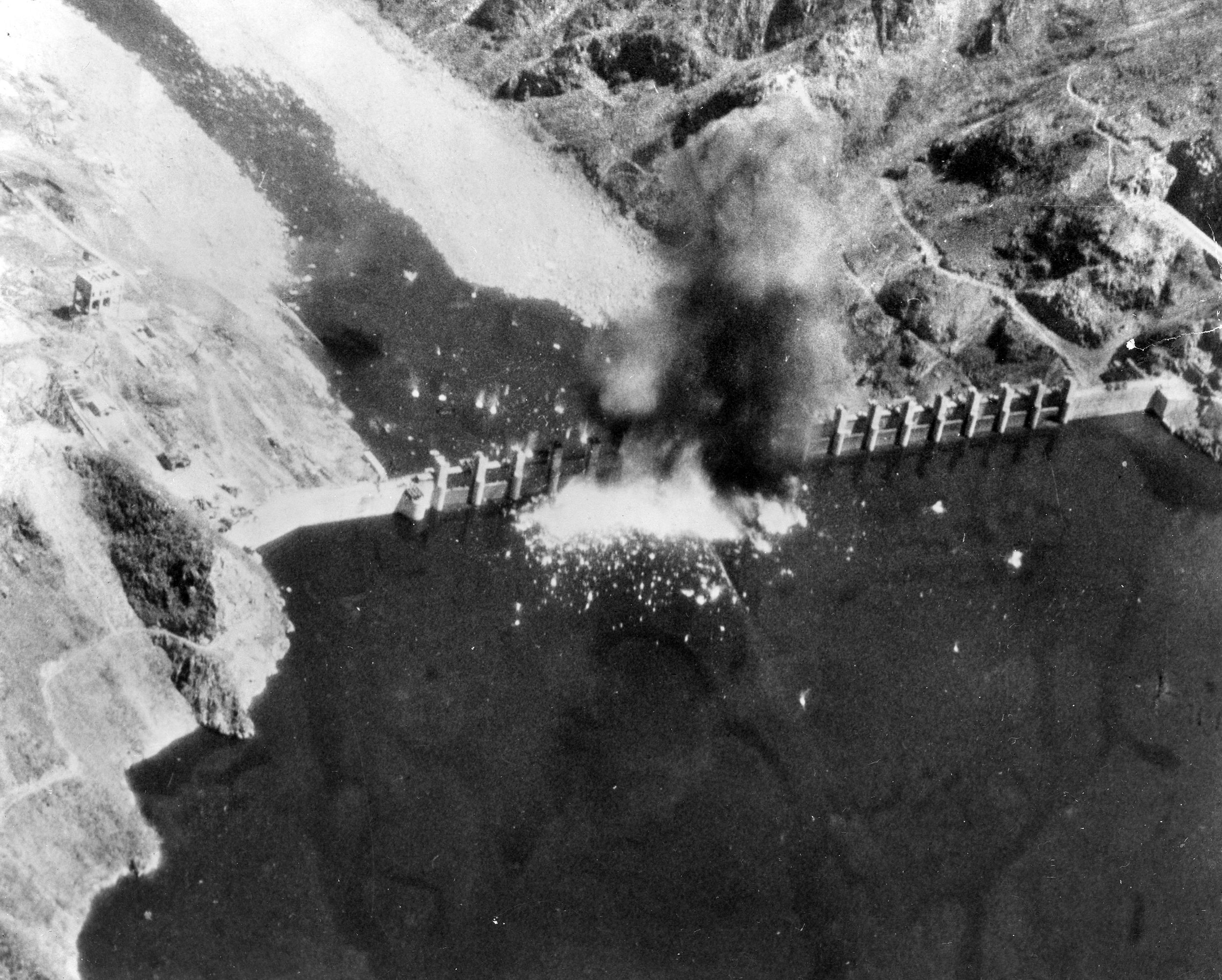
Flying across the Korean countryside, the attack formation arrived at the target at 5:40 p.m. The Corsairs took the lead, eliminating enough of the enemy’s flak positions to allow Carlson’s formation to make their run. The six planes crossed the reservoir, executed their dive, and unloaded their payload. Twelve 2,000-lb. bombs hit the target, but not one hit the critical sluice gates. One did manage to break off a little of the dam’s surface. The “Tiny Tim” rockets fared even worse, merely bouncing off the dam. Upon returning to the Princeton, the only good news was that every Skyraider and Corsair had made it back. New ideas were needed.
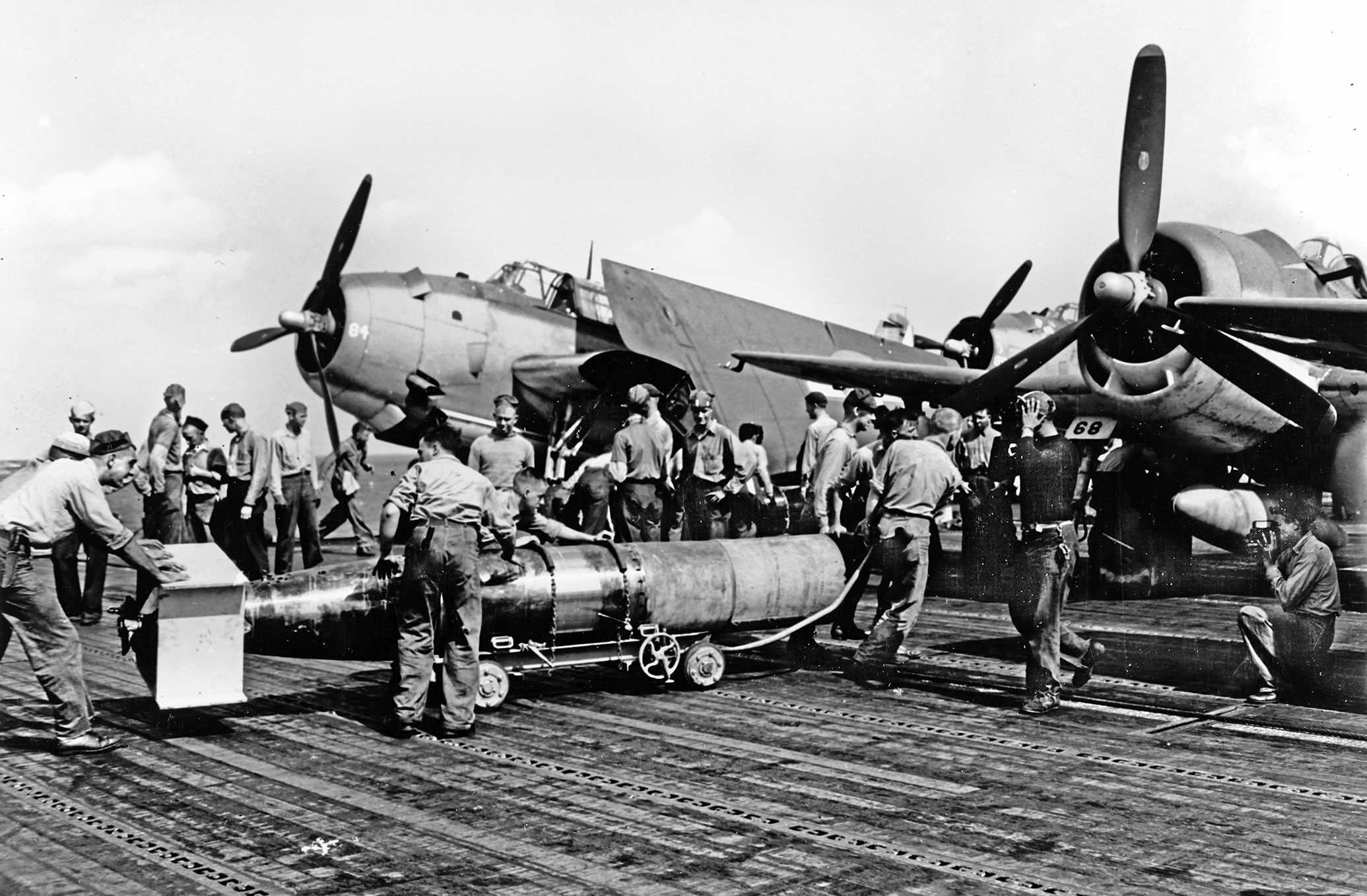
That night, the carrier’s skipper, Captain William Gallery, suggested using aerial torpedoes. Before sailing to Korea from Washington, the Princeton had been loaded with a dozen of the World War II-vintage Mark XIII aerial torpedoes. Obstacles to this unorthodox approach quickly arose. Apart from Merrick and Carlson, a call through the squadrons stationed aboard Princeton resulted in only three pilots that had experience with torpedoes. They remembered its less than stellar performance during the Second World War. Due to these limited resources, a strike force of eight AD-4’s was assigned to the mission, with five pilots from attack squadron VA-195 and three from the composite squadron VC-35. (A composite squadron consisted of fighters and bombers). The eight men spent the night familiarizing themselves with the Mark XIIIs. Calculation determined that the Skyraider pilots had to drop their payload from a height of 50 feet at an airspeed of 160 mph. Any deviation from these parameters would cause the torpedo to either sink too soon or skip along the surface. Twelve Corsairs taken from fighter squadrons VF-192 and VF-193 would fly escort duty, primarily flak suppression. Accompanying the force was a Grumman F9F-2 Panther photo-reconnaissance jet to capture the raid and its results on film.
Even worse than the fact that only a handful of pilots had an understanding of torpedoes was that none of the aircraft carrier’s ordnancemen had ever dealt with torpedoes. Developed after the 1942 Battle of Midway, the Mark XIII aerial torpedo carried 600-lbs. of Torpex. After locating the weapons, manuals had to be found and regularly consulted for on-the-job learning on how to mount the torpedo to the Skyraider. In order to mount the “tin fish,” the dive brake in the middle of the fuselage had to be disabled. The ordnancemen also had to install a protective plywood box around the torpedo’s tailfins and propeller—designed to break off upon impacting the water— as well as placing a plywood “drag ring” over the nose to slow its flight after release and entry into the reservoir. For a secondary mission against tunnels near the dam being used as shelters by NKPA troops, the AD-4s carried a pair of napalm bombs.
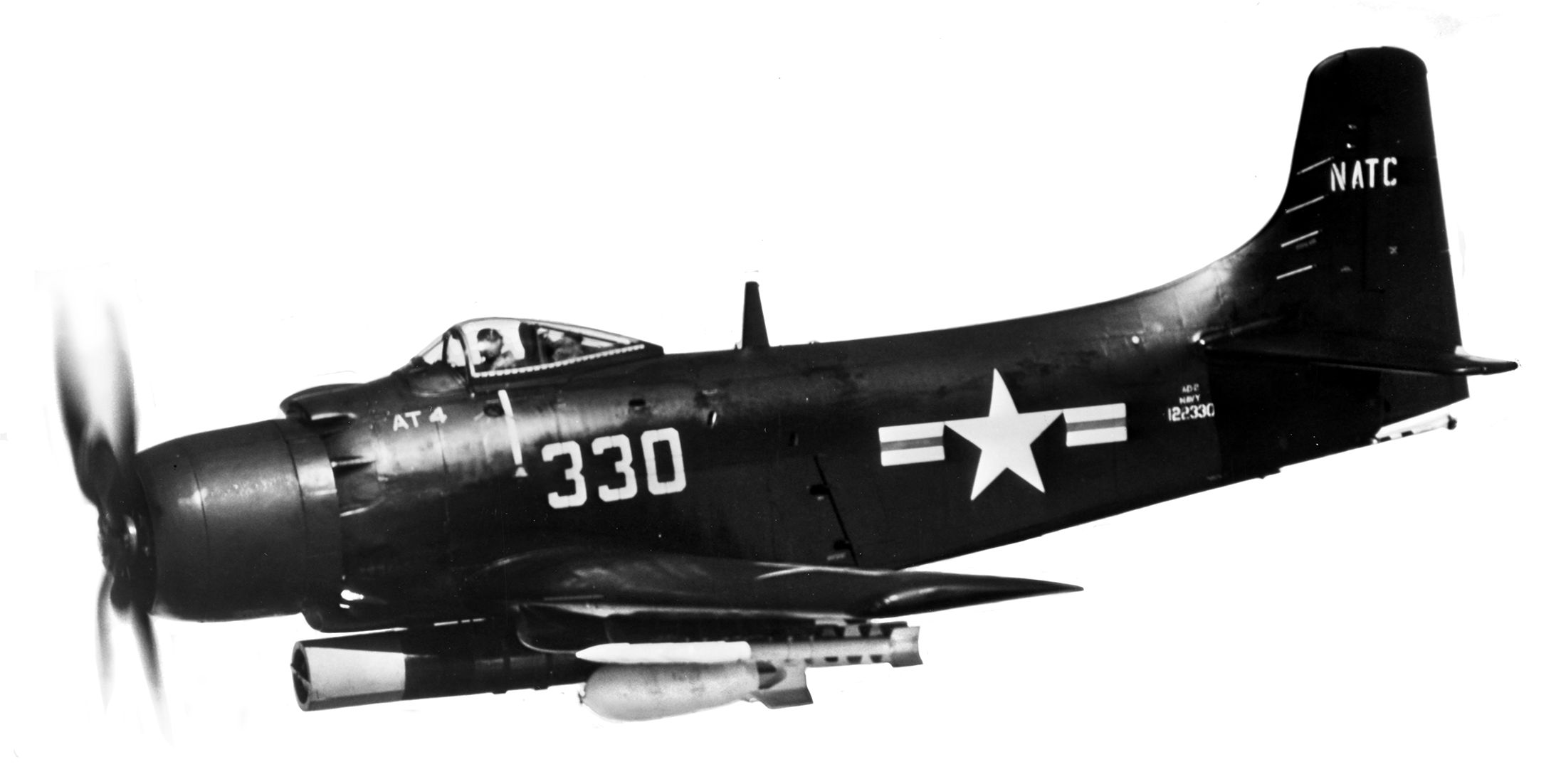
After the intense cram sessions by both pilots and ordnance crew to learn about the Mark XIIIs, Merrick led the strike force off the U.S.S. Princeton on May 1, 1951. Differing from the dive-bombing strike, this attack approach had to be precise. The terrain added difficulty to an already dangerous mission. To perfectly line-up the release of the torpedoes, the strike force needed to fly between a pair of 4,000-foot-tall mountains to approach the dam, which meant only two Skyraiders could pass through at a time.
“It was a little tricky because there was a bend in the reservoir and we had to come down at fairly high speed, level out and get down to about 160-165 knots and fly about fifty feet high,” Carlson recalled.
Not until after the raid did intelligence reach U.N. forces that a few days earlier the North Koreans had strung a thick wire 800 feet above the waterline as an anti-aircraft measure. This obstacle was not encountered on either attack. The AD-4s were descending to reach the 50-foot requirement when they appeared at Hwachon Dam at 11:30 a.m. Not expecting such a quick follow-up raid, the anti-aircrafts crews found themselves caught off-guard and offered only a light and inconsistent response. Those who fired at the naval aircraft soon found their positions targeted by the escorting Corsairs.
Pilots mentioned having struggled to maintain the necessary height and speed for proper release of the precious cargo. As each pair of Skyraiders made their attack run, torpedoes were released 400 yards from the dam. As quick as the Navy pilots arrived, their mission ended. Of the eight, one went off-course and missed the target. Another “tin fish” struck the dam but failed to detonate. Six of the eight torpedoes ran true, striking the sluice gates. The trailing photo-reconnaissance Panther captured the spectacular results. Hwachon Dam’s center sluice gate disappeared after being struck. Another gate had a 10-foot hole blown in it
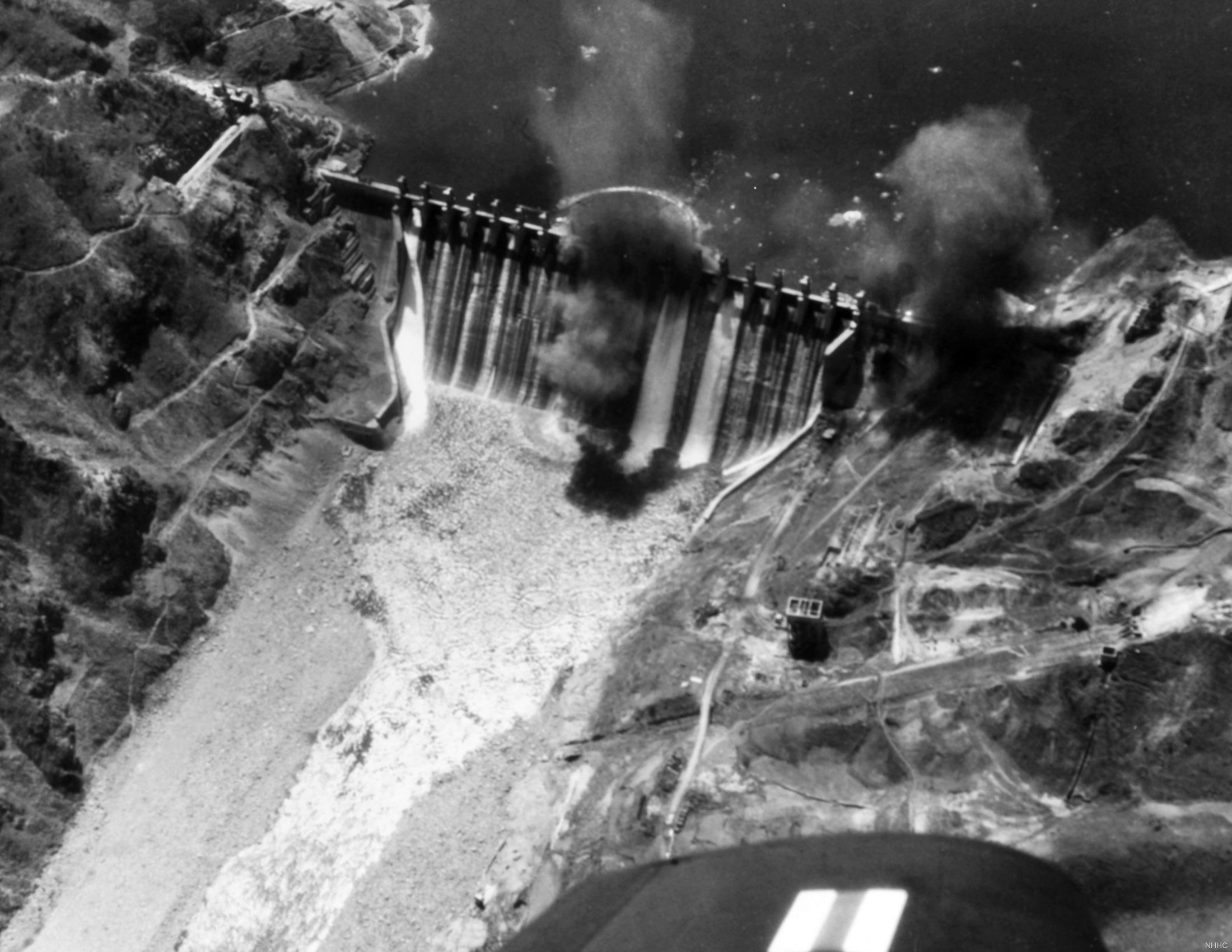
Although the message back to the Princeton was terse and efficient, the pilots could not help but feel a sense of triumph while watching millions of gallons of water empty into the river valleys. With the increased water levels on the rivers, Communist troops found routes blocked as they advanced in their latest offensive. Neither of the U.N.’s foes possessed the ability or time to repair the damage. The Chinese and North Koreans would no longer be able to use the dam to control river levels and impact the war in central Korea.
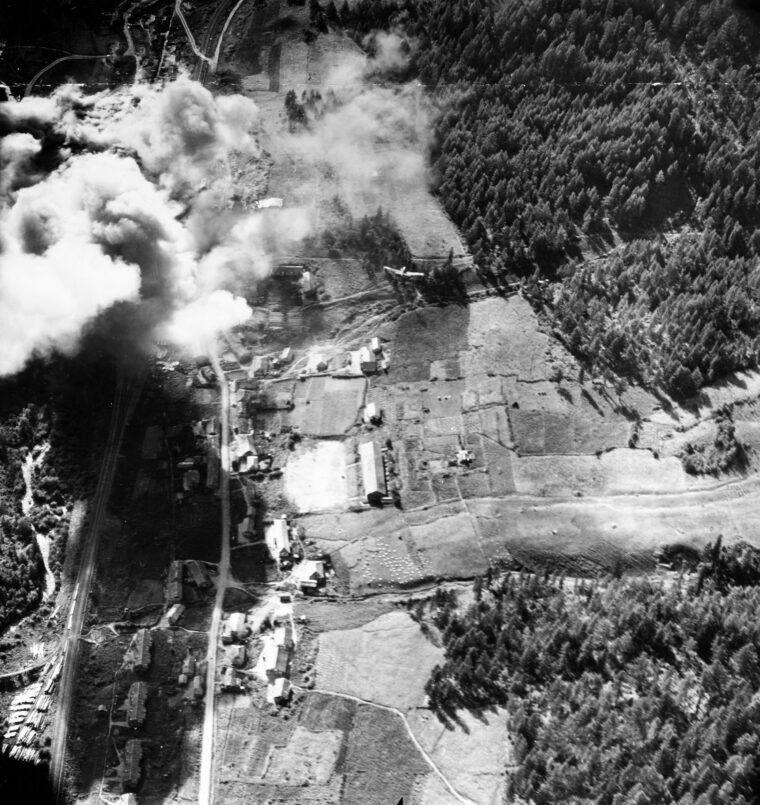
After taking care of the sluice gates of the Hwachon Dam, Merrick’s pilots still had their napalm bombs. The Skyraiders and Corsairs turned towards the tunnels a few miles away. Again, the enemy was caught by surprise as napalm bombs rained down upon them. Intelligence later learned that some 610 soldiers from an NPKA infantry battalion sheltering in the tunnels had been killed or wounded.
All Skyraider pilots earned the Distinguished Flying Cross for this innovative and daring raid—including Merrick, who was downed by anti-aircraft fire on May 18. He was posthumously awarded the Navy Cross for Hwachon Dam and another mission. Since the end of the Korean War in July 1953, two more generators have been added to the Hwachon (now spelled Hwacheon) Dam, making it one of South Korea’s most important sources of electrical power.
Chinese and North Korean forces having control of the Hwachon Dam forced the ranking U.N. officials in Korea to deal with an unfamiliar situation. After the Communist showed the devastating impact of being able to control water levels, efforts to deal with the problem using a ground assault then conventional bombs failed. An out-of-the-box idea to use aerial torpedoes to eliminate the dam’s sluice gates arose. After crash courses to acquaint naval personnel with this World War II weapon, eight naval pilots flew their Douglas Skyraiders into history and successfully eliminated Communist ability to use Hwachon Dam to influence battlefield conditions by destroying a sluice gate and severely damaging a second. With their unique triumph on May 1—the last aerial torpedo raid in history—VA-195 changed their nickname to become the second aviation squadron named “Dambusters.”
Join The Conversation
Comments
View All Comments