By Kevin Seabrooke
The gray, churning waters of the English Channel slammed against the steel ramp of the landing craft on June 10, 1944. It was D-Day plus four, and Coast Guard Commander Quentin R. Walsh was stepping into the sprawling, violent chaos of Utah Beach. The beachhead was secure, but it remained a tangled mess of men, machinery, and the lingering debris of the initial invasion.
Walsh was not there as a standard infantryman. He led a special 53-man reconnaissance team consisting largely of Navy Seabees and a handful of officers. Their mission was highly classified and absolutely vital to the survival of the Allied invasion—push inland, reach the deep-water port of Cherbourg at the tip of the Cotentin Peninsula, and secure its harbor facilities before the retreating German army could completely destroy them.
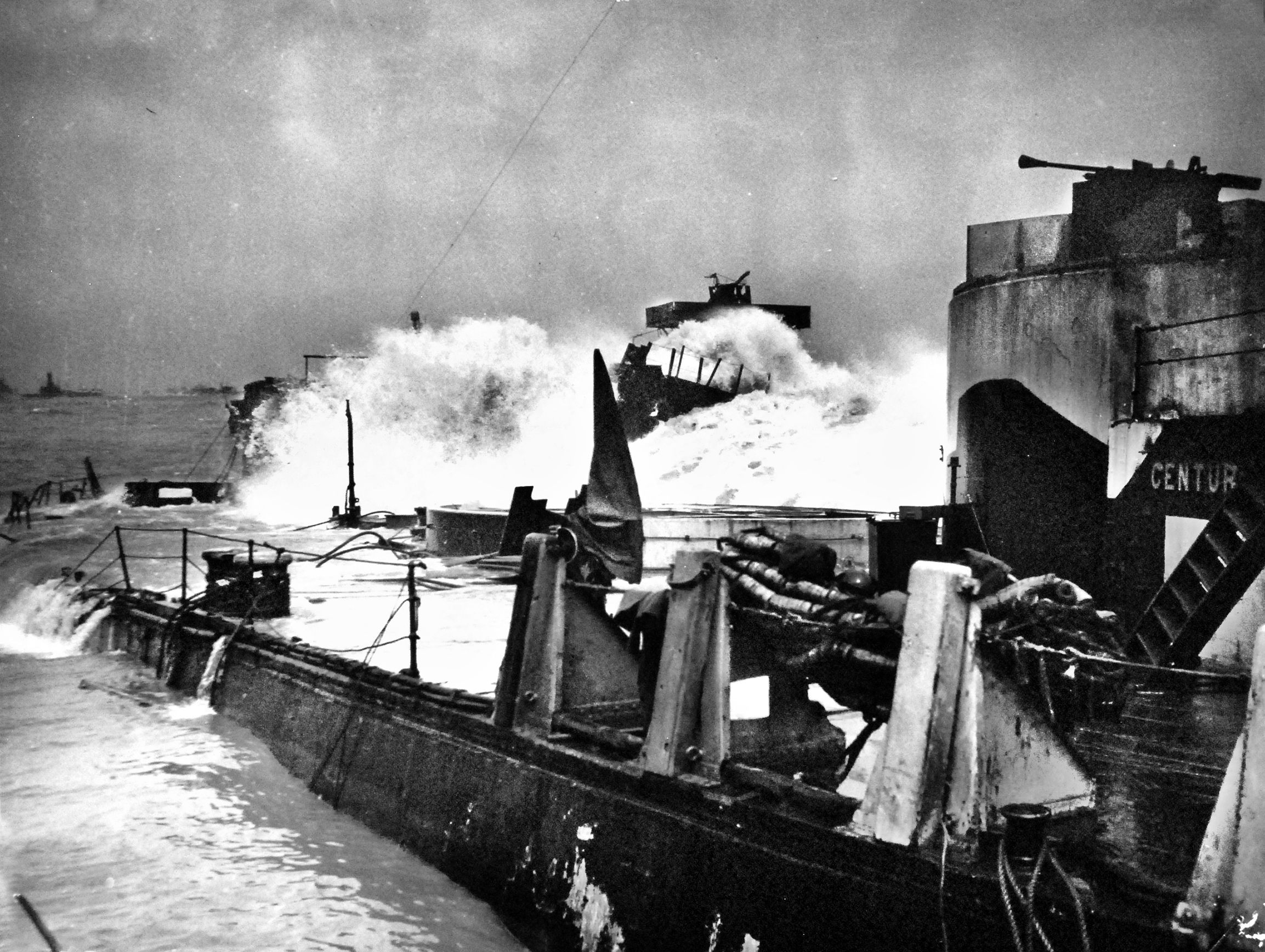
The temporary artificial harbors—Mulberries A and B—built off the coast primarily from concrete, steel, and old scuttled ships would not hold up forever. The heavily mechanized Allied war machine needed massive amounts of fuel, ammunition, and other supplies to be shipped over from England. The German high command knew this, and Adolf Hitler had ordered the city’s defenders to hold the port to the last man.
“The name of the game was Cherbourg,” Walsh later wrote. “We had to capture, clear and operate a deep water port to stay ashore.” This was especially true in the stormy English Channel where good weather rarely lasts more than a few days. After that, Walsh said, “an amphibious operation cannot be allowed to bog down. Momentum must be maintained.”
Walsh was born on February 2, 1910, in Providence, Rhode Island, but grew up in Groton, Connecticut, which sits directly across the Thames River from New London, the home of the United States Coast Guard Academy.
Growing up on the New England sea coast, defined by its harsh weather, bustling shipyards, and deep naval traditions—and the white hulls of USCG cutters constantly in view along the Thames River, it seemed Walsh was destined for the sea. He was 19 when he enrolled in the Coast Guard Academy in 1929. Legislation passed that year required cadets to be instructed in both line (deck) and engineering duties, forcing a four-year workload to be completed in three years, along with rigorous training designed to quickly weed out those lacking physical stamina and mental fortitude.
Competitive, aggressive and a natural athlete, Walsh developed into a formidable boxer, eventually serving as the co-captain of the Academy’s boxing team. That experience would later define his command style and his ability to hold his nerve under intense pressure.
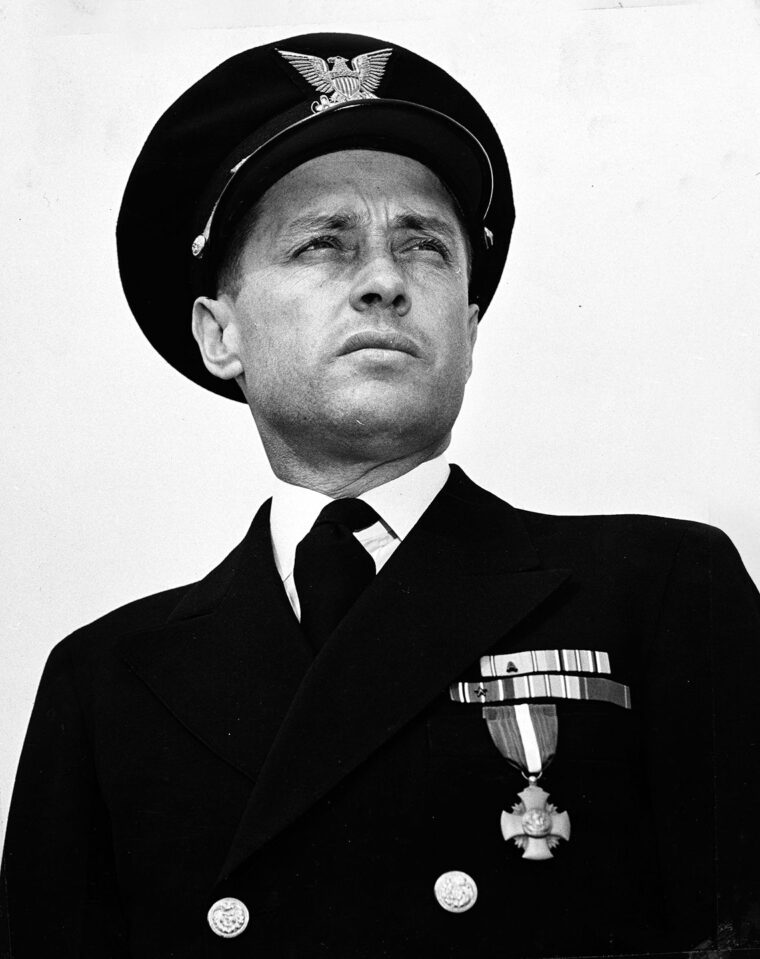
Though he graduated in a time of peace in 1933, the young ensign saw action on the former Navy destroyer Herndon at the height of the “Rum War,” the Coast Guard’s aggressive campaign to enforce Prohibition—patrolling the the turbulent waters between the Gulf of Maine, Cape Hatteras, and Nova Scotia, relentlessly hunting down armed, high-speed rum-runners. Later that year, he found himself serving on a ship sailing out of Key West to protect American citizens during the volatile Cuban Revolution of 1933.
In May 1937, he began a year acting as a whaling inspector—and effectively a government observer—aboard the American-flagged factory ship Ulysses, where he spent 132 consecutive days out of sight of land, sailing over 30,000 miles through the frigid, treacherous waters of the Indian Ocean and Antarctica.
By July of 1943, Walsh found himself in Gourock, Scotland, serving on a Coast Guard Hearing Unit handling problems concerning U.S. ships and personnel in U.K. ports. In September he was called to London because Adm. Harold R. Stark, Commander of the U.S. Naval Forces in Europe, had requested a Coast Guard officer for his staff. Walsh would serve in the Planning and Logistics Section handling the plans for the “Advanced Bases”—ports that would be captured on the continent during the invasion. Walsh became the chief staff officer responsible for plans to clear, occupy and operate captured French ports under U.S. Navy Captain Norman Ives, the designated “Commander Advanced Bases.”
A new highest-level security classification had been created for Operation Overlord that was more sensitive than “Top Secret.” Information on plans for the Normandy landings, covering the invasion date, landing beaches, and target details, could only be accessed by those designated as a “BIGOT” or were on the “BIGOT list.” This included all personnel handling the key secrets of Neptune, code name for the Invasion of Normandy, the assault phase of Operation Overlord.
In order to get Cherbourg’s port up and running as soon as possible, the Navy would need first-hand information on the condition of the harbor—sunken ships, mine fields and other impediments.
Walsh suggested the best way to do this would be for the Navy to have its own reconnaissance party on the ground with the VII Corps of General Omar Bradley’s First Army assigned to capture it. The plan was approved and Walsh was chosen to lead USN Task Unit 127.2.8 into Cherbourg on D+6. In April 1944, Walsh went north to Scotland to Rosneath Naval Base on the Firth of Clyde, which served as a major U.S. Navy installation and receiving station, to organize and train the recon party.
The first thing Walsh did was ask for three Nissen huts for quarters for about 55 men, four motorcycles, two 2.5-ton trucks, nine jeeps and a communication truck—along with rifles, pistols, bazookas, hand grenades. His request was denied–Walsh couldn’t tell them what it was for and “special mission concerning the invasion wasn’t good enough.” After a few phone calls, Walsh got what he asked for from the skeptical base commander.
About 300 men, mostly from draw units, volunteered for Walsh’s mission, but only 53 were selected. They trained from 5 a.m. to 8 p.m., seven days a week. In the evenings, they watched instructional films on topics like bomb disposal, booby traps, and urban combat. “My idea was to make the training so tough and arduous that combat would seem easy by comparison,” Walsh recalled. Those long days of physical and tactical exertion would soon be put to the ultimate test.
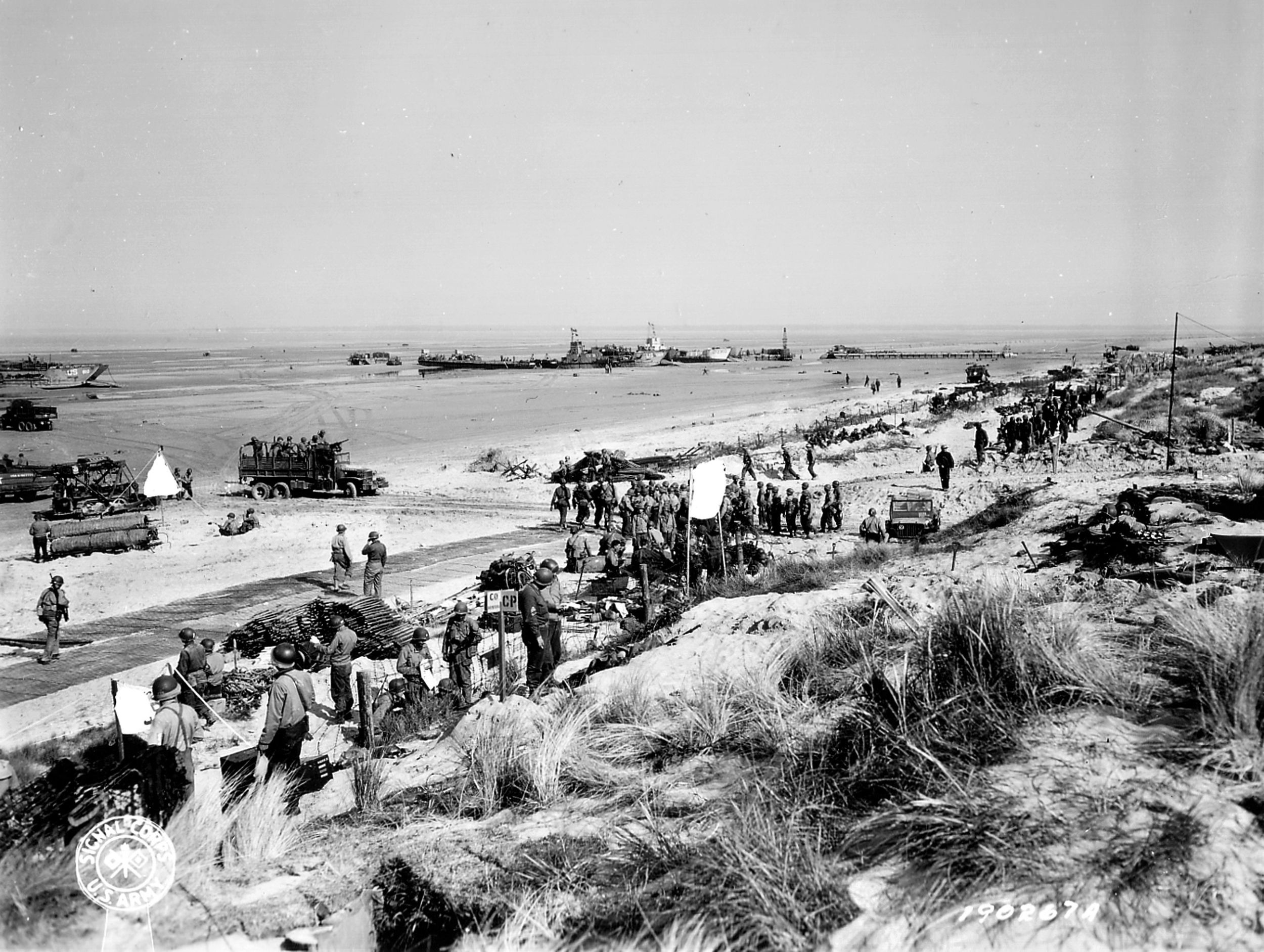
In southern England before crossing the channel, Walsh reported to Admiral Don Moon, commander of Assault Force “U” at Utah Beach and then to Gen. Lawton J. Collins, 7th Corps, U.S. Army at Breamore. Informed of the reconnaissance mission at Cherbourg for the Navy, Collins ordered Walsh to land at Utah on D+4 because he planned to capture the city on D+20 instead of D+6 as originally planned because more German units had been deployed to Normandy.

“I was to report to his headquarters later in Normandy and ordered not to carry written orders, operational plans, no diary, and no cameras,” Walsh later wrote. “In my book Collins was one of our excellent, outstanding generals. With all his responsibilities he gave me at least thirty minutes of his time and had a staff member show me a wall map of the German Forces in Normandy.”
After landing at Utah Beach, Walsh and his men pushed into the Norman countryside. The terrain, normally idyllic in the summer, was a shattered landscape of flooded fields, shredded hedgerows, and artillery-cratered roads. The spring rains had turned the dirt paths into sucking, knee-deep mud that grabbed at their boots and exhausted their legs. The distant, continuous thud of heavy artillery vibrated in their chests, a relentless reminder of what lay ahead. For more than two weeks, the tiny task unit slogged northward, keeping pace with the advancing infantrymen of the U.S. Army.
The American forces reached the outskirts of Cherbourg by June 22, but the city was heavily defended. It wasn’t until June 26 that Walsh’s unit finally pushed into the city proper, linking up with elements of the U.S. Army’s 79th Infantry Division. Cherbourg was a nightmare of intimate, urban warfare as machine guns echoed down the smoky cobblestone streets.
Fighting house-to-house and street-to-street defined the brutal advance. The German defenders were deeply entrenched, having positioned lethal MG-42 machine guns in basement windows at sidewalk level to create deadly funnels of interlocking fire that shredded anything attempting to move up the avenues.
Walsh recalled the Germans using wooden bullets painted red or green—that made an “ugly” wound at a certain range—during the street fighting in Cherbourg. He said a German prisoner told him they were used “only in the rifles of men engaged in close order firing, such as street fighting, where German troops were liable to fire in the direction of other German soldiers engaged in the same street fighting.”
The Americans were forced to each building floor by floor, digging the enemy out of the rubble with grenades and close-quarters combat. Dead and wounded from both sides littered the streets. By nightfall, the Allies managed to wrest control of the eastern half of the port, but the western side—the industrial heart of the harbor—remained a heavily fortified stronghold.
The morning of June 27 dawned over a broken, smoking city. Walsh realized that to evaluate the port facilities, he first had to conquer the remaining defenses. The operation had already cost his small unit a staggering 25-percent casualty rate. Gathering just 16 men, he decided to seize the initiative and strike the old naval arsenal on the western waterfront.
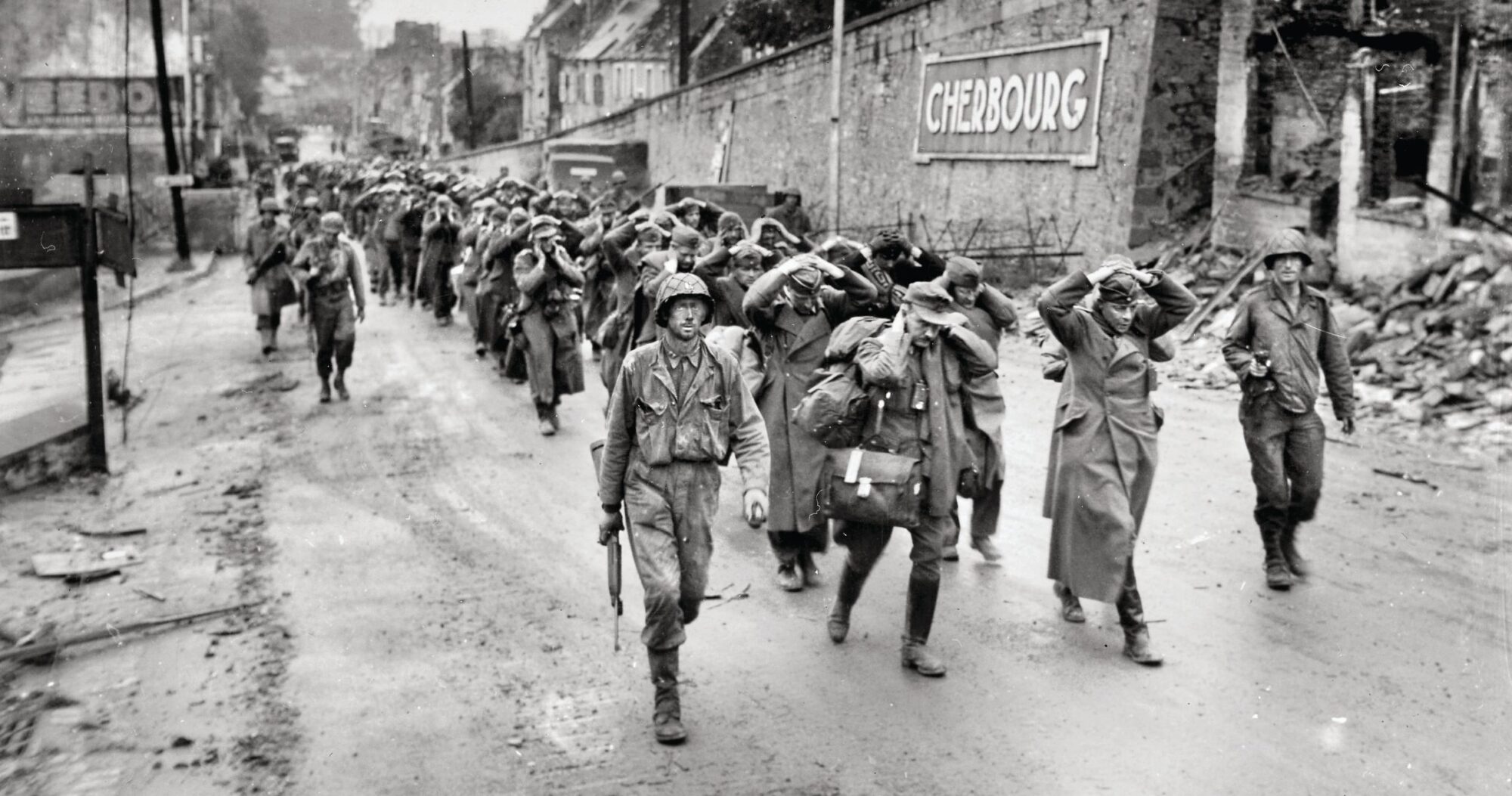
The arsenal was a dark labyrinth of subterranean concrete bunkers and heavy steel doors, bristling with snipers. Under a hail of rifle fire, Walsh and his men made a coordinated assault using bazookas to blow the heavy steel doors off their hinges, followed with volleys of fragmentation grenades. The sheer ferocity and speed of the American assault completely shocked the defenders. Stunned by what they assumed was a massive vanguard, the German resistance in the arsenal collapsed—400 enemy soldiers emerged from the smoke, hands raised, surrendering to a Coast Guardsman and 16 Seabees.
But the fight was far from over as Walsh soon learned of a far more desperate situation looming directly over the harbor. Fort du Homet, a formidable stone citadel, remained in German hands. Inside its thick walls, a garrison of 350 heavily armed troops was prepared for a protracted siege. Even worse, they held 52 American paratroopers prisoner within the fortress.
Calling in an artillery barrage or mounting a frontal assault would be a death sentence for the captive GIs and brute force would only result in a tragic massacre. Walsh needed a radically different tactic. Turning to Navy Reserve Lt. Frank Lauer, Walsh asked him if he had ever played poker.
Lauer watched as Walsh tied a piece of white parachute silk to a makeshift pole to act as a flag of truce, and the two men stepped out from the cover of the ruined arsenal. Leaving their heavy weapons behind, the two men began the long walk toward the citadel gates, knowing that hundreds of German rifles and machine guns were tracking their every step. It was audacity personified.
They demanded an audience with the garrison commander and the stunned guards led them into the fortress full of battle-hardened soldiers. Deep behind enemy lines and entirely cut off from rescue, Walsh executed the biggest bluff of his life.
He did not negotiate; he dictated terms. Staring the German commander directly in the eye, Walsh painted a terrifying, entirely fictitious picture. He claimed that Cherbourg had completely fallen. He stated with absolute conviction that he had an overwhelming force of 800 combat-hardened American troops waiting just outside the fortress walls, backed by heavy armor and artillery. He warned the German officer that if the fort did not capitulate immediately, his massive force would reduce the citadel to dust, killing everyone inside.
The tension in the stone command post was suffocating. The German commander weighed his options, staring intensely at Walsh, searching for any flicker of hesitation or any crack in the American’s armor. He found none. Walsh’s demeanor was absolute ice. The seconds stretched into an eternity as the lives of 52 American paratroopers hung precariously in the balance.
Finally, the German officer’s resolve broke. He handed over his sidearm and surrendered the fortress unconditionally. Without firing a single shot at the citadel, Walsh and his tiny element disarmed three hundred and fifty enemy troops. The heavy steel doors of Fort du Homet swung open, and 52 ecstatic American paratroopers walked out into the daylight as free men. In less than three weeks, starting from a muddy beachhead, Walsh had captured 750 enemy combatants, liberated his fellow Americans, and secured the most vital strategic port in the European theater, earning the Navy Cross for his unparalleled bravery.
Great story! Thanks!