william rosecrans
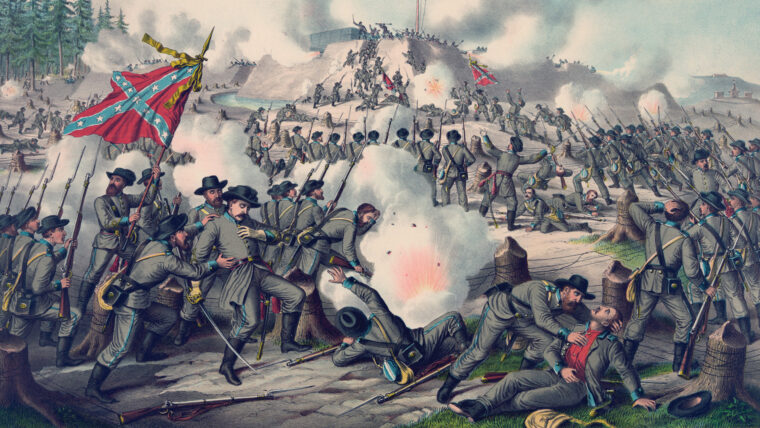
The Knoxville Campaign: Battle of Fort Sanders
By Arnold BlumbergAfter the crushing Union defeat at the Battle of Fredericksburg on December 13, 1862, President Abraham Lincoln relieved Maj. Read more
william rosecrans
After the crushing Union defeat at the Battle of Fredericksburg on December 13, 1862, President Abraham Lincoln relieved Maj. Read more
william rosecrans
One of the most hard-fighting divisions in the Army of the Cumberland, the one led by Maj. Read more
william rosecrans
It had been a little over six months since Major General William S. Rosecrans and his Army of the Cumberland had checked the Confederates at the Battle of Stones River (December 31,1862–January 2,1863). Read more
william rosecrans
Seemingly from birth, William Haines Lytle was bound for glory. As the last surviving male offspring of one of Cincinnati’s leading pioneer families, Lytle was the prototypical golden boy. Read more
william rosecrans
Horace Porter was born April 15, 1837 in Huntingdon, Pa. He traced his ancestry and family motto, “Vigilantia et virtute,” to William De La Grange, who accompanied William the Conqueror to England in 1066. Read more
william rosecrans
For weeks, Maj. Gen. William Rosecrans had been hearing increased grumblings from Washington about how he should move his army out of Nashville and strike General Braxton Bragg’s Confederate forces 30 miles away in Murfreesboro. Read more
william rosecrans
U.S. President Abraham Lincoln had no military experience and discarded most of Lt. Gen. Winfield Scott’s so-called Anaconda Plan, which critics deemed too conservative. Read more
william rosecrans
Of all the unlikely heroes of the Civil War, none was more unlikely than Bushrod Johnson, Ohio-born Quaker turned Confederate general. Read more
william rosecrans
It was nearly 11 on the morning of September 20, 1863, and the woods around slow-moving Chickamauga Creek in northwest Georgia were ominously quiet. Read more
william rosecrans
For the weary troops of the Army of the Cumberland, there was precious little sleep to be had in the farm fields and cedar thickets northwest of Murfreesboro, Tennessee. Read more
william rosecrans
In late July 1863, after the conclusion of the Gettysburg campaign, the Union Army of the Potomac, under Maj. Read more
william rosecrans
“It was a sad, sorrowful day,” recalled Confederate Major James McCreary, “and more tears of grief rolled over my weather beaten cheeks on this mournful occasion than have before for years.” Read more
william rosecrans
Even more than most people, Union general William Rosecrans was often his own worst enemy. Hot-tempered, emotional, and frequently given to speaking—or shouting—before he thought, the Ohio-born commander of the Army of the Cumberland made enemies easily, even if he usually forgot in an instant what had made him angry in the first place. Read more